Trends in Modern Storytelling in Film: Conan – Actors and Characters ’82 & ’11 Comparison

OffTheCharts

So in comparison, what do the films and their characters tell us of how narratives were forged in 1982 compared to 2011?

In 1982, they relied on persona for casting first.  Arnold was a name then, not much more, but one known and larger than life.  Conan was more than a grunting thug and would take some ability to perform, but it wasn’t Hamlet so it was well within his purview of early skills.  The filmmakers wisely chose similarly talented actors to act beside him most of the time (Bergman and Lopez are very good, but they aren’t master thespians) so as not to outshine him, and added veteran screen virtuosos von Sydow, Jones, and Mako to be solid feet on the acting floor to make sure there was some balance.

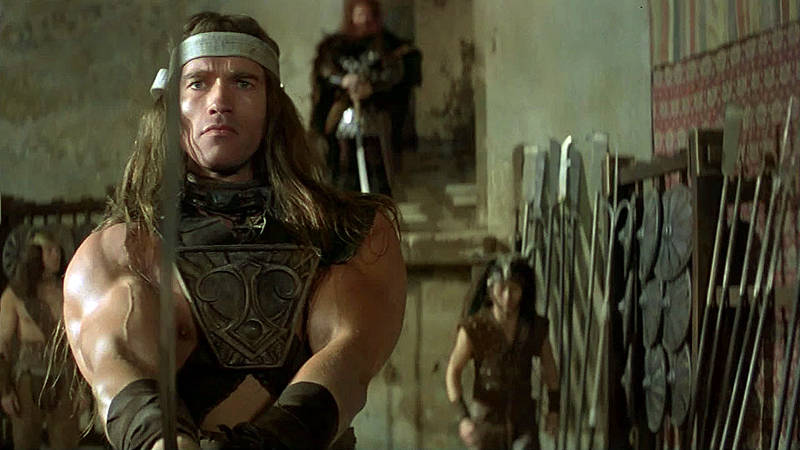
Conan 1982 learning his swordsmanship.

In 2011, they seemed to rely on the look more than the persona.  Momoa played a good-looking barbarian in Game of Thrones, a character very Conan-like, so since he’s the kind of guy that would bring young women to a hack and slash movie usually audience’d by young men he was a win for them.  The other “good guy” characters seem to appear more out of convenience than necessity, the possible exception being Artus, Conan’s friend.  Tamara is the pretty damsel in distress and El-Shan is a sneaky thief who comes in handy because they need a sneaky thief.

Conan 2011 wielding his own sword.

Zym as a villain is far more in-your-face than Doom; bashing, smashing, and slashing his way through the film seeking revenge…much like Conan really, except he is basically wearing a t-shirt that reads “I’m evil and I know it.”  Doom’s perspective is far more gray, as proven by a speech he gives:

Purging is at last at hand. Day of Doom is here. All that is evil, all their allies; your parents, your leaders, those who would call themselves your judges; those who have lied and corrupted the Earth, they shall all be cleansed.

Like any kooky cult leader Doom sees himself as righteous, not wicked.  Not for some personal wrong (“You killed my evil wife!”) but because as the last Atlantean he is clinging to a time when his people were the power of the world and he longs to go back to those halcyon days.  But the movie doesn’t need to spoon you that – it’s just part of the back story, insinuated by dialogue, mood, and Jones’ performance.

Overall, it gives the newer film less complexity, but not really in a good way, just in a “this-is-just-a-sword-swinging-hack-n-slash-adventure-for-fun-so-let’s-not-do-any-more-than-that” kind of way, which really is the trend of narratives now.  If something can be simpler it is made simpler.  Or often “darker” because much of the audience automatically feels “darker” is “better” or “more real” (See Star Wars I-III).  “Real” has come to mean everything has to be shown or explained directly.  Nothing has nuance or subtlety.  Many narratives’ most powerful points are either spelled out and/or done so blatantly as to provide little interpretation or analysis, thereby robbing the audience of some of the intensity of personal realization.

Next time will be the  summation, one best provided by a riddle…

An or A? What to Do

GrammarTips

I’m not surprised when people ask me about this rule. Many believe that if a word begins with a vowel, then you use an, and if it begins with a consonant, you use an a. Unfortunately, it’s not that simple. It is the English language, after all…

My favorite thing about this rule is that it’s based on sound, not the written letters/word. If you’re confused about this rule, say the phrase aloud and you’ll usually hear which word (article) is correct.

Article: the, a, an – precedes a noun and tells you a noun will follow

Noun: a person, place, thing, or idea

Vowel: In the alphabet, the letters a, e, i, o, u, and sometimes y

Consonant: not a vowel (all the other letters)

The Rules

An – Use an if the noun following makes a vowel sound.

An apple, effort, octopus, honor

As you can see with honor, the h is there, but it is silent. If you say honor, you’ll hear the aw sound, which sounds like a vowel.

A – Use a if the noun following makes a consonant sound.

A fish, dog, rope, song

The exception (because there’s always an exception): the long u (pronounced yoo) sound.

A U-turn, unicorn, user

The best test is to think it aloud, so you hear the sound the noun makes. It’s all based on phonetics, and you’ll know whether it sounds and feels right or wrong.

For fun, say the following aloud and you’ll hear how wrong these sound and feel: an phone, an ladder, a ant, a ending.

If you have any tips or questions, feel free to comment below!

Sources: https://owl.english.purdue.edu/owl/resource/591/01/

Grammar Blue Book

Story of the Month: Walking in Memphis

StoryoftheMonth

What follows is the story of five guys who witnessed the intrusion of supernatural forces into the late-night, alcohol-infused descent into madness that so often accompanies underground poker games. Every detail is completely accurate, and no embellishments have been added. I may have been intoxicated at the time and, to be honest, I might be lying outright about any or all of it, so you probably should not assume any of this actually happened . . . although it did.

 Walking in Memphis

by a guest RevPub writer

Among the group were Brody, Jesse, Moe, Paxton, and Ray. Brody was the ring leader of the night’s circus, and he was a true player in more ways than one. His job prepping venues for conventions and trade shows introduced him people at every echelon of society, and he found it easy to connect to all of them. His passion for fast cars and easy women belied his playing style, which was calculated, methodical, and dangerous.

Brody’s cousin, Jesse, was the host for the evening. His well-paying position at an international manufacturer afforded him the ability to purchase his home outright before turning 30. Jesse’s mountain of a truck couldn’t fit in the garage, so he did the only logical thing and turned the garage into a poker palace. Jesse’s play style was laid back. He didn’t waste time bluffing; instead he enjoyed lively conversation and alcohol.

Brody’s other cousin, Moe, had also inherited Brody’s genetic ability to attract the opposite sex. Bored with his ability to pick up a different girl every night, he now thrived on the challenge of picking up big pots off those foolish enough to call his bluffs at the wrong time. His play style was unmistakably aggressive, and he never met a player he couldn’t outplay.

Paxton was Brody’s friend who was enjoying his summer break from college. His appreciation for fast cars mirrored that of Brody’s, so their friendship was inevitable. Paxton’s play style was cautious and precise. He waited for the right set of cards to set check/raise traps that could steal half your chips before you realized you never had a chance. Then there was Brody’s other friend, Ray. Ray and Brody were friends from a previous sales job. Ray was the prototypical salesman, and some of his swagger rubbed off on Brody. Ray was the kind of salesman a company would use to sell sales techniques to sales teams. He didn’t sell things professionally for the money; he enjoyed it for the thrill of bending people to his will to close a deal. It was this thrill that brought him to games where he could bend people into abandoning their cards by convincing them he had better ones. At best, his play style could be described as unorthodox and, at worst, it was pure lunacy. He didn’t let a little thing like a lousy hand stand in his way, and he would often play hands blind. Naturally, this approach frequently caused Ray to go home broke.

It was a warm summer’s night, and the players arrived around 8:00 pm. After an initial round of drinks, playing commenced. Up to this point, the night was unremarkable. The conversation and entertainment proceeded as it had dozens of times before. With the first deal of the cards, however, Ray changed. Outwardly, he was the same confident, charismatic guy who could befriend you before speaking a word.

Looking into his eyes, however, revealed something else present. The game initially progressed with everyone making small talk and playing in his typical manner, except Ray. He wasn’t playing at all. He anted up when it was his turn, but he folded every hand after briefly glancing at his cards. Then, after 30 minutes, it happened. With two others committed preflop, Ray started mumbling. His mumbling slowly grew louder until his words became clear. Ray was singing part of Cher’s version of Walking in Memphis. His words were not as harmonic as Cher’s, but rather rhythmic and soft like a monk’s chant. Ray repeated the same verse, “When I was walking in Memphis . . . walking with my feet 10 feet off the Beale . . . walking in Memphis . . . but do I really feel the way I feel.”

With each of us looking at each other laughing at the musical improvisation, Ray bet one third of his chips. One of the remaining two players folded, and one called with a pocket pair of queens. The following two rounds of betting were minimal. Then, when Ray and Brody showed their hands, it became clear Ray had bet almost 40% of his chips on a terrible hand consisting of 9 and 2 that were not even in the same suit. This was a horrible hand to bet, and especially one with which to bet so heavily. Somehow, he won. The fourth and fifth community cards were a two and a nine, so Ray picked up two pair while Brody’s initially superior pair of pocket queens became useless. It was an interesting way to win a good amount of chips, but this is certainly not the first time a weak hand won despite the odds. After all, the wild swings of Texas Hold’em are what make the game so much fun to play and watch. I’ve had similar wins myself, and it was most likely just a lucky bluff that he beat when called . . . or so I thought.

Two hands later, almost the exact same thing happened. Ray chanted the song’s lyrics with a 7 and 4 off suit and a smaller pot and won with community cards that were not revealed when he initially bet. Then it happened again four hands later. And again. And again. And again. For roughly 45 minutes, Ray won hand after hand with lousy cards after chanting the song. He became the overwhelming chip leader and eliminated two players. Eventually, the remaining two players refused to play against him when he led off singing the song. They folded those hands instead.

Ordinarily, this kind of control over your opponents would be an advantage for Ray. He could have won the tournament by simply singing the song every hand to collect the other players’ antes, which would make him the victor when they ran out of chips. However, Ray played the game for the thrill of the bet. Grinding out a boring win wasn’t really a victory to him, and for some reason, he could not win without singing the song, regardless how strong his cards. It seemed that whatever demonic force Ray channeled to win the unwinnable also damned him to lose that which should have easily been his.

I am not a statistician, but based on my years of experience playing Texas Hold’em, I can say I have never seen a player defy such insurmountable odds so consistently. Ultimately, with his powers lost, Ray was eliminated. Moe then beat Brody to win the tournament and the glory. I’ve only seen Ray a couple times since that night, neither of which playing poker. He apparently stopped playing after that night. He doesn’t talk about his reason for quitting, but we all know it’s because he didn’t like being “touched by an ‘angel.’”

As for me, I still don’t have much better things to do than play poker on Saturday nights. I am smarter about it now. No more suburban houses. I only play where it’s safe, in the back rooms and alleys filled with hustlers and card sharks . . . where people get stabbed for beating someone with a 9, 2 off suit preflop bet and unimaginably terrifying things would happen for singing a Cher song . . . where everybody knows your name, and they’re always glad you came.

Trends in Modern Storytelling in Film: Conan – Actors and Characters (2011)

As I mentioned previously, the 2011 version’s star Jason Momoa actually looks the part of Conan far more than Arnold.  He really does resemble a Vallejo painting quite well.  His choices for his portrayal of the conqueror aren’t bad at all.  He laughs heartily, drinks, brags, threatens all with believability, so why is it that when people say “Conan” the vast majority will say something in an Austrian accent?  Charisma.  Momoa certainly has the attitude and the look but he doesn’t have that “special quality” that Arnold possesses.  It’s no shame, few do, but it’s one of the strongest reasons I think Arnold made a superior Conan.  His presence and persona in the part are just overwhelming.  Add to that the voice, and yes, range Arnie gives his Conan (his exclamation of “you killed my people!” in rage and despair is far more effective than the many anger-filled tirades in the new film voiced in a grumbling hiss through clenched teeth) and this it becomes relatively clear why 1982’s portrayal will endure while 2011’s is classified as more a popcorn film.

Momoa looked very Conan-esque as Drogo in Game of Thrones.

Furthermore since we see so much of Conan’s childhood (a trend I think the film industry needs to start doing without…we see how Michael Meyers, Hannibal Lector, Darth Vader, and Conan become who they are rather than providing glimpses of a backstory and letting either good dialogue flesh them out or leaving it to the audience’s imagination) we see he has changed little from when he was a warrior boy to when he was a warrior adult.  Leaving only modest room for the character to grow and removing the mystique provided so well through montage in the first film.

Momoa’s performance is quite good, but not as larger-than-life as a guy who’s entire life is “larger-than-life” but what of his cast mates? Nonso Anonzie is great as Artus and wins the prize for the secondary character I’d most like to see in a spinoff.  Said Taghmaoui is good as a stereotypical thief but his character is in it with such unusual irregularity you don’t get nearly as attached to him as you do Subotai.  The main female character, Tamara, played by Rachel Nichols is done well, but she falls back into the “chosen one” category that so many characters are in (though “chosen for sacrifice” is less appealing) and has none of the bad-assery of Valeria.  Which only leaves our villains.

Of course Khalar Zym is our bad guy, played well with manic ferocity by Stephen Lang, however when comparing villains we see how much simpler he is as a character to Thulsa Doom.  Not only did his back story require a long pre-title narration, but he IS a skull-smashing, sword wielding, wildman.  He’s the Sonny Corleone of Conan villains to Thulsa Doom’s Michael and it makes you wonder how a cell-block boss like him could maintain power in the intervening decades between Conan’s village being burned and adult Conan’s revenge.

Zym looks more like a crazy villain than did Jones’ Thulsa Doom

This film’s scene is clearly stolen, as was mentioned previously, by Rose McGowan as Marique, who is a far more fascinating villain than Zym.  Not only is she a wicked sorceress with serious Elektra issues, but she is played somehow both as a incredibly creepy and still somewhat sultry by McGowan, who really has to try not to be full-on sultry just standing there in most of her roles.

Rose McGowan is great as Marique, possibly the best character in the film as her background and motivations aren’t always 100% obvious.

2011’s actors all did well with what they were given and made a fun adventure film, but it’s almost as though the bar they were provided was set far lower than in 1982’s outing.  Next post we’ll compare the two methods and see what they both accomplish.

How to Survive a Hostage Horror Movie

A dear friend said to me this week, “No one would keep you as a hostage.” We shared a good laugh and knew she was right. NO one would be able to keep me as a hostage. I’m a nightmare – moody, mouthy, and opinionated – and meanness comes very natural to me.

We discussed what I would do in a horror movie hostage situation. Think Saw, Hostile, Texas Chainsaw Massacre. These movies have a psychopath or group of them who take “innocent” people hostage and torture them until death. Have no fear, though – with these tips, you may survive or at least die sooner!

*we don’t guarantee it, though.

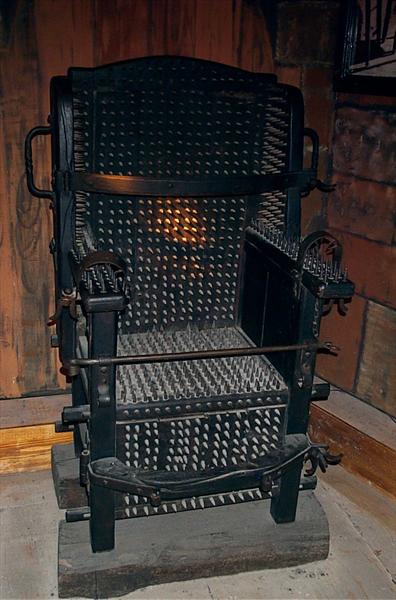
Torture chair1. Demand they kill you. We’ve learned over the years in horror movies that begging for your life doesn’t work (thanks JB). Crying and pleading gets you no where. The killer already knows you are a human being and they want to take your life – thus the reason you are in the situation. They don’t care. Instead, force them to kill you. Show no fear in death, and you may actually survive.

2. Relate to them. No one ever survives because they tell the killer how great their life is or how much they have to live for. In fact, it probably makes your killer want to torture you more because they don’t have the same things. They want you to share the pain. Instead, talk about how much your life sucks. Dig deep, too. Look for things like your mother didn’t love you, sibling rivalry, broken hearts, the things that really scarred you. We all have them. It may be therapeutic for you, too.

3. Call them out. Killers enjoy watching you suffer, so don’t. If they cut off your finger, say you have seven more and give them the bird. If they make tiny incisions, ask if that’s the best they can do or to give you the knife, and you’ll do it. If they hit you, tell them your grandma hits harder. Get inside their head and make them doubt their ability. Either it’ll amplify their own insecurities or they’ll kill you faster – either is better than being tortured.

4. Get personal. You don’t know why they’re a psychopath, so test the waters. Ask questions such as: did your mommy not love you? Did your daddy beat you? Did your true love see you for the crazy psycho you are and bail? Or maybe he/she ran off with your brother, sister, best friend? Ask in the most mocking tone possible and find the reason. Use it against them. Be nasty.

5. Show emotion (but don’t cry). Be angry, degrading, and forceful. Yell and mock them. Mock them A LOT. Call them a drama queen, say things like awe…you poor thing, no one loves you (in your best baby speak). Or when I get out of this chair, I’ll show you how to torture someone. Feel it! Doing this will accomplish one of two things: defeating them or receiving your death wish.

Most of us don’t want to be tortured to death, so the best option is to avoid it. You may get away. If so, grab a manageable weapon and beat or hack them into oblivion. If not, going quickly is a better alternative to suffering for days, maybe even weeks. Keep in mind that you’ll never be the same, and if you do die, you can come back as a vengeful spirit and haunt them into eternity.

Trends in Modern Storytelling in Film: Conan – Actors and Characters (1982)

OffTheCharts

According to the weirdo, but shamefully funny Pauly Shore comedy Son-in-Law,­ “charisma” is “… a special quality of leadership that captures the popular imagination and inspires allegiance and devotion.”  It’s a rare thing, even amongst the popular, talented, or famous.  If Pop Idol and American Idol have proved anything beyond the desire for mass audiences to watch public humiliation, it’s that just being great at something isn’t often sufficient.  But being good enough and having a lot of charisma can often be the difference between the singer who makes the records people buy and the singer who simply rings up the records people buy.

No one would ever claim Arnie is a great thespian.  I don’t feel he’s given the credit he deserves for being a decent actor most of the time though.  Arnold is good at playing Arnold, and these are often the roles he takes.  Most people couldn’t name off the top of their heads the characters Arnold plays in Predator, Commando, and  The Running Man (Alan “Dutch” Schaefer, John Matrix, and Ben Richards, by the way) as most people just say, “I like it when Arnold did this or that.”  But he does emote sadness, humor, goofiness, and rage all effectively, even if it’s essentially the same in most of his movies.

Arnold in 1977s “Pumping Iron” looking a lot like Conan as King of Aquilonia

His portrayal of Conan is no different.  He very successfully expresses emotion and his Conan is vengeful, inquisitive, ferocious, and gloomy, all believably during the film.  When he prays to Crom, you believe it.  When he asks “does it always smell this bad? How does the wind ever get in here?” you find yourself asking it along with him.  When he glares humorously and knowingly at Subotai for having a better god than him we glare with him.

And why is that?  Arnold has charisma.  His persona is even bigger than his Mr Olympia biceps.  In fact, it’s what got him the part as Conan.  Going by Boris Vallejo’s art and Robert E. Howards dark-fringed, sullen-eyed, bronze-skinned Cimmerian, the only aspect Arnie had was his massive physique and his larger-than-life personality, so readily on display in Pumping Iron where he was just being himself.  A part he played effectively for the next 30 years.  In fact, when you ask a lot of people what they know about Conan they more often than not say some lines, sometimes made up…in Arnold’s voice.  He left his stamp on the character as indelibly as he left it on the Terminator.  Yeah so-called “better” actors have been in other Terminator movies, but when asked “did you see The Terminator?” no one would respond, “Is that the Christian Bale movie?” despite many people out there jumping on the Bale wagon recently.  Many mistakenly believe if Arnold wasn’t a world-class muscleman he wouldn’t ever have been a star.  That’s certainly part of what he built his mountain of money on, but if you look at just this film it also stars Ben Davidson and Sven-Ole Thorsen who are arguably bigger and muscley-er than Arnold, but 9 out of 10 people wouldn’t know them.  So there is definitely something he has that they don’t.  And that something is “a special quality of leadership…yadda yadda yadda.”

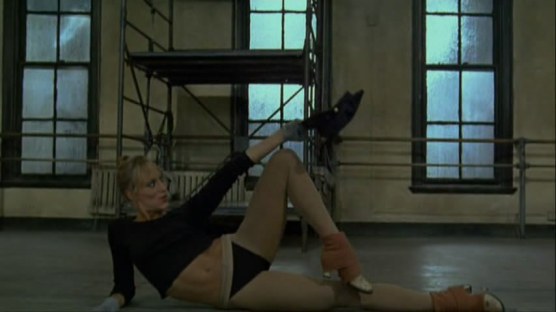
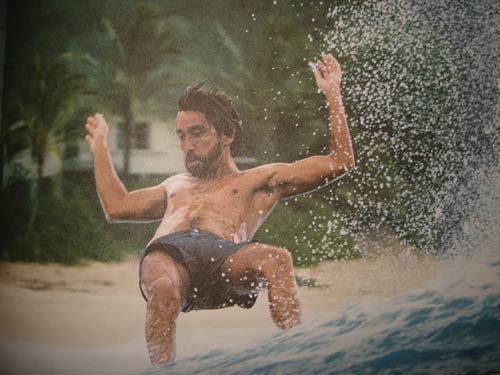
The other characters in the 1982 film received their parts for similar reasons.  Sandahl Bergman was cast as Valeria after director John Milius saw her in, believe it or not, All That Jazz, and exclaimed “she’s a valkyrie!”  Gerry Lopez, Subotai, a surfing buddy of Milius’, received his part based largely on his disarming personality rather than his acting ability, and it is his demeanor more than his dialogue that brings the character out.  Yet put together, they created some great characters, and despite my desire to propose marriage to Valeria at any given moment, Subotai comes close to stealing the show.

Sandahl Bergman in the “Air-Rotica” sequence in “All that Jazz”
Gerry Lopez was a surfer before he was an actor.  It was his swagger, slouch, and persona that makes the character of Subotai what he is.

The guy who really might steal the show is no surprise.  Despite a power-house cameo by Max von Sydow and some great over-work by Mako, James Earl Jones is without a doubt one of the most effective villains in fantasy films as Thulsa Doom.  The first question I would pose is: how many evil things do you see Thulsa Doom do?  Really the only thing you see him do personally is behead Conan’s mother in the beginning of the film; though given the world that’s established you’d think that kind of thing happens all the time.  So what makes Doom effective as a villain?  Sure he’s a 1,000-year-old sorcerer leader of a cannibal cult, but it’s what he doesn’t do that makes him powerfully scary; not because he can’t just because he couldn’t be bothered.  Jones plays him with so much subtle power you’re only moments away from falling to your knees in the worship of Set yourself.  Jones actually says he doesn’t want to play his villains in the typical, manic, Batman-villain type crazy evil.  Think Darth Vader, and, I think more powerfully, Thulsa Doom.  He never gratingly shouts orders or smashes skulls.  You know he can but he has “guys” for that.  He’s far too powerful to mix it up.  So when he says, “Now they will know why they are afraid of the dark. Now they learn why they fear the night” you shake in your boots far more than if he drew an axe and roared.

As Doom James Earl Jones radiated silent, subtle power. He wasn’t needlessly cruel or wildly vicious. It made him seem all the more powerful because of his confidence and calm.  In that scene it is his utter LACK of emotion that makes him seem so frightening.   The scene itself is terrifically done, shot in silence with only the score and Jones to focus emotions.

The characters are all believable for their world and included in an organic, if sometimes convenient ways for the story.  Again, this film isn’t perfect (what film is) but for the most part you overlook anything that isn’t 100% pristine because its intentions are so pure and its narrative so excellent.  Next time, we’ll look and see how the 2011 characters and actors compare.