They say insanity is doing the same thing over and over again expecting different results. I disagree.
Phantom Phone
Last month I house/dog sat for a good friend. I was there Wednesday, Thursday, and a half day on Friday. Everything was going well until Thursday morning.
That morning, the dogs and I returned from an early walk, and as I set up my laptop to begin working, I heard the first ring. Go ahead, play the video. You know you want to…
Then I heard the second ring, and the third, fourth, fifth… hundredth. I’m not exaggerating. A phone beneath the apartment floor was ringing nonstop. It rang all day and night Thursday, and was still ringing Friday afternoon when I left for work.
I tried to drown it out as best I could with the TV or music. I’d even leave to get fresh air, but the ringing followed me. When I took the dogs out, I tried to find the apartment the sound was coming from, but once I got into the hall, it sounded as if it was all around me. I couldn’t figure out which way to begin my search.
It was my tell-tale heart. The ringing echoed in my head, and I wondered if it was all in my imagination. I thought I was really going nuts – it’s about time after all.
So, is insanity doing the same thing repeatedly expecting different results? No. Insanity is listening to the same sound for 36 hours straight, never finding the source or able to control it! It took me two days to get that ringing out of my head, and every time I think about it, I want to hold myself and rock back and forth.
Music documentaries are a great way to learn about a band or artist, but have you ever learned something more? Has one ever exposed you to more than the band and forced you to dig deeper? Rattle and Hum did that for me.
I was six years old when it came out and saw it for the first time when I was eight. I watched it at a friend’s house, and we watched it loud – over and over again.
Rattle and Hum is much more than a U2 documentary. Sure, the focus is the band, but it truly is about the journey. And not just their journey. It’s about a journey of exploration and discovery, a journey about learning more. I received a crash course in culture during this movie, and here’s what I came away with:
Charles Manson. Maybe the most famous serial killer of all time, and my first reference to it was in the opening song Helter Skelter. I had no idea such people existed or how and why they did the things they did. I lost a little innocence and gained some much needed cynicism.
Harlem. I’m a Nashville native and still haven’t made it further north than Maryland. This was my first experience with Harlem, which led to me learning about the Harlem Renaissance. I remember feeling a connection with those scenes. Maybe it was the poverty or the soul and passion, but something resonated with me. The church choir singing I Still Haven’t Found What I’m Looking For is still one of my favorite parts.
Billie Holiday. Growing up with a parent in an 80s metal band, I wasn’t exposed to jazz. Angel of Harlem opened my eyes to jazz singers and African American musicians.
B.B. King. I wasn’t exposed to blues either. Recently, a friend jokingly said to me, “You don’t know anything about B.B. King.” I pshed and explained I knew about B.B. King – thanks to Rattle and Hum. The movie introduced me to the him, the blues, and the sound.
Graceland/Memphis. I’ve always loved Elvis, but I didn’t know what Graceland was or want to visit Memphis until I saw this movie. It’s also inspiring to see Larry sit on the bike, even though he wasn’t supposed to. Rebelling isn’t always a bad thing.
America. When you live it every day, you overlook the beauty around you. Taking a few moments and looking at it through a camera lens allows you to see it for what it is. Beneath the traffic, aholes, and pollution, we really do live in a pretty amazing place. Even in the 80s, America was a melting pot of culture.
Rattle and Hum taught me more history and culture in two hours than any history class ever could. The movie touched on people, cultures, and politics, and inspired me to learn more. I can still sing every word to every song. I still laugh and pause when it gets heavy. Remember, it’s not just about the music – it’s about what we take from it.
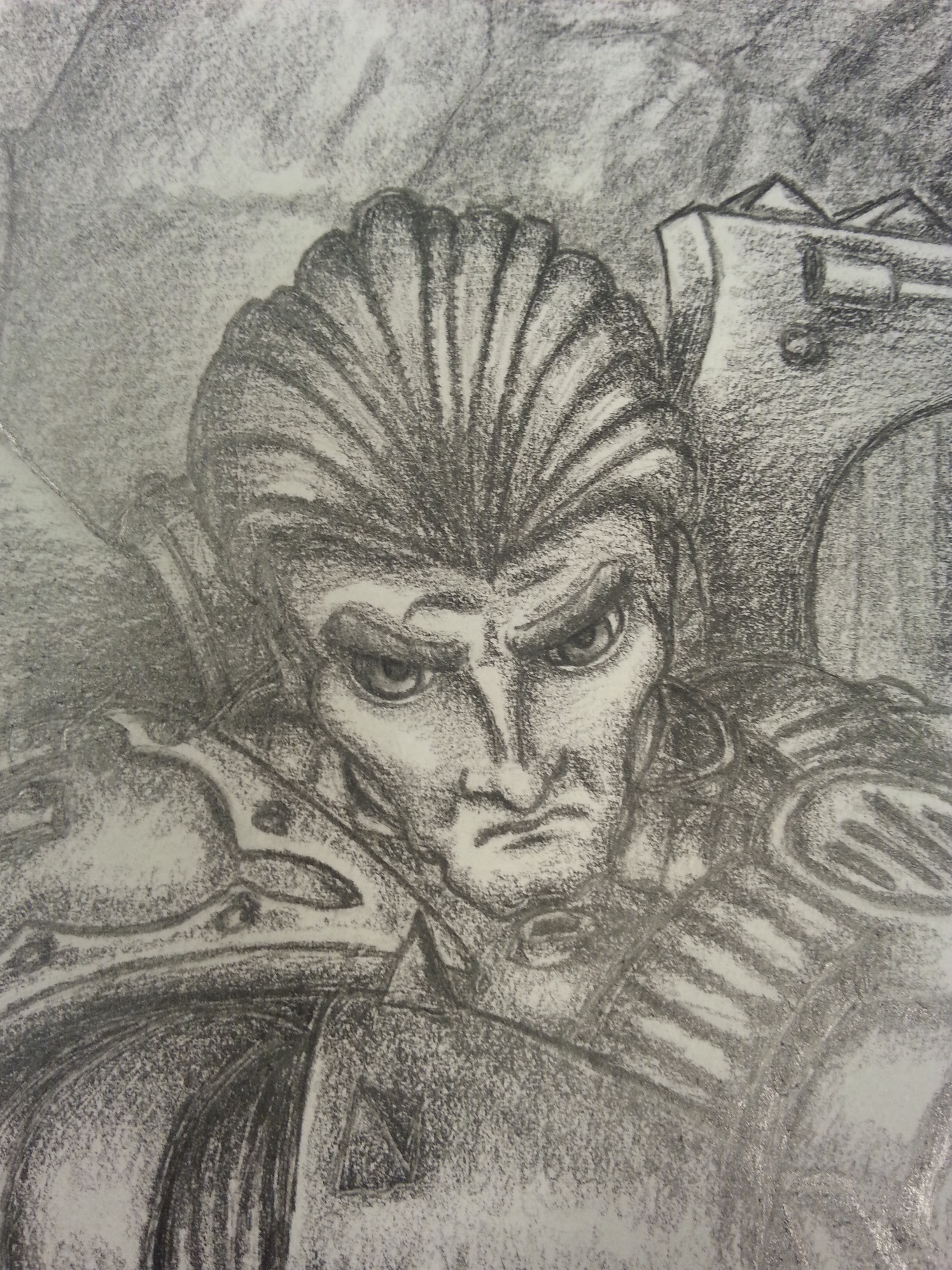
My Original Illustration inspired by a scene from Chosen of Khorne.
Click for a detailed view!
I have to admit that Games Workshop, though they get a lot of stick from forums, has made a great game and created a terrific universe with some wonderful characters. When I first got into the Warhammer world I purchased a lot of used books, old codexes, whatever I could get my hands on to learn more about it and immerse myself completely in the grim darkness of the far future.
During my hunts for anything narrative 40k I could find I came across Gav Thorpe’s Raven’s Flight and regular readers of RevPub might guess why I decided to get that one! That one audio drama, read wonderfully by Toby Longworth, got me hooked on the Black Library audio drama/audio novel series. I’ve got almost all the ones I could find and have a few favorites. Raven’s Flight remains on my top list because of its terrific narrative and the rousing action sequence when Corax charges the Iron Warriors. The Garro series is also a superlative series and Mission Purge was a nice surprise and a great Deathwatch story. Recently there have been some terrific Horus Heresy dramas (Censureis excellent, as was the short Warmaster) as well as some good additions to the Space Marine Battles series (Veil of Darkness’ first person narration is wonderful).
My favorite and the one I’ve listened to the most, however, is Anthony Reynolds’ Chosen of Khorne.In the 40k universe I am a staunch, staunch loyalist (For the Emperor!), which is why it speaks volumes to both the writing and performance this drama, one that is centered wholly on traitor Chaos Space Marine characters, that this one is my favorite. Of all the dramas I’ve heard I don’t think I’ve heard any of them with as vivid imagery and as clear a narrative as this Chosen of Khorne. Not only is the story very tightly written and the settings so clear, but the action set-pieces wonderfully well-described and easy to picture. Not only that but the story arc of the narrative’s star, Kharn the Betrayer, is remarkably well done and, despite my pro-imperium stance I found myself cheering for him as the story went on.
The hands-down star of Chosen of Khorne, after the writing, is Chris Fairbanks as Kharn the Betrayer. Fairbanks’ performance is ferocious and subtle. His Kharn isn’t a wild, bloody brute but a smoldering killer slowly building to a burning crescendo. I first heard Fairbanks’ Kharn in The Butcher’s Nails before I knew anything about the character, but Chosen of Khorne had me running to the game store to pick up a Kharn model that day. Fairbanks’ performance is so good I was even cheering for him over my own chapter master, Azrael, in The Trials of Azrael.
One image in this audio drama has always stood out for me, so much so that, despite years of not drawing large, finished pieces I had to get the image of it down in graphite.
When Malvin Bitterspear first enters Kharn’s lair beneath the arena the setting is described as a gladiatorial dungeon. Kharn is said to be “slouched on the dais like an arrogant warrior king upon his throne” with Gorechild nearby and his collection of skulls laid out before him. I couldn’t get the image out of my head, and so interpreted it as best as I could.
My Kharn differs from the official Games Workshop/Forge World Kharn in that I gave him hair. I’m actually a little tired of bald Space Marines and Fairbanks’ accent for Kharn reminds me of a more-intense, brutal Bela Lugosi so I gave him a bit of a 1930s Dracula-style cut. Not only that but it went well with the description in the drama as his face being long and noble.
I relied heavily on the Warlords of the Dark Millennium to do Kharn’s wargear, taking my favorite aspects from previous interpretations and including them in the design.
One of the most fascinating parts of Reynold’s writing of Chosen of Khorne was Kharn’s outward demeanor compared to the raging inferno within. He gives the character amazing depth and provides clear motivation for his actions, something very few narratives do well. Because of his description and his actions, I tried to give Kharn a look of impassive malevolence, outwardly calm but promising rage.
Anthony Reynolds’ story mixed with the magnificent performance by Chris Fairbank really provided me with great inspiration. This illustration was amazing to work on, and I hope it lives up to what the writer and performer had in mind when they made Chosen of Khorne!
With healthy diets and workouts sweeping the nation in efforts to live longer, it’s important to remember those won’t necessarily keep you young at heart.
I am fast closing in on the big 40 and am still in great touch with my youthful side. So, I thought I would share some tips that will keep all of us from turning into that old geezer we swore we would never become.
Try some new music. We all have favorite genres and artists, however, try something completely different and see if it fits you. Recently, I have become hooked on female-fronted pop-core or punk-pop. Paramore was the first band I tried. After realizing how much I enjoyed this upbeat, feel-good music, I found similar bands that were harder (Picture Me Broken) or softer (Darling Parade) that provided me with an energizing youthful feel. I am among the older fans at the concerts, but I am never the oldest!
Read a young adult book. If you have not read Harry Potter, shame on you! Books can help you remember the problems you faced as an adolescent and all the joys that followed. As I got older, I became more work and family focused. Not that it is a bad thing, but I love getting lost in a fantasy that reminds me of my past aspirations. It also helps me realize it is never too late to follow my dreams.
Watch cartoons. There is nothing that simple, slapstick, nonsensical humor can’t cure. Cartoons are one of the best stress relievers. A simple episode of SpongeBob can make a bad day disappear into laughs. “It could be worse, you could be bald and have a big nose,” is my favorite quote whenever someone is having a bad day.
Play a game. If you’ve ever watched Tabletop, then you see how board games can help you relive the “glory days”. There are numerous simple card games as well (Flux, Munchkin), and they will have you laughing and hanging out with friends like you used to. If you are a hardcore gamer, there are now more ways to connect online and play than ever before. If you are the athletic type, try an adult athletic league (even kickball) to rev up your engines.
You may feel younger, and be surprised when you better understand your kids and his or her friends when you can remember that it is alright to let out a bit of your wild side.
What is the riddle of steel? The 1982 film asked this question in some of its first spoken dialogue, in 2011 it is asked in the forge, in both films it is posed by Conan’s father.
In 2011 the answer is given in the same scene “fire and ice” provides the strength of steel. Meaning of course that as heated/quenched steel is best tempered, a spirit that consists of equal parts furious passion and level-headed temperance is indomitable. A fine lesson for the young Conan, but one he has trouble mastering throughout the film.
Ron Perlman as Conan’s father in the 2011 film teaching his son about steel.
In the 1982 film the answer is provided but never written down on a piece of paper, tied to a rock, and thrown at the audience’s collective forehead so the audience must interpret the answer, and not everyone’s is guaranteed to be the exactly same.
Conan’s original solution is to rely on the strength of steel. He blunders from place to place, hacking and slashing, until he comes face-to-face with Doom, whose legion of followers catches him easily and Thulsa Doom provides him another answer: flesh is stronger. Steel is fine, but with his horde of fervent acolytes succumbing to his false prophet-eering, some willing to turn on and murder their own parents, Doom can overcome steel. Was that the answer then? If so Conan and the world were doomed. But that wasn’t the answer either. During the last battle with Doom’s lieutenants Valeria keeps her promise, that not even death could stop her from fighting by his side, and aids Conan when he most needs it. Then, renewed with strength, Conan rises to his feet, shatters his opponent’s sword, his father’s sword, and destroys the High Priest of Set, a man bigger, stronger, filled with faith in a false prophet, and with steel forged by the very man who provided Conan the riddle. Then looking at the shattered sword, he crosses his weapons in his battle-pit salute and bows his head to the Valeria’s funerary altar. This battle was for her, and she gave him the answer at last: steel is weak, flesh is weak, but the strength of true belief and true purpose can overcome greater steel, greater strength, and any false beliefs no matter how powerful in the brutal world of Hyboria.
Conan then takes his father’s broken sword and kills Thulsa Doom and burns his temple to ash; neither taking his place as a new demagogue nor slaughtering his followers. It is at this point that James Earl Jones suggests Conan becomes a hero. By destroying the cult of Set and Doom he does something “for the whole world” not just himself. For the betterment of everyone, not just for his own revenge. Meaning there is a progression of the character, from wrathful to heroic. And doing it all not as a “chosen one” but just driven by his own will. Not a god nor a giant. Just a man. Finding the answer to his riddle.
Where does this leave forging a narrative in modern filmmaking? Without sounding as old-mannish as shouting “things were better when…” I would like to at least silently mouth it. Mostly because this trend has exploded into all forms of media; popular books, movies, music, video games; a trend where the narrative is so simple and closed it leaves no room to grow and has been dropped to the lowest common denominator. Plots now have to be obvious, spelled out, and blatant. Scenes have to be short, colorful, and loud. Characters have to be broad and exaggerated. Nothing can be implied in a character’s personality or purpose; it must be shown in excruciating detail (lengthy sequences of flashbacks, voice-overs, and “childhood” scenes instead of effective montaging done in older films) or spoken in needless expositionary dialogue. To quote the Robot Devil from Futurama, “Your lyrics lack subtlety! You can’t just have your characters announce how they feel! That makes me feel angry!” So why do the various industries want to remove all nuance and just have their characters simply announce how they feel? The answer is simple: it’s easier and they have very low opinions of us…
This is definitely not an indictment to say “all new movies bad, all older movies good” but there is something to the reduction in intricacy of a lot of newer media. I for one would like to see less hand-holding and provide room to let the audience divine its own answers or at least take the narrative training wheels off.
I never again want to have a roadmap explaining all the stops during a tale of high adventure!
A few years ago, a colleague posted a Facebook status that stuck with me: How much is your employer paying you to ignore your dreams?
I remember thinking how fortunate I was to love what I do. I am grateful to have a job in my field doing something I love. It took a lot of work, though.
I’ve been criticized most of my life for not falling into line, not striving to make a ton of money, or getting into a more in-demand field. Sure, I could have managed a chain of stores or majored in another subject, but I didn’t. I majored in a language I love to do the only job I envisioned doing the rest of my life. My passion for reading and language mean more to me than any salary. I can work 50-60 hours a week, barely sleep, and fight migraines because I love what I do. It’s worth it.
True happiness, not just contentment, stems from passion. If you’re not passionate, then you just go through the motions, looking back 20 years later asking what the #$#@? Where has my life gone? Ignoring your passions makes you hollow. You become numb and have difficulty finding happiness in anything – especially yourself.
Passion is something you must exercise. And those who have it, show it. You see it in their work, attitude, physical appearance, and general happiness. The ones who love what they do radiate enthusiasm and inspire others to do the same.
So what do you to do ensure your practicing your passions?
1. Discover it. What fulfills you? Try different things and move on if you don’t feel completely attached to it. Once you find it, you’ll know. You’ll crave it. You’ll need it, and if you don’t have it, you’ll feel incomplete.
2. Make time for it. If you truly love it, you will never be too busy for it. If you don’t practice it, it lingers in the back of your mind – nagging at you. My peeps are great examples of this tip because they have full-time jobs, relationships, and families, but still live their passions. One illustrates. One teaches hot yoga. Another plays guitar. Another plays video games. And they do these things almost every day.
3. Stand up for it. Who cares what <fill in the blank> thinks? It doesn’t matter if they criticize it. You are responsible for finding your own happiness, not theirs. And if they really love you, they should see how important it is to you.
4. Never settle. This is the most dangerous action we can take. Settling can lead to regret and doubt. To our knowledge, we only live once so make the best of it. Find your path and follow it, even if it’s exhausting. Once you get there, you’ll be glad you kept going.
5. Remember your dreams. Life gets in the way of almost everything. Deal with it. Don’t stop believing in yourself and your dreams. If you find another passion and drop another one, that’s okay. If you have several, work them all in. Strive to do what you love and never give up.
Here are some of my favorite people who live their passions!







 Revenant Publications