Writing for Web – Chapter 1 – Know Yourself and Your Audience

Assignment: Pick three words to describe your generation. Then write two paragraphs on why you chose those words.

My words: tech-savvy, impatient, opinionated

I am in Generation Y, and although I’m not entirely sure what that means, I didn’t hesitate when I scribbled down the three words above. Afterward, I thought of myself and the dozens of people I know around my age, and those three words applied. You may have noticed I cheated by using tech-savvy. I can do this because I used it properly (adjectives describe nouns, even hyphenated ones) and because I like it way more than techie. Generation Y is a group that is not afraid to try new technology. We are fearless when it comes to computers and devices and often view them as toys. We hear of a new iPhone or iPad coming out, and it is a competition about who can get it first. Others channel their excitement into programming; whether it’s building a new site or developing new software. I don’t know much about coding, but I’m happy to take instructions and work my way through it. If you had told me five years I would know how to work a WordPress site or a Central Content System, I would’ve laughed in your face. That is a common trait in my generation; when it comes to computers and mobile devices, bring it on. The more it can do, the more popular it is, and the harder we work to get it.

The last two adjectives tie together well. We are impatient and opinionated because of the technology used above. I used to get so frustrated in traffic and cussed my way through Tool’s Anemia on repeat, until one day I made myself stop. Generation Y hates to wait. It’s that simple. We whine about being in line too long, a drive thru too long, or sitting in traffic or at a light. We fidget, complain, honk, and yell because we have somewhere to be. We need to get over it and learn to breathe. That leads me to my final word: opinionated. Generation Y loves to tell you what it thinks. I’m definitely guilty of it (as you can see from this very site), and I want to be heard. All of us want to be heard and agreed with all the time. Maybe we’re used to controlling the technology, the machines and devices we own, or we are uncomfortable with real confrontation. With pushing a button, the device does exactly what we want. People do not work this way, and we don’t like it. What happens when we disagree with something? Watch out! Thanks to the world of websites and social media platforms, we can tell you how much or little we agree or disagree, and we expect you to care enough to read about it or watch us talk about it. YouTube, comment sections, “like” abilities, and forums make it possible for people to ramble endlessly about what they think. Not only is it possible, it’s encouraged. Generation Y loves to read its own thoughts.

Notes:

I learned some pretty interesting things in this chapter that focused on me, the writer, and you, the audience. I read about clarity, spark, and meaning – all of which are essential to effective Web writing. The assignments, all 10-minute nonstop exercises, included writing a letter to grandma, texting a friend, and the one above, which was my favorite. This assignment was significant because I had to write about a large group of people I hope to reach with our content.

Felder stresses being lively but straightforward, so I’m eager to learn how to be direct and purposeful without being dry. If the writing becomes dry or boring, she recommends stepping back and looking at it from another viewpoint. I struggle with this the most, and I wonder from what angle should I look?

What are your stepping-back strategies? Do you literally walk away for a few hours, or do you take skyline view approach? How do you change your vantage point?

An Illustrator’s Foray into the World of Adobe Illustrator – Week 1

From the moment I picked up a pencil, or crayons, or whatever I could put to paper to leave a mark, I’ve been an illustrator.  I still love to draw with paper and pencil and still make sounds effects for the drawings I work on (yes, I rev engines when I’m drawing vehicles or make sword fight sounds when drawing weapons).  I’ve loathed to put down the “analog” drawing technology to try the new digital versions, but with all the projects I have in my head and the harsh realities of the art design world it soon became apparent that illustrators who didn’t adapt to digital graphic design methods would be left behind … especially one-man publication studios like me.  So a few years ago I started playing with various graphic design software and found that most of them were accessible and could be quite fun to operate in.

I’m a self-taught digital graphic designer.  And by self-taught I mean I just try things in software until they work, which usually entails clicking buttons or cursors and then pressing Ctrl+z when the desired result doesn’t occur.  I’m no computer guru, but like most in my generation I can usually operate basic programs.  I have done most of my graphics work up to this point in various iterations of Adobe Photoshop.  Stretching its tools to the max, I have been able to do image editing, graphics creation, logo design, and layouts in software that was never really designed to do all of those functions specifically.  Essentially, I’ve been making do with what I had and getting by with “good enough” in design.

That is until I was given the opportunity to work with both Illustrator CS5 and InDesign CS5 and discovered the greater power inherent in using the appropriate software for the appropriate task.

I went into Illustrator thinking it would be like Photoshop.  I could start with a concept and click my way around until I found what worked and “undo” my way through the program until it did what I wanted.  In Illustrator I found the first piece of software that did not let me do this.  Unlike Photoshop, when you start a project in Illustrator you start with nothing.  No image to edit, only your creativity to go on.  So in one sense it’s freeing; you’re no longer trapped by the confines of a base image and are free to create an image of your own.  This freedom has its own limits however, and those are represented by the software interface.  Many features in Illustrator don’t do exactly what you’d expect.  For example, those who think an eraser in Illustrator will do what it does in Photoshop will be shocked when it does nothing of the sort.  I, like I’m sure many of you, found myself scrambling to make sense out of what everything does and how it’s different.

I’m always reluctant to seek help in software.  I always feel I should be able to figure it out, but in the case of Illustrator I really needed the assistance.  I turned to one of my best friends, Google, and did the most basic search: “Illustrator drawing tips” and came up with the following tutorial as a result:

http://terrywhite.com/techblog/5-tips-on-drawing-in-illustrator-cs5-with-special-guest-mordy-golding/

This 15-minute tutorial was a terrific starting point, and I highly recommend it.  The host instructs you on how to make a magnifying glass in Illustrator CS5 using just the shape creation and shape builder tools.  More importantly, he assists you in seeing images as shapes and you start to think in combinations of shapes to make compositions.  I followed the steps and made the simple graphic he teaches you:

Learned from the convenient "5 Tips" tutorial

By performing only a couple of functions of the shape builder tool, you begin to think of other applications for it. You can go from a simple polygon shape like the glass and create slightly more complex objects made of polygons like this:

Axe graphic made using the methods learned in the "5 Tips" tutorial.

It’s a very flawed graphic but a vast improvement over not even knowing how to navigate the software!

Unsatisfied with the flat look of the metal on the axe I was curious how to make it look more like real metal, so I searched “metal textures in illustrator” and came up with this:

http://www.khulsey.com/adobe-illustrator-gradient-mesh.html

With those two tutorials combined, I gained the tools I needed to get started and created this:

New and improved Axe using the methods learned in the "5 Tips" and "Metal Texture" tutorials.

Two tutorials and things have drastically improved!

If you’re new to Illustrator, give these tutorials a try.  It takes a tiny bit of the mystique out of the software and gives you a great place to start getting used to the interface.  Plus you’re creating from scratch in a way unlike anything you can do Photoshop.  If someone like me, who still clings to pencil and paper like grim death can be dragged into the digital age by these, anyone can!

Over the coming weeks as I learn things in Illustrator I’ll post them.  Next week I’ll post a couple great tutorials I found on building spheres, adding more texture, and rendering in 3D.  I’m learning as I go, as many of you might be doing too, so if anyone out there has any tutorials they’ve found related to the one I’ve posted for the week, please share them.  Hopefully, we can all navigate the complexity of Illustrator together …

Writing for Web – Book Review Intro

A couple of weeks ago, I decided I wanted to learn how to write for Web. Now, I write frequently at work and those articles are on websites, but is it the same as writing for Web? What is it that writers do differently for print and Web? Does it expand further than SEO-friendly terms and funny videos?

I did a quick Amazon search and found a book entitled, Writing for Web: Creating Compelling Web Content Using Words, Pictures, and Sounds. Honestly, I picked this book because it was cheaper than similar books and had good reviews for being easy to use, interesting and entertaining, and effective.

My book arrived, and I immediately began thumbing through the pages. That’s when I noticed the Try This and Challenges sections. I thought, “this book is not only going to teach me how to write for Web, it’s going to MAKE me do it and interact with me.” I was sold.

While I was reading the intro the author suggested taking breaks to do the exercises. She emphasized taking these breaks to get the most out of the book and asked that I keep an open mind.

Here, I had this idea: I should blog my progress and treat it like an interactive book review. So, here we are. I’m going to review this book, and include my Try This and Challenges sections, as an experiment to see how I like blogging regularly, try to build an audience for our creative projects, and truly learn how to write compelling content for Web. As an added bonus, we’ll see how much others can learn too.

So, let the journey begin, and let this quote motivate you to do something different today:

“Every day do something that will inch you closer to a better tomorrow.”Doug Firebaugh

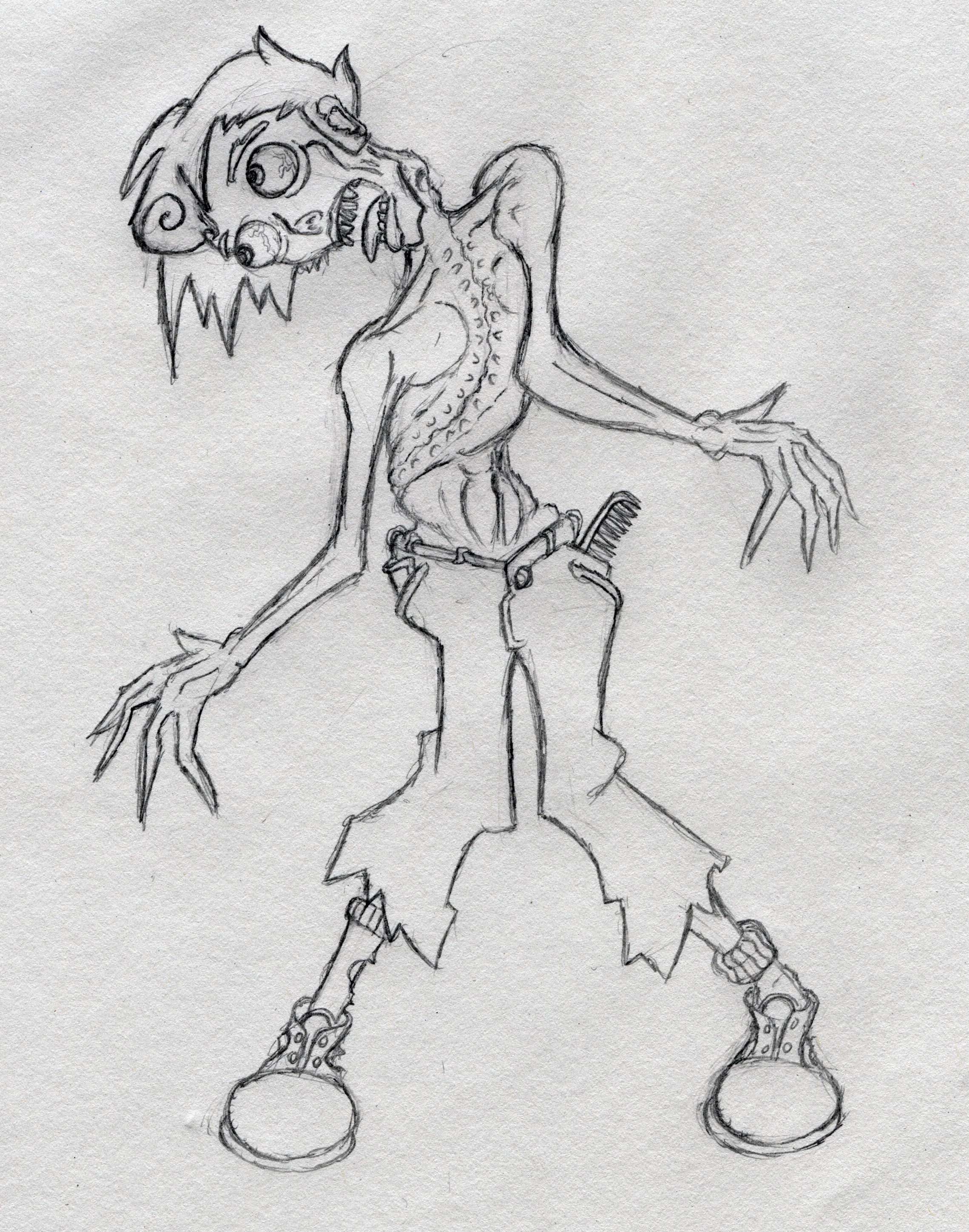
Swing with Twist

Twist by James Castro

Under a streetlamp, in a midnight mist,

shaking and drooling, stood poor Twist.

A dancer by heart with hair to envy,

a player in the 50s wanted by many.

He was never a fighter, unless it was called for;

he was a lover, but could never be more.

No one screamed as they saw him grooving,

though after a glance everyone kept moving.

— By Joey Petty

Remakes and Reboots: Part 4

The Failed Remake

Of course not all remakes can achieve the heights of some of the previously mentioned films.  We have recently been inundated with remakes that have either fallen short or failed spectacularly.  Famously, there is the disastrous remake of Psycho, which was copied short-for-shot with a new cast in color.  As if a new director could possibly have made the film better than Alfred Hitchcock?  The argument could be made that it is the same method used for the Night of the Living Dead update, but there are subtle differences… most importantly Savini participated in Romero movies and made his film to honor Romero and help audiences remember the original.  Psycho… I’m not entirely certain what the purpose of it was.  Everyone, even people who have never seen it, KNOW the original.  It was shot by a cinematic virtuoso whose work could not be replicated or improved upon.  The same could be said for Kurosawa (if Hitchcock has an equal, his name is Akira Kurosawa), but remakes of Kurosawa often honor the original and try to place the basics of his story in a new place (as we have seen, with mixed results).  There has been word that Kurosawa’s magnum opus, The Seven Samurai, is getting yet another American remake, this one starring George Clooney.  Not only would it be the second western remake of this terrific film, this is overall a TERRIBLE idea, however still will not insult the original as much as reshooting the source film in color, shot-for-shot, with new actors as though he didn’t get it right the first time a la Psycho.  Please people… just bite the bullet, enjoy the black and white and watch the originals… there’s a reason these films are considered some of, if not THE, greatest movies in film history…

Cult Classic Case Study: Clash of the Titans (1981)

Leaving classics aside (as the general reception of the Psycho reaction proved) cult classics have become the focus of the remake machine.  While they are more understandable fodder for a remake, the reason behind the popularity of the original is still lost on most remakers.  One easy example is Planet of the Apes, which also achieved the same level of negative response as Psycho despite Tim Burton at the helm.  I saw the remake only once, and I remember enough to know I wouldn’t want to see it again.  We’ll jump to a more recent remake disaster: Clash of the Titans.

First, the nature of the cult classic.  The cult classic remains a cult because it succeeds in spite of its flaws.  It is greater than the sum of its parts.  Clash of the Titans (1981) was a delightfully cheesy feast.  Harry Hamlin’s Perseus is a feathered-haired relic of the late 70s and early 80s.  Monsters and creations by stop-motion animation wizard Ray Harryhausen show the art form at its precision best, from scorpions and vultures, to tiny clockwork owls, and Medusa with her dozens of snakes.  Acting legends like Laurence Olivier, and soon-to-be legends like Maggie Smith graced the screen with B-movie actors like Hamlin and Ursula Andress.  The story is right out of the basics of mythology, a hero is set upon by a vengeful god… he now has to set out on a journey, far too big for him, aided only by his guile (and some well-placed allies on Olympus) he goes to save his love, Andromeda, from the wrath of a sea goddess and her vicious creatures.  He gets an adorable clockwork owl, Bubo from Athena, a special sword and shield (of course), and rides the unridable Pegasus, one of Zeus’ winged horses.  Along the way, he fights with the twisted Calibos, fends off attacks from Calibos’ vulture and scorpions, duels Medusa, and finally saves the day by turning Poseidon’s mighty Kraken to stone with Medusa’s severed head.  The film is fun because it is so silly.  Stop motion isn’t as slick as CGI, but that’s what makes it special, something that took craft, patience, and years if not decades of training to get a physical something in front of the camera with actual lights reflecting off of it and casting actual shadows.  You wonder at how the little R2D2-esque owl flew, or how the menacing vulture, or the elegant Pegasus did the same.  You know it’s all just “the movies,” but you still leave it wondering how someone could take the time and effort to do all these things.  Perseus himself is a demi-god who acts like an everyman.  He doesn’t have the strength of Hercules, by far the most famous demi-god, but his cleverness makes up for it.  He succeeds by out-thinking enemies not out-muscling them.  He gets help when he needs it, and accepts it because he knows he needs it.  He travels the world to save his love while the gods literally play at dice high above him.

The film is not the masterpiece of Yojimbo, or Psycho, it’s not even a reflection of the times like The Karate Kid, instead it’s just a fun movie designed to entertain audiences and take them away to a fantasy world like movies are meant to do.  Then the remake…

Cult Classic Remake: Clash of the Titans (2010)

It’s hard to tell whether the 2010 version was supposed to be a remake or a reboot of a series.  In the end, it doesn’t matter.  It is one of the worst remakes, and one of the worst recent movies, in a number of years.

There has been a trend in movies, especially action movies and historical period movies, for revenge as a motivation for the protagonist.  Braveheart and Gladiator are two critically acclaimed movies that display this trend.  It’s strange to consider as revenge is, at its root, a very ugly thing; something not to be desired in a person, and certainly not a hero.  In the 1980s Clash (hereafter known as Clash) Perseus’ motivation was rescue.  He has offended the sea goddess, Thetis, and now she seeks her revenge by forcing Perseus’ betrothed Andromeda to be sacrificed.  Note that it is the villain of the piece after revenge… as traditionally a villain would be after something that petty.  In the 2010 remake, Crap of the Titans (hereafter known as Crap… for obvious reasons) Perseus’ family is killed by Hades at sea (Why Hades at SEA and not Poseidon?  I’d guess because the filmmakers thought, “Hey Hades is like the Devil he’s so much COOLER than Poseidon!”), and Perseus tries to defy the gods by tracking down Hades and defeating him.  That’s right, Perseus is seeking revenge for his family, which we’ve seen in every movie that features a guy with a sword since 1997… yawn.  Perseus in Clash looked every bit the classic Greek hero (save for the feathered hair).  Greeks always favored cunning over brute force.  Perseus uses his cunning constantly, he’s quick, clever, and fast thinking.  Things aren’t always spelled out for him (or the audience), and he has to decipher mysterious puzzles to defeat overpowering enemies.  And Perseus in Crap?  He’s a generic thug.  His shaved head, square jaw, and tiny-tight mouth make him look more like a second string UFC challenger than a Greek hero.  He’s capable of two emotions, rage and despair.  He shifts his feet, looks sad, shouts, and acts as though he has no common sense whatsoever.  He uses NO guile instead relying on just being mighty.  He is very mighty.  He cuts his way out of a big scorpion after all.  He refuses favors of gods trying to help him; instead he endangers his travelling companions because of his own pride and selfishness.  He is easily the most unlikable movie hero of the last 5 years.  His quest doesn’t even make sense.  Andromeda is no longer his love interest.  She’s just a princess who gave him water and will be sacrificed because the town her father rules has defied the gods.  It seems Perseus (especially the selfish brute they made him) could go on his quest to “kill” a deathless god without worrying about saving her since he has no plot-developed attachment to her.  Instead his love interest is Io, who is as unnecessary a character as has never existed in a movie.  She’s basically there to prod this mess of a plot along and explain things to Perseus (and the audience who are treated like imbeciles by the filmmakers).  They could’ve named her Expositiana and been more honest with everyone.  Then there is Perseus’ quest.  He wants to kill Hades?  What kind of sense does that make?  The gods can’t even kill each other…  Even Homeric hero Diomedes was only able send Ares back to Olympus after gutting him with a spear imbued with power by Athena herself.  Today’s Perseus’ quest can be described in real life as this: your family is killed in a drive by; so you collect the finest police officers in the city and your closest friends to go punch a Gambino in the face.  Well done, you’ve killed everyone with you and eventually yourself, even if you knock him out, break his nose, and put him in the hospital for a month.  Eventually, they will be coming for you, and they have the ability to take you out far better than you can take them out…  Even if you are friends with the Governor…

Breaking the Remake Rules: Insulting the Original

So that’s the plot.  It’s bad enough.  How can a remake be worse than just a bad movie?  Easily, it can insult, demean, and forever try to one-up the original.  As I said from the beginning, remakes owe the original their existence.  They should recognize this, accept it, and honor the source material as much as possible.  Crap breaks this rule and never misses an opportunity to declare itself bigger, better, and badder than Clash.  They achieved the last one at least… in all the wrong ways.

Early in the film Perseus finds the clockwork owl.  He is told to leave it behind, as it’s apparently nothing useful.   The filmmakers to the audience: take THAT beloved classic character!  When scorpions appear in the desert in Crap they start out about the same size as the ones Perseus fights in Clash, then they get bigger and bigger until the final scorpion is the size of Delta’s Pacific airline fleet welded together into some metallic art-school drop-out garbage collage.  The filmmakers to the audience: You see?!  Look how much bigger and menacing our monsters are!  In Crap, Perseus comes upon a herd of elegant white Pegasus (which were all killed but one in Clash), suddenly they scatter and run as a bigger, BLACK Pegasus stomps into scene.  Filmmakers to audience: Yeah, we scared off those piddly white ones you saw in the original.  Look at how much COOLER the menacing BLACK Pegasus is!  Aren’t we awesome?  In Crap, the Kraken finally shows up released from, I guess Hades.  And why a SEA beast, the Kraken, is controlled by the lord of the underworld I have NO idea… just another display of how absolutely poorly the film was written using the original ideas.  The Kraken is the size of Tokyo bay.  Filmmakers to audience: See what we said about the scorpions? Yeah, he’s bigger, slimier and looks like a video game end boss, phase II.

In the end of Clash, Perseus uses his guile to turn the Kraken to stone, save the day, and win his girl.  The end of Crap is the same thing, but Perseus of course doesn’t get Andromeda. Instead, a coda is added where Io, who has DIED, is brought back from the dead by a LITERAL deus ex machina, and they leave the opening for a sequel, which is now impending for next year.  Pat yourselves on the back everyone for appealing to the lowest common denominator…

15 Signs of a Horror Movie Fan


You know you’re a horror movie fan if…

  1. You conceal “weapons” throughout your home. I.e.: knitting needles, table lamps, hammers, screw drivers, vases, ball bats, kitchen knives, ink pens and hard-back books.
  2. You hear a strange noise so you grab a weapon and investigate.
  3. Once investigating, you never think to say, “Hello, is anyone there?”
  4. A strange noise isn’t an intruder, it’s a ghost.
  5. Nothing is weird or unexplained, it’s always a poltergeist.
  6. You have an evacuation plan for every building you enter in case of a zombie apocalypse.
  7. You have a plan and supplies, and you will survive the zombie apocalypse.
  8. When swimming in a lake or ocean, you can’t help but think something will grab your feet or legs at any moment.
  9. You feel compelled to howl at a full moon.
  10. Dolls creep you out, and you may be scared of clowns or leprechauns.
  11. Vampires are hot, and you secretly want to be one.
  12. More importantly, you felt that way before the Twilight series.
  13. You watch slasher movies to relax and boost your mood after a tough day at work or school.
  14. You were voted, “Final girl or guy” in class or at work.
  15. Last, but not least… Your child wakes up from sleep walking. The next morning there are scratches on his/her arm. Your first theory… demonic possession.

— From the mind and experiences of RP