How to be a Good Fan: Introduction

Off the Edge

We’re all fans of something.  It doesn’t matter what; we can be fans of sports, food, TV shows, video games, books, characters, just about anything.  I personally have been a fan of numerous things including history, comic books, art, bands, and games.  I still am a big fan of too many things to count, though admittedly I only throw myself completely into a few.  After all, there are only so many hours a day to spend on one’s obsessions.

There has been a move recently away from being a “fan” and being a “good fan.”  Too many people nowadays are what I think of as “bad fans.”  These are the people who are belligerent and haughty with their fandom, and not only obsess about certain things, but belittle, attack, or denounce those who don’t share the interest or, even worse, dislike the interest.

These kinds of fans I mostly run into with the “geek” subculture.  Though I have seen them in the limited experience I’ve had in the sports subculture as well.

Commodus was a “Bad Fan”

I feel it necessary to mention something about the “new geek” subculture.  All my life I’ve been considered a “nerd” for whatever that’s worth.  I’ve never been into sports or popular culture much.  I grew up in the Save by the Bell, Real World, and Beverly Hills 90210, and never enjoyed a full episode of any of them.  Except for Tai Kwon Do and recently boxing, I never played sports and spent most of my time reading, drawing, or playing with action figures into my teens (I admit that happily.  It’s fun and ya know what? Still is!)  Thus, during school, several of my friends (who shared similar interests) and I were labeled by the @55holes of the world as “dorks” and “nerds.”  I distinctly remember a kid in middle school asking me and my buddy Mike where our “neon-colored pocket protectors” were.  I’m not sure the insult there, since I never wore neon and never owned a pocket protector, but it speaks to how we were viewed.

Nowadays due to internet and tech culture, “geek” has become cool.  While “back in the day” geeks banded together because of distinct lack of “cool” perception from the popular culture, they have become a section of the popular culture and, much to my dismay, have adopted many of the negative features popular culture has always had; negativity, exclusionism, derision, and segregation.  People “aren’t enough” of a geek or “aren’t real” geeks.  People are “geek posers” or “faux geeks.”  While I was growing up, the geek groups tended to be more accepting to people — we were outcasts, how on earth could we exclude other outcasts?  So you had comic dorks, video game dorks, and school dorks all crowded together.  Today, these groups have broken up and even actively dislike other “geek factions,” a lot like various denominations of a church that don’t get along.  We’ve all interpreted the nerd scripture differently, and not only are those who disagree with us WRONG, they aren’t welcome in our presence.

This brings me back to fandom.  It feels like geek fans have completely lost control recently, and many have gone from being “good fans” to being the worst of “bad fans.”  I think of the difference as being the difference between “patriotism” and “nationalism.”  Patriotism I have always seen as a positive.  It’s a feeling of pride and stating, “Despite all its flaws, I love my country.”  Nationalism is pejorative, a negative and superlative view of, “Not only do I love my country, but my country has no flaws, and is not only BETTER than yours but the BEST there can be.”  This breeds nothing but hostility.

In this series (I’m not sure how long it will be, but it’ll run and run…) I plan to lay out what I think the best ways are of being a “good fan” in the hopes of maybe getting it across that you can love, obsess, and immerse yourself into something without being a toxic individual to those who don’t share the interest or disagree with it.

The first topic will start next week with Accepting All Paths to Fandom.

Off the Edge #4: Issues with Next Gen Gaming

Off the Edge

I’ve maintained a console through every generation of gaming, NES, Genesis, Saturn, Playstation, Dreamcast, Playstation 2, XBOX, Gamecube, Playstation 3, Wii, XBOX 360.  I’ve owned (or still own) all of these at one point or another and I just assumed I would always have a console.  I have to say the recent pre-launches of the upcoming PS4 and especially the XBOX One have kind of put me off buying either next gen system.

The first question I have is, “why?”  Though I jettisoned my 360, I have to say the PS3 and 360 are still both strong systems.  They can get loads of life out of them and provide years of games with the “current” gen technology.  I know there are loads of gamers out there who always want more and more in terms of graphical capabilities but they can squeeze so much out of the hardware it seems unnecessary that new hardware is needed to make games look better.

The second objection is the threat of DRM control.  Most of us are familiar with the gaming industry in general and have heard that, despite shaky economic conditions and various natural disasters, the game divisions of most of these companies are turning profits, and in some cases are helping keep the rest of the company afloat.  So why are game companies so concerned about “piracy” or the used game industry?  It isn’t about their economic viability at this point it’s just greed.  As a cartridge-gaming kid I never had more than a handful of games.  My friends were in a similar situation.  So we borrowed and traded with each other.  Broke kids could play lots of games that way.  When your friends wanted it back you had to either do without or, more often, sell some of your old ones and buy the new one you wanted.  Buying used and trading has always been a dynamic part of the culture.  The new plan is to DRM all games.  To borrow a game from a friend you still have to pay for a game.  This makes trading useless.  All so companies already turning profits can make more money.

Even worse is the method in which they verify the DRM, specifically the XBOX One seems to have adopted the atrocious method used for Diablo III and the latest Sim City, always-on online server verification.  It reminds me of the first time I put in my copy of Empire Total War and it made me install Steam.  At that time Steam had to connect to the internet.  I had a dodgy wi-fi connection.  I couldn’t play it.  A similar problem occurred when Diablo III came out, despite all the server preparation they didn’t have enough to allow the first-wave rush and people who pre-ordered the game couldn’t play it.  The same happened with Sim City.  Companies are now forcing you to be online even when you just want to play single-player games.  I exclusively play one player so this is a barrier; as they focus on their marketing on online gamers and ignore what I’m guessing companies feel is a less-valuable customer.  Microsoft can tout the number of servers they have ready for launch.  There will be people who can’t get on.  They will crash, and those gamers who want to just basically play a game won’t be able to.

They’re watching us…but they aren’t paying any attention to what WE want…

And my third major objection, can we have a game machine that really just plays games?  Both Sony and Microsoft seem to be obsessed with all the other stuff their dream machines can do.  It can connect to their proprietary networks to play proprietary movies!  It can constantly keep connected to social media!  It can control your TV!  It watches you while you sleep and checks your vitals like HAL from 2001!  Ok.  All well and good…and well-and-creepy, but does it play games?  Are the games any good?  Do they do anything new and worthwhile?  It doesn’t seem to be the case just yet.  They look slightly better from what I can tell.  The question really is do they look good for what they NEED to do?  Sonic the Hedgehog and Double Dragon II still look amazing for what they need to do.  Make it HD and it doesn’t add much more.  Make it 3D and it doesn’t make it better.  Add motion control and it generally gets in the way…  Do they do anything worthwhile and new?  Or is it just “here’s the single player game (with maybe some motion control stuff) and here’s the multiplayer game.”  At this point I’m not sure how much innovation can be put into games, but typically the innovation comes from designers and writers not the hardware.  Get some good, creative ideas and you can make 8-bits look amazing.

I once read a book called The Pentagon Wars by Air Force Colonel James Burton.  In the book he describes the major issue with weapons development in the Pentagon (in the 80s and it’s probably still true) is that weapons manufacturers use military funding to create new technology that was ridiculously overpriced and entirely unnecessary.  The developers and consequently the Pentagon top-brass, made the weapons they wanted to see using the new technology they wanted to play with.  In doing so they totally ignored what the soldiers and pilots wanted and needed.  He discovered pilots mostly dog fight with enemy planes via sight…in response the Pentagon and weapons industry produced a missile that can fire from miles away and missed far more often than it hit.  A troop transport vehicle was requested to carry troops and instead it was outfitted with so much hardware it doesn’t carry enough troops and can’t do anything well, it just does them “good enough.”  While reading about next-gen consoles I thought of this book.  The console manufacturers are spending WAY too much time trying to shoe horn the newest technology into their latest plastic box.  All the cameras, TV-internet connectivity, social media functionality, 3D gimmicks, motion control, and voice activation won’t be worth anything if the newest, fanciest game machine doesn’t have good games or play let you play them easily.  There will be decent games on it, but to me, it won’t be worth what we’ll be paying for all the technology I don’t want or need.

The only way to send a message to the gaming industry would be to NOT buy their latest over-engineered next-gen system or let them know NOW what we really want in a new system.  The economic system is all on its head; it should be what the market desires not what the industry mandates we will have.  I won’t be getting one any time soon after launch.  But I have a feeling the market will buy it.  They’ll buy it, complain about it, and continue to support an industry that cares more about doing what they can do rather than doing what’s needed; and increasing profits via absurd protection methods rather than simply making products their market wants to buy.

I’ll have fun with Mega Man 2 and Streets of Rage 3 in the meantime…

I’d take almost any one of these any day at this point…

90s Shooters: The Joy of the Wolfenstein – Doom Era

Though I was a video gamer from a young age, playing Atari and NES, I didn’t get into PC gaming until I was in middle school.

My first home PC was a simple IBM with no hard drive.  I played games directly off a 3.5” diskette and could only play shareware versions of Where in the World is Carmen Sandiego? and use Print Shop Pro to print on the DOT Matrix Printer.  As time went on it became difficult to find games I could play that only had one disk…luckily we eventually upgraded our PC to one with a moderate hard drive (I think around 120 mb or so) and a whole new world of gaming opened up.

This was when I was introduced to shareware versions of Wolfenstein 3D, Blake Stone, and eventually Doom.

These represent the first person shooters I ever played, and some of the earliest entries into the genre.  My friend Mike provided me with Wolfenstein and eventually Blake Stone.  We played both shooting games on the 8th grade newspaper computer instead of actually working on the school newspaper (I don’t know if we even had one) until we got caught.

Wolfenstein Title Screen

Wolfenstein 3D was fascinating, killing all those Nazis in castle hallways.  Hearing their low-fi German shouts (“Halt!”  “Guten Tag! Mein Leben!” “Schutstaffel!”) and eventually working up to fight some strange version of Adolf Hitler in terminator armor.

“Halt!”

Blake Stone is almost forgotten now, but it was a sci-fi game of the same making.  I remember the blue-green gun and the mad scientist and green alien bad guys.  Blake Stone was another one Mike and I played in English class (right behind the teacher if I recall…) and, though I never played it at home, it really got me into the corridor shooter game.

BlakeStone

When Doom came out it changed the dynamic for me.  Released from the corridors, you now moved through expansive locales and multiple-story levels.  I played it on shareware, only the first few levels and I played them over and over.  It’s the first “god mode” I ever used (IDDQD!) and even more often I’d use IDKFA for all weapons.

I played Doom relentlessly.  I was one of the few individuals who bought a Sega 32X and even though it didn’t have a lot of games I truly enjoyed the ones it had.  I listened to Use Your Illusion I & II and played Doom for months on my 32X as a middle schooler.

Once my PC could handle it I finally got a copy of Ultimate Doom and Doom II at the local Media Play and swapped the dozens of disks to install them.  It was this era when you could play a game for months…even years.  Turn on some midi music and play Doom for hours just as a time waster.  I can’t even remember how many homework assignments I blew off to kill the Cyberdemon yet again…

I’m pretty sure the Imp sound effects are actually camel sounds. Weird to think about it now….

I actually remember it being a controversy at the time: did Doom make kids violent?  It was ludicrous to me.  Doom was as realistic as a cartoon (though a tad gorier than most I’ll admit) and it would follow that kids would only learn how to kill cacodemons with a keyboard while wielding a pixelated plasma rifle…  How that equates to loading a pistol I’ll never understand.  I’d say unless you’re a spiked imp throwing fireballs on screen and I’m a crew cut face wielding a video-chain gun society should be safe.

Doom really stands as the last first person shooter I really loved.  Others came along (Duke Nukem 3D shortly after the Doom era…Kingpin when I was in college) but none really captured that WolfensteinDoom feeling for me.  Now it’s one of my least favorite genres, burdened with a heavy emphasis on multiplayer (I’ve said it a million times…I deal with idiots all day in my real life…I don’t need to deal with anonymous idiots during my leisure time…) and less on long campaigns I could put on some music and kick back to they haven’t appealed to me.

So here’s to the 90s first person shooter.  Turn on the game, turn off your brain, and enjoy some mindless (but entirely harmless) violence!

Life Lessons from Video Games Versus Mode: Bonus Stage!

LifeLessonsHeader

While Street Fighter and Mortal Kombat were locked in deadly battle for arcade supremacy other franchises came and went on the console market.  TMNT Tournament Fighters, Clayfighter, and the dreaded Shaq-Fu all appeared to take advantage of the fighting game popularity.

One franchise stood out to me and, though it’s vanished into retro-obscurity, it is probably my favorite of the bunch.

Eternal Champions

Eternal Champions showed up as a Sega-only franchises on the Genesis and utilized the same aggressive marketing campaign that Sega used to fight Nintendo.  I remember seeing the plastic clamshell box stalking around the residential hallways chasing down other fighting games throughout the house.  Admittedly these kinds of ads are a turn off to me.  I’d rather not compare one item to another, just let me know what’s good about the one you’re selling me.  But Eternal Champions won me over.  It combined the cartoon-style animations and unique character styles of Street Fighter with the brutality and violence of Mortal Kombat.

The premise was terrific.  A group of warriors, all throughout time, each meets a premature demise . The Eternal Champion has offered them a chance to return to their respective time, moments before their deaths, and have the chance to prevent their deaths before they happened.  I loved the premise, and when the Sega CD sequel offered more fighters and more options I jumped on that version too.

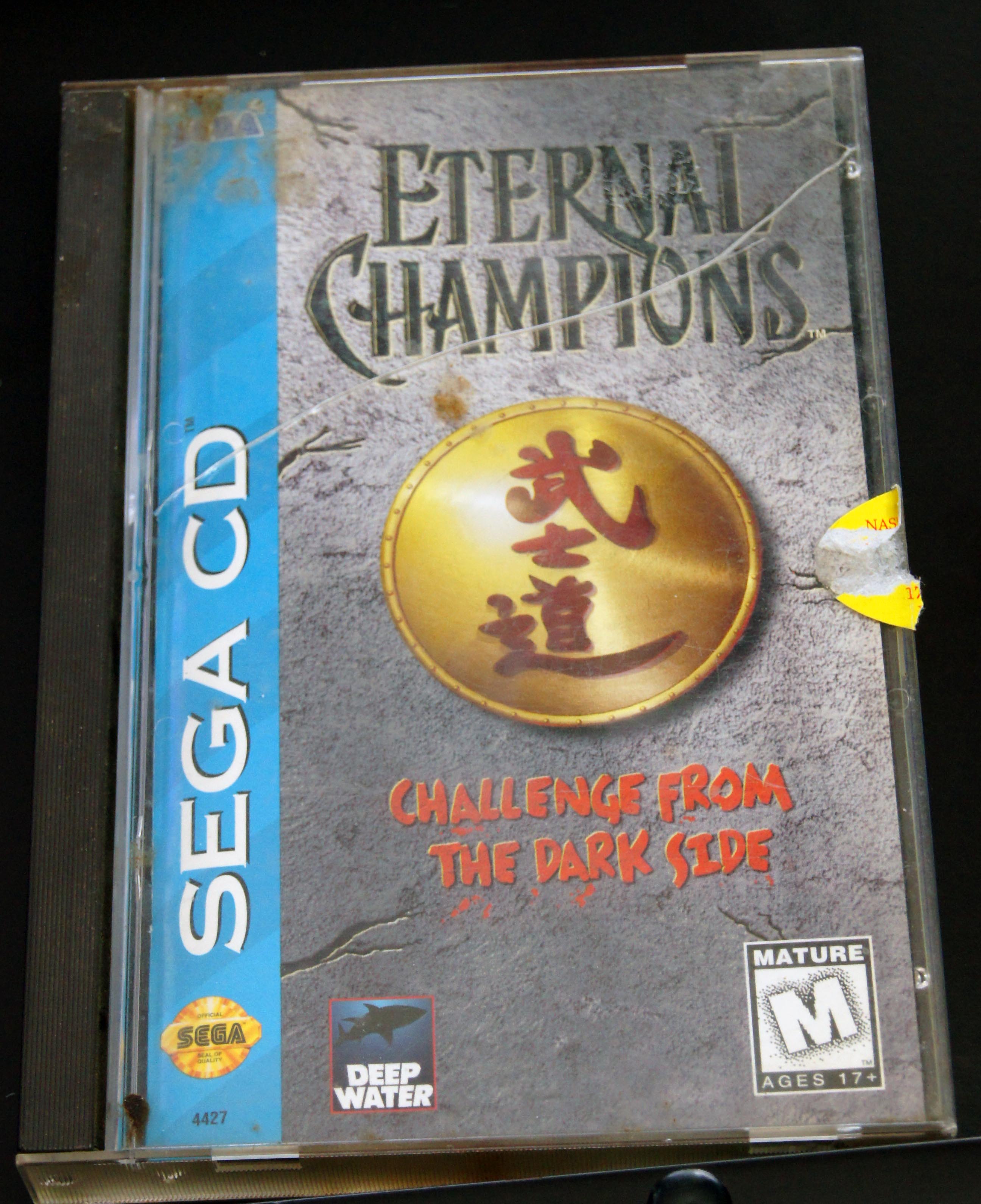
Eternal Champions CD
My copy of EC: Challenge from the Dark Side

At the time reviewers, who are always an annoying snarky bunch I’ve found (and I still maintain it’s easier to write a bad review than a good one…recently reviewers don’t think it’s “cool” to like things they review), called it a Mortal Kombat rip-off, based solely on its bloodiness.  But the gameplay and presentation was FAR closer to Street Fighter than Mortal Kombat.

The special moves, character movement, and attacks all resembled Street Fighter.  I remember playing as a caveman named “Slash” (I was then and am still a GnR fan I had to play as Slash) and how incredibly hot the portrait of Shadow Yamoto looked in the game, so much so that I hated to beat her up.  My favorites on the Genesis were RAX, the futuristic kickboxer and Midknight, the vampire.  In the Sega CD sequel Challenge from the Darkside I added Chin Wo and Ramses III to my favorites list.  They all used specific martial arts styles as well and, since I was deep into Tae Kwon Do at the time, I loved the variety.

The kills that were the most fun came from the environments.  I remember the car in Larcen’s stage riddling you with bullets and getting sucked into the big fan on Blade’s.  Dinosaurs ate you, you got electrocuted, and burned.  The tricky part was getting your opponent into the right position to meet their destruction.

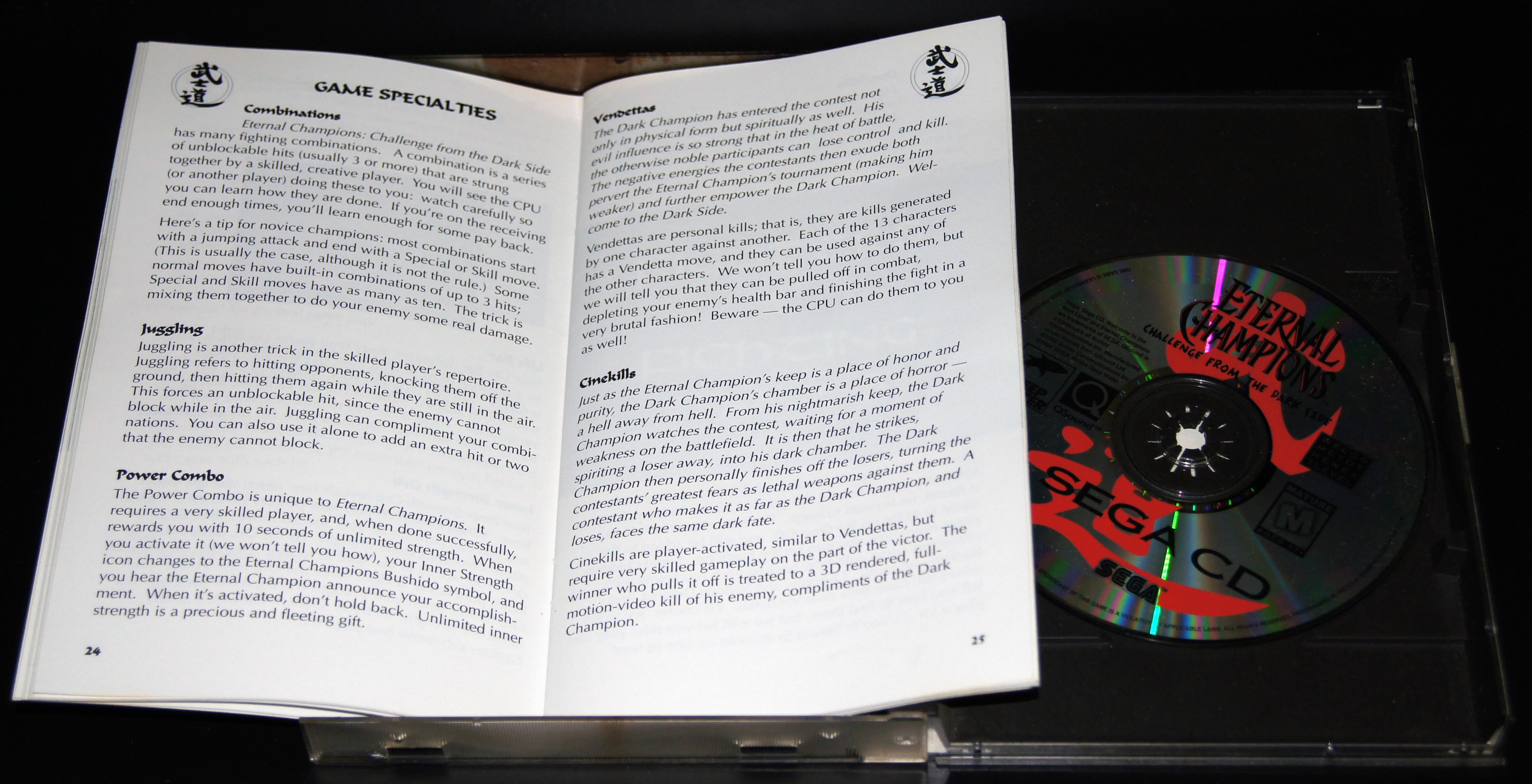
Eternal Champions CD
Description of moves including some of the kills!

UN-like Mortal Kombat, it required the strategy and techniques of Street Fighter to defeat an enemy.   Often killing your enemy was just an awesome bonus.  The Challenge from the Darkside offered more kills, challenging, but terrific if you pulled them off, and often related to stories.  Sometimes a new event happened you’d never seen before and, remember this is PRE-INTERNET, you had to figure out how that happened.

Added to this was the secret element.  Eternal Champions was loaded with secret characters.  From a Senator (taking potshots at political anti-game violence grandstanding) and my favorites, the animal characters, a chicken named Crispy, a monkey named Zuni , an owl (loved the owl) named Hooter, a snake named Slither, and a dog named Yappy.  These were simple diversions from the regular game…but brought humor and replay value into the fighting game, which can be sorely missing in some of them.

Eternal Champions: Challenge from the Darkside, along with Sega Saturn’s X-Men: Children of the Atom, remain my favorite non-Street Fighter fighting games.  It doesn’t suffer the same “Duke Nukem” effect I mentioned that impacts Mortal Kombat for me and is still loads of fun to play.  I personally would like to see a return to the Eternal Champions franchise.  Updated in the same way as Street Fighter IV, keeping true to 2D fighting roots but updating the graphics and gameplay.  The premise, characters, and styling already exists.  You’ve got a foundation, gaming industry, get to it!

So while Street Fighter reigns supreme in my fighting game memories…Eternal Champions: Challenge from the Dark Side holds a special place as the potentially the best fighting game no one remembers…and potentially a challenge to SF’s throne…

For a full look at my love for classic Sega check out my love letter to the Genesis-Saturn days!

Life Lessons from Video Games Versus Mode: SFII v MK Finale!

LifeLessonsHeader

There are two kinds of people in this world: those who prefer Street Fighter and those who prefer Mortal Kombat.  Yes we can love them both, but if you were stuck on a desert island which would you prefer?  We all have an answer.   This will be no surprise, I’m a Street Fighter person.

Part of it has to do with my introduction to it.  I learned it first so its moves in a one-on-one style tournament fighter became second nature to me.  I’m not a fancy or elaborate Street Fighter player, I keep things basic, but I also win a LOT (right Mike? >: ) )  Here’s why I prefer Capcom’s Street Fighter to Acclaim’s Mortal Kombat.  Keep in mind I’m only dealing with the 16-bit iterations of the games, not the later ones.

Longevity: I don’t mean one series has or will outlast the other.  We’ve seen bad versions and weird crossovers for both franchises, I mean the longevity of these 16-bit games themselves.  Street Fighter II is a fun game.  All the special moves, all the different characters and strategies, it still feels the same way as it did when I first played it.  Mortal Kombat has suffered the Duke Nukem effect for me.  Despite all its violence and cutting edge effects…it all seems somehow…childish.  As though maybe that kind of thing is only really cool to a 12-15 year old.  Mortal Kombat’s brutality actually feels like a gimmick now.

SPAM: I think we’ve all done hadouken-hadouken-hadouken-hadouken or TIGER (high)-TIGER (low)-TIGER (high)-TIGER (low) against the computer or a live foe.  I have.  Especially Zangief and Balrog (M. Bison in Japan).  But if you did that on a harder difficulty or against a competent foe you also saw a jumping roundhouse or a leaping short into a sweep.  You can only spam fireballs for so long.  I can beat Mortal Kombat by doing flying kicks and upper cuts.  And JUST flying kicks and uppercuts.  The flying kicks strategy is how I always beat Goro.  I could usually get a flawless victory on him too.  Even on tougher difficulties.  It seems easier to spam cheesy moves in Mortal Kombat to me.  So much so that I’d try to play fair then just say, “forget it I’m spamming to win…”  I’m sure the MK masters out there know ways to break those kinds of things, but it doesn’t make it any less frustrating when some chump starts doing it to you…or any less lame when you see it work on the game’s hulking sub-boss!  One cause of this problem is reflected in the next item!

Diversity:  I mentioned this in my Street Fighter post, but it wasn’t until I did my Mortal Kombat post that I realized how diverse Street Fighter is in comparison.  Street Fighter had two characters that played essentially the same, Ryu and Ken.  In Mortal Kombat, except for special moves, they all essentially play the same.  And it struck me the reason why, no one really cared about the fight.  I never did as a kid.  I typically just rushed through the fight however I could…I only cared about fatalities and unlocking secrets.  In a way MK’s secrets and violence kind of trapped it.  By giving all the characters the same basic set of moves with the same range, speed, and strength, it made it essentially the same game over and over with different kills at the end of each round and those kills are what I looked forward to.

Fun: The most important thing to me.  To this day I can plug in Champion Edition or Super into my Nomad or CDX and pick up right where I left off as though it was 1992 all over again.  I can have just as much fun, find just as much challenge, and remember all my timing and moves through straight muscle memory.  I admit I haven’t played Mortal Kombat since I quit playing it in the 90s (though I have played the newer ones!)

All of this is not an indictment of Mortal Kombat at all.  I love the game.  I loved the time I spent with it and I still cherish the franchise as the brutal cousin of Street Fighter, the Asia-gothic-hellscape fighting game that still has plenty of room to grow and reinvent itself at every opportunity.  I just prefer Street Fighter.  All of these opinions are of course mine only.  I think Mortal Kombat fans also have good points as to why they prefer their franchise and I’d love to hear some.

Which do you guys prefer?

In my opinion it’s a clear win and a…

KO

KO

…for Street Fighter!

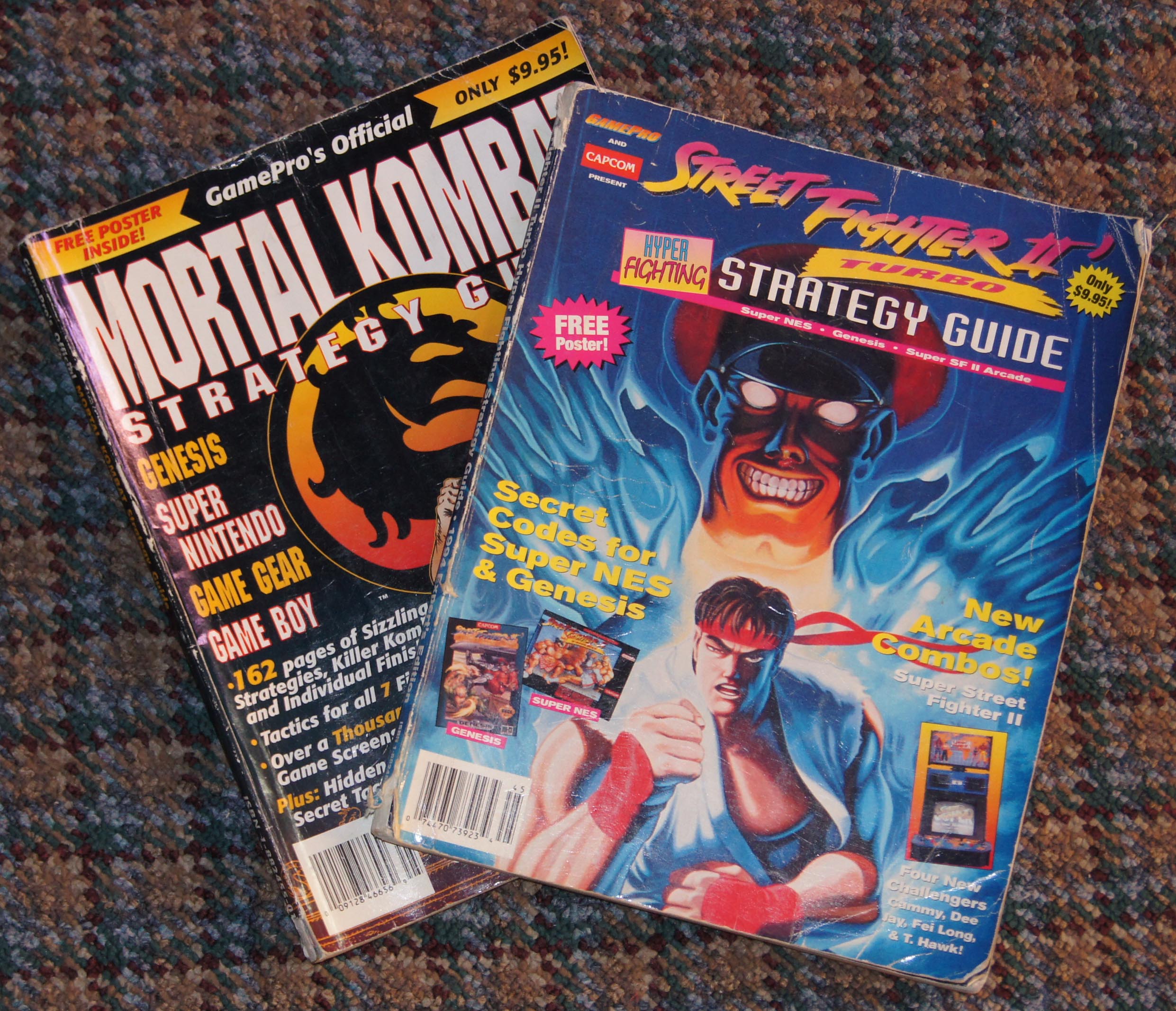
My original strategy guides from the 90s.  Before the internet…books like these were the only way to get info!

Guide Covers

Guides Open

Life Lessons from Video Games Versus Mode: Mortal Kombat

LifeLessonsHeader

Mortal Kombat…  I admit I never played Mortal Kombat in the arcades when the cabinet first came out (though I remember it took some of the crowd away from my SFII cabinet at the skating rink…) What got my attention with this game were two things: word of mouth and the ad campaign.

I was already used to Street Fighter’s cartoon graphics and its somewhat Looney Tunes violence (even literally seeing stars when dizzy) but I heard a new game was out that upped the maturity level.  It showed real violence and blood and, rumor had it, you could even kill people in this game!  To a 10-12 year old this sounded amazing.  I couldn’t believe any of this could be true!  Then the ads came out for the home version.  The epic commercial featuring 90s techno music and the single shout of “MORTAL KOMBAAAT!” got everyone’s attention.  Followed immediately by the firestorm from parents’ groups and politicians saying the game was too violent for kids and should be banned.  All this did was make kids like me who didn’t pay attention realize “hey I gotta see this bloody game!”

Again I got it for the Sega Genesis, and in this case I was LUCKY.  While the SNES version bent to the will of parents’ groups and removed the bloody aspects, the Sega version just made you put in a code.  This was before the internet folks so, like all the codes I learned, I went to the local FoodMax, opened up GamePro magazine, found the code (down, up, left, left A, right down) and repeated it over and over as I  walked home.  Voila.  Bloody Mortal Kombat.

Mortal Kombat was like nothing I’d ever played before.  I half expected it to play like Street Fighter, it was what I was used to.  I was shocked when pressing back didn’t block, and finding that block button was tricky!  But once I got into it Mortal Kombat, and the superior Mortal Kombat II, sucked me in.  The digitized characters looked more “grown-up” than the cartoons of Street Fighter.  The flinging blood, the wild special moves, and the fatalities…oh the fatalities.  Finding these out was a gold mine of gaming information.  I couldn’t memorize them, I had to write them all down and then play the game over and over until I could execute each one.  Ripping out spinal cords (I was a huge fan of Predator so this was awesome to me), pulling out hearts, uppercutting off heads, skulls spitting fire…this was unlike anything I’d ever seen.

Again I felt lucky to have my 6 button controller and the Sega version on MK I.  I learned Mortal Kombat, not playing alone, but with my buddy Mike, who was far better at it than I was (I still trump you in Street Fighter though, Mike…)  We played it relentlessly and learned all the kills, environmental kills, and secret characters and levels.  They still stick with me, after all these years, and its etched into my adolescent gaming memory.

So what gave Mortal Kombat its legacy?

1.)    Maturity: Until Mortal Kombat the most “badass” game in the arcade was…Pit Fighter…shudder…  Street Fighter was full of cartoon characters and cartoon violence, all the beat em ups had a similar look and feel.  Mortal Kombat, with digitized actors playing the characters had a more “cinematic” ambience.  By now I was into Tae Kwon Do and I could recognize the realism in the basic combat moves and appreciated it as a step toward “growing up” in gaming.  The blood and violence just filled out what I expected as a maturing gamer to see more and more of.  Boy was that right…

2.)    Unique Control: After the success of Street Fighter many games copied its controls and animated style to varying degrees of success.  Mortal Kombat was the first game of its kind to use high-punch, low-punch, high-kick, low-kick uppercuts, etc that I ever played.  These moves were all designed to set up special moves that would do the real damage.  And the special moves themselves were terrific and memorable, “GET OVER HERE!” Raiden’s nonsensical babbling during his torpedo move, and Sub-Zero’s Freeze attack.  It didn’t FEEL like other fighting games at the time, but I’ve found, especially as 3D takes over the fighting game genre…the control scheme has become more popular.

3.)    Fascinating Characters: As far as standard attacks, all Mortal Kombat characters essentially play the same.  What makes them cool is their look and their special moves.  Kano was one of my favorites, he just looked wicked with that cyborg eye.  I usually played as Scorpion though. That vicious spear and 90s Ninja outfit made him a stand out option.  Even non-playable Goro still sticks with me as one of the most memorable bosses in video game history.

4.)    Marketing: Mortal Kombat hit at just the right time.  Gamers were maturing, violence in gaming was a hot topic, and the market was expanding.  All the noise people made in fear of Mortal Kombat just made it more interesting.  It stays true to the cliche, no such thing as bad publicity!

5.)    Secrecy:  This concept goes hand-in-hand with Mortal Kombat.  I didn’t believe fatalities were real until I saw one myself.  I just assumed it was talk.  I remember when a guy in my 7th grade class, Charles, mentioned Reptile the first time.  I didn’t believe the character existed…then he did.  For every secret proved to be true, two more theoretical ones appeared.  For every one debunked five more appeared.  If just ONE of all those proved to be grounded in some reality, it made us plug the cartridges back in again and buy the next sequel!

So there is my recollection of Mortal Kombat and why I loved it.  As I mentioned Mortal Kombat II was even better.  I never even tried to play the arcade of that one and just bought it when it came out (or got it for birthday or Christmas…yes kids…games have been 50-60 dollars for a LONG time…)  Playing as new characters, adding new fatalities, kinds of fatalities, and stage hazards made the game fresh and fascinating.  It, like Street Fighter has gone 3D, added new gameplay styles and mechanics, and even jumped genres (Shaolin Monks was an awesome game…), and while it didn’t retain the very basics of the original, they have generally felt true to the original, with secrets, wild characters, and crazy kills.

Next post will be my final comparison and why I prefer one over the other (I’m sure everyone can see where this is going!)

And for  bonus: