The Best Film of 2015: Mad Max Fury Road Part 3

Visual Design:

The term “special effects” has become an ugly one for me in modern cinema. There was a time when SFX referred to make up effects, miniatures, green screen, stop motion, traditional animation, puppetry, stunts, and CGI. Now “special effects” only seems to involve CGI. Even traditional make up effects have gone CGI. Anytime someone says a film had “great special effects” they usually mean it had “good CGI.”

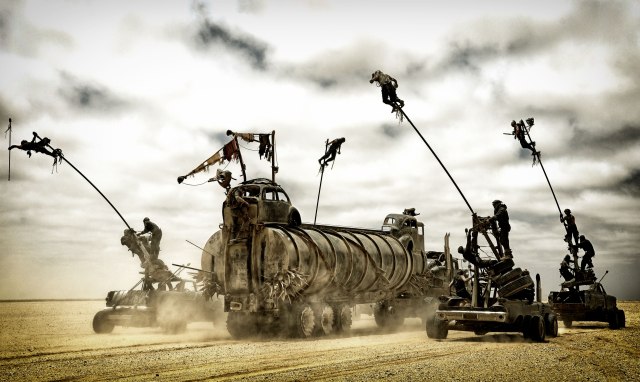
Mad Max Fury Road uses CGI. It uses it the way my other modern action film favorite, Dredd, did: to enhance scenes, NOT to create them. Fury Road, like Dredd and like everything directed by my favorite currently active director, Edgar Wright, uses primarily practical effects. Every car you see racing through the dusty desert, every weird character, all their odd costumes, even the crazy life-threatening stunts, are all actually happening. There is one large CGI set-piece used for the close of Act I, the dust storm. It should be noted that the way this scene was shot it was shot as though on a real camera. The angles are believable the camera never does a Peter Jackson-style swing through the top of the clouds, down through the funnel, then out to the cars. So even though the massive storm is computer creation we believe it to be real because it is filmed as realistically as the really real material.

madmaxsand

CGI is again used at the end of the film to enhance one of the movie’s spectacular crashes. Pieces were nudged to make them crowd more, and the debris was enhanced to give the scene an almost wryly comical punch (immediately after one of the emotional climaxes of the film it was well-played). Here again the scene was shot realistically, but items added to enhance the scene in question.
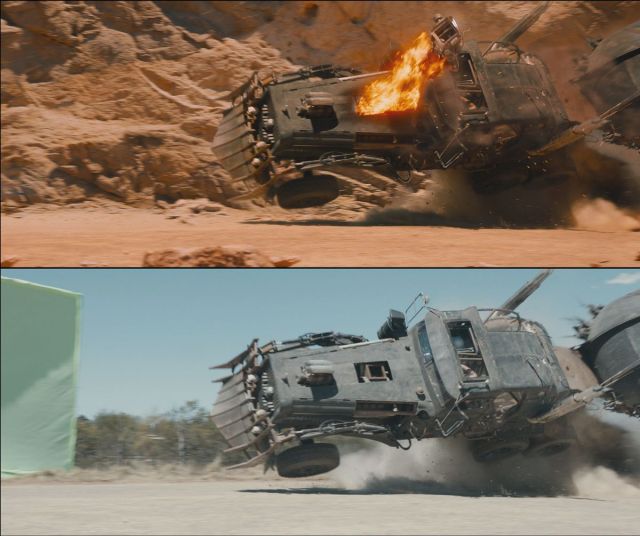
MMFR_REEL_6_FINAL-2-25074
The Crash of the Warrig shows how CGI is used to NUDGE a sequence…not create it…

There is something about having an actual item in front of the camera. It’s why original Star Wars miniature shots and the opening to Star Trek: The Next Generation have a timeless charm, where the lifeless animated creatures from the newer Star Wars films haven’t resonated as much. It’s also why Lucas’ use of WWII fighter footage made such good dogfighting scenes in A New Hope. Everything behaved or was based on reality. Something in our brains tells us that real items don’t behave the way CGI would often have us believe. I’m not one to rail completely against CGI, but seeing what can be accomplished when computer technology is combined with classical practical effects as seen in Scott Pilgrim, Dredd, and Fury Road as opposed to the dead-eyed, green screen covered worlds often encountered in big-budget action, sci-fi, and fantasy films of the modern era.

Editing:

Editing is horribly abused in modern film. Everyone uses the same tropes (the silence then punch line, the quick shots and cuts in fights, etc) and no one really understands why these techniques are used. Looking at modern fight scenes, even in fun modern action movies like The Expendables, James Bond, or Bourne films, close shots are used with wobbly shoulder-cams and rapid cuts. It’s almost designed to make it difficult to follow. In his documentary My Stunts Jackie Chan pointed out that in old Chinese martial arts films they wanted to see the toes of each combatant. There is a benefit to this as you see the full scene and understand the narrative of the fight. Chan’s films cut much closer, but still many fight scenes occur in wider shots, only changing angles when scenery or a closer shot is needed as an insert for a stunt that couldn’t quite work. Modern editing seems to be making up for the fact that most actors in these films can’t perform the scenes and also making up for the fact that they can’t create scenes that are well choreographed. Watching Max’s fearsome brawl with Furiosa is a treat. It is shot wide enough to see the action. Everything in the story of the fight (Wrestler Brett “Hitman” Hart often discusses the importance of getting the story of a fight clear, each combat has a narrative and the combatants have to tell their part) is obvious and the fight itself is rousing. Max uses subterfuge at first. Then Furiosa uses distraction. Both attack and defend brutally, Max only holding back as he isn’t, by nature, a heartless killer of innocents. Warboy Nux and Joe’s wives, spectators to the combat begin to interfere, pulling Max and Furiosa with chains even tackling them and attempting to provide assistance to their chosen side. In the end, even though the fight is sped up slightly, put it on full fast-forward, and it still makes sense. You know the story of the combat and who has the upper hand and why.

Editing mixed with great direction is even more important. Prior to the fight mentioned above, Max asks for water. Furiosa begins to bring it to him but Max, studying her carefully, decides it’s best if the rather dangerous imperator doesn’t get too close and gestures for one of the wives to bring him water. Then gestures for another to cut the chain that’s binding him. During this sequence nearly no dialogue is spoken but the messages are clear. In a wonderful piece of combined editing and direction, Furiosa (out of focus in the background) is obscured by the wives helping Max. They shift slightly and we see her rapidly charging him, then she tackles him. It’s a brilliant piece of subtle filmmaking that you just don’t see anymore. A perfect “marriage” as it were of editing and directing.

https://www.youtube.com/watch?v=OxZ90pP-Bas

Sound Design:

It’s been said that sound design is one of those things you never notice unless it is done badly; lo-res sounds, poorly chosen effects, a badly cast voice actor can all derail even the best-shot, well-crafted narrative. I’m not sure I’ve ever seen a film with better sound design. From the rusty roar of engines to the barren sound of the desert, the effects are spot on. Furthermore, the way the sound effects combine the score is even more impressive. Like the famous repeated refrain of Beethoven’s 5th there is a rhythm that appears again and again. It appears when Furiosa knocks dust from the Rig’s intake. When Nux pounds his head on the tank. A repeated “boom” followed by a series of rhythmic booms that almost serves as Fury Road’s heartbeat. Sometimes (such as while Furiosa pounds sand off the warrig’s air intakes) it starts as foley, but is joined with the rhythmic drums of the score. This combination of effects and score are almost wonderfully married in the Doof Warrior, whose guitar strains are both part of the film and part of the soundtrack. Hearing the strains of the warparties’ drummer boy ominously announcing their approach in the distance or over sweeping aerial shots is a great device, to hear it combined with the music during the action sequences suggests sound design that has reached another level. It got everything right in Fury Road and it should NOT be ignored.

https://www.youtube.com/watch?v=EPydRKuhuEk

Conclusion:

So where does this leave Mad Max Fury Road in terms of Academy Awards? A film wonderfully conceived, tightly written, masterfully shot, and beautifully designed? My guess? Without an Oscar. Maybe one for editing or sound design. But none of the “big” awards for which it’s nominated. Why? For one Fury Road is not an “Oscar” movie. Though the Academy has voted for some so-called revolutionary films in the past (though I’m not sure I’d call The Artist that…) it has stayed firmly grounded in typical Oscar bait. Normally traditional. Typically Drama. Portrayals broad and “against type.” It’s why the “supporting” role awards are almost always much more interesting and usually filled with the better performances. So when something entirely traditional (I’m guessing The Revenant) wins everything this Sunday keep in mind that, even though the talented staff and cast of Fury Road walked out of the Dolby Theatre onto Hollywood Boulevard without as many of the little gold statues as they deserve, they do deserve enormous recognition for what they achieved and will hopefully win the vote of public opinion as “The People’s Best Picture of 2015.”

Today’s Teens Wouldn’t Have Survived the ’80s and ’90s

As a parent to a teenager, I am fully qualified to write this post. It’s necessary to do so, or I may explode on one of today’s youth. This week, I watched the timeless ’90s classic Jawbreaker. A deliciously wicked mix of pretty iconic ’90s teen actors and girl-hate, complete with social statements, murder and Marilyn Manson.

Watching Jawbreaker got me thinking though. As I struggle with my own teenager to do simple things like homework, I am reminded that teens in the ’80s and ’90s had it hard. We were caught between an evolving world while trying to maintain our innocence

RavenRant

Here are five reasons why today’s teens would have “literally” died in the ’80s and ’90s:

Lack of tech

I love the meme that says: Respect your parents because they survived school without Google. Preach on. Not only that, but teachers nowadays also give students digital resources to study and do their work. Most of us had to go to the library (gasp!) to research and use a computer. Some of us – those really lucky – had computers at home, but dealt with slow Internet connections and printers that freaked out the night before a paper was due. There were no cellphones, much less ones that did work for you. Texting and social media didn’t exist. If you wanted to reach someone, you called or paged their beeper. Even less of us had those.

As far as entertainment, we had a TV and maybe a video game console. We read books. We played outside. We got sunburned from staying out too long because there was nothing else to do. We couldn’t – and most didn’t want to – waste time staring at a screen all day. Sure, technology makes much of our tasks easier now, but teens need to get a grip and do something else. It’s not rocket science; maybe get off the devices and do something productive.

We were a lot tougher

I had to get my first job when I was 10 years old. I didn’t have a choice because I wanted something important that my parents couldn’t afford. My first job was mowing yards and washing cars. I used a push mower, and the back incline was at a 45-degree angle. I weighed all of 65 lbs., but I pushed that mower side to side on that hill every week. When I was 15, I started at the store and remained there until I was 26. I essentially grew up at work.

Many of our parents couldn’t afford to buy us whatever we wanted. We got a couple of things for holidays, and we appreciated them. Way more than teens today do. And we dang sure didn’t get a $300 phone and $700 bucks worth of games, clothes, music, etc. In high school, most of my friends had almost full-time jobs, and we had to have them to help support ourselves and families. We had and wanted to become self-sufficient.

The world did not revolve around us. Ever.

The absence of social media meant we could not – and never would be – the center of attention. We were all equal. Sure, there were cliques, but you knew who your true friends were and you helped protect others. We cared about life. We knew hurt and sorrow. I knew four people in high school who died in tragic accidents, but we didn’t disrespect them by posting horrible comments about how much we hated them or go on about how big the loss. We were private, and we respected each other. We had a sense of comradery and looked out for one another. The world owned us nothing, and we had to depend on ourselves.

No Re-dos

I was blown away a few weeks ago when I found out kids can retake tests they fail (in Nashville). What?! Retakes?

I feel this is a disservice to students. First, there are no retakes in college. Secondly, there are no retakes in life or work. If you fail, you fail. It’s that simple. Teens in the ’80s and ’90s made a ton of mistakes, but most of us turned out fine. We made mistakes, partied, lied to our parents, they busted us, and we paid the price. It made us smarter too because we had to think of creative ways to get what we wanted. How do you change or improve yourself if you can just redo your mistakes? That goes against reality in ways I don’t even have words to express. Shame on the administrators who approved that process in order to achieve higher test scores.

Censorship Didn’t Exist

I was young when Tipper Gore went on her censorship crusade and eventually got the “explicit language” warning on albums. Did that stop me from buying those albums. Of course not! Did it stop people of age buying me CDs with those lyrics? Of course not! The music scene in the ’80s and ’90s was raw, expressive and full of protest. Much of it was passionate and spoke out against wrongdoings. We weren’t sheltered from the real world, we lived in it and could relate to the music.

We watched the O.J. Simpson trial and verdict in our classrooms (I was 13 years old). We followed trials that accused Michael Jackson of child sexual abuse (11 years old). We were there when Bill Clinton faced his adultery mistake with Monica Lewinsky (15 years old). We lived through the Columbine High School tragedy (17 years old) and watched the world in turmoil during the Gulf War (8-9 years old). Our parents didn’t keep it from us; they educated and better prepared us for the world that we live in now.

With all that said, I applaud all of you who grew up in the ’80s and ’90s. Thanks for reading and becoming the people you are!

Best Film of 2015: Mad Max Fury Road Part 2

There has been some criticism of Fury Road as being vague or half-conceived.  These assertions prove how lacking in subtly modern film audiences are, and may explain why so many newer films are overly-simplified and artificially written.

150321165651-mad-max-fury-road-super-169

The Plot: One argument I’ve heard against Fury Road is that is supposedly has a “lack of plot.” While the characters section from last week dispels that concept easily, there is in fact a main plot it just isn’t an in-your-face, overly intricate, and horribly overly designed story. The makers of the film lay it out like this: The first half of the film is a chase; the second half is a race. That sums it up very well. Theron’s Furiosa kidnaps Immortan Joe’s wives in order to both bring them to freedom and severely and personally hurt Joe himself. Max, used as a living blood transfusion for the sick and dying Nux, is brought along with the Warboy when the Citadel mobilizes for pursuit and all of their paths cross during the action.

Why does this work? Its simplicity is its strong suit. Because the action takes place over such a basic backdrop, the film can focus on characters and the world. As described last week each set of characters has their own subplot, their own story arc which takes place during the film. If the plot was overwritten or absurdly intricate it would have made the plot and all the subplots far too confusing. Or required all of the over-explanation and dialogue exposition that have frequented modern films.

mad-max-fury-road-image-the-war-rig

There is nothing wrong with a simple plot, audiences and filmmakers have convinced themselves over the last decade that complexity equals effectiveness. In a lesser film Max would have rescued Furiosa as a child, she’d find out Joe was her father, Nux is her cousin, and two of the wives her half-sisters. And by killing Joe they foil a plot that would have turned all of his followers into mutants. Here the plot is small and personal. The relationships are happenstance and coincidental. It’s as was discussed in the Dredd review: sometimes keeping the story small-scale makes it more relatable to the audience (Dredd’s “Drug bust” line sums this philosophy up perfectly). The world doesn’t need to be in peril if we love the characters enough. Their peril and their stories make it worth it.

The World: This is where the film shines its brightest. The world of Fury Road is incredibly deep and detailed. BUT the detail is never explained it is all inferred, making a fantastical world seem that much more real. What is a “half-life warboy?” What does it mean to be “so shiny, so chrome?” What’s the significance of “McFeasting?” Why do all of these guys spray their mouths with silver before attempting to kill themselves? What does it mean to be “kamikrazee?” What is UP with Joe’s weirdo religious cult? The film never tells you. Well never directly. You can draw the conclusions that will answer all those questions yourself during the movie, but no one ever sits down in an artificial way through strained actors speaking in a way no human beings ever speak with each other. These aspects of life merely are in this world. The characters all seem to understand what they mean and through their actions and context we can figure them out too. Or at least draw educated conclusions.

mad-max-6
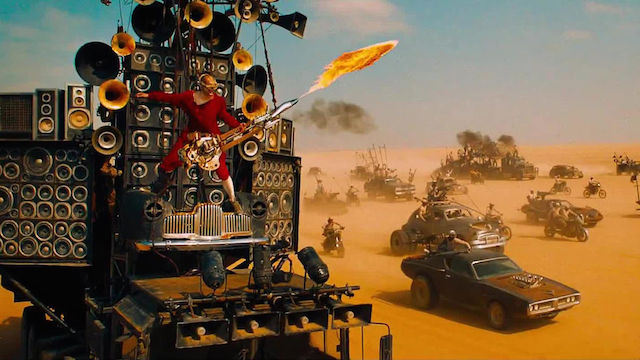
The never explain why there’s a guy with a flamethrower guitar riding a drum truck and they never need too…

The character interactions also assist in building the world. No one speaks unless necessary.   In a society totally lacking in trust and companionship this would almost certainly be the case and all those who made it to this point would be tough, isolated, survivors. “Imperator” is never defined but we know its significance by the way the others interact with Furiosa. She’s respected and revered. Joe easily calls the leaders of both the Bulletfarm and Gastown, even though it seems to be over their objections. How could this be? Again you can tell this from the context even if no one blatantly says it.

Ss-mad-max-fury-road-146
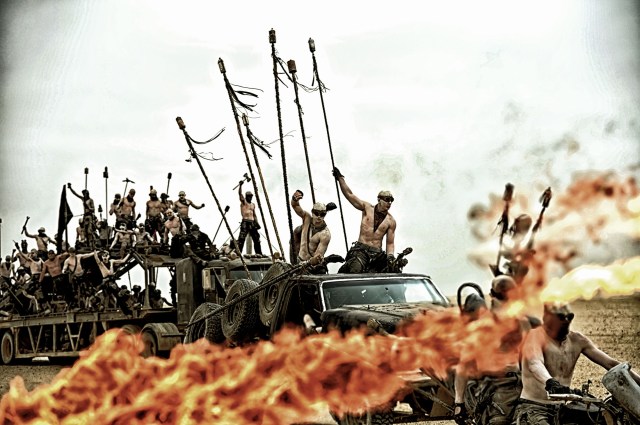
The Kamikrazee warboys.  They have a deep and fascinating belief system.  What it consists of, why they believe it, and all of its many trappings is NEVER explained.  It can easily be inferred but no screen or narrative time is taken up directly or artificially explaining the many facets of their world.

Subtlety is unfortunately lacking in modern cinema. Everything has to be big and operatic. It has to be about your son and revenge and you have to plan and stars align to create remarkable coincidences that are all artificially created of course by the writer. Mad Max’s plot and world deceptively simple. It is quite difficult to make these elements seem random, and random in a way that history supports (more often than not it’s chance that dictates events not fate…) These characters come together to tell a relatively local story of small global impact but high personal import. The story and its characters have weight because of the world in which they inhabit and the value they are all given to us.

In the final post in this series next week we’ll look at the technical aspects of the film and how a modern movie created spectacular scenes using many practical effects.

Valentine 2001: 14 Reasons Why It’s a Solid Slasher Movie

Valentine (2001) has worked its way up my list of favorite slasher movies. I never make a big deal about Valentine’s Day, but it shocks me that so many people hate this movie. Valentine 2001 came out in the same year as some better horror movies – such as 13 Ghosts remake, The Devil’s Backbone and Jeepers Creepers – but Valentine is still a fun slasher and worth a watch.

In honor of Valentine’s Day and to challenge all those who hate it, here are the reasons why it doesn’t suck (contains spoilers):

Valentine-2001
Photo: playonlinemovie.com

Boys will be boys. The male characters in this movie are hilariously bad people. Valentine sends a very strong message that finding Mr. Right is almost impossible. Throughout the movie, the girls are trying to find dates, and the pool is filled with egotistical d-bags. That’s the dating world, but the movie doesn’t send a hopeless message. It essentially says it’s ok to be single.

Everyone can relate. The movie starts at a dance with a nerdy, unpopular kid trying to ask several girls to dance. He faces constant, and most times, vicious rejection. We’ve all been rejected, so it speaks to a large audience.

Most of the victims receive creative Valentine’s Day cards. These cards are some of my favorite cards ever and add a nice touch. For example, “Roses are red. Violets are blue. They’re going to need dental records to identify you.” Not only are they creatively twisted, they’re funny.

You don’t feel bad for any of these characters. Sometimes, you feel like certain people should survive a slasher. Not in this one. Most of the characters are shallow and selfish, and most of them get exactly what they deserve.

Valentine keeps you guessing throughout, and there’s a fun little twist. It doesn’t end like most slashers, and the surprise is well worth the watch.

All 90s and early 2000s horror movie fans will love the cast. There are several actors you know from other movies. The Valentine cast includes: Denise Richards (Wild Things), Hedy Burress (Cabin by the Lake), Katherine Heigl (Bride of Chucky), Marley Shelton (Planet Terror, Scream 4.)

Listen to the music because the soundtrack rocks. For all you heavy rock fans, you’ll love hearing Deftones, Orgy, Manson, Rob Zombie and Linkin Park.

Everyone has distinct personalities and issues. One thing current movies lack in general is good stereotyping; there is a reason stereotyping exists. In movies, it often pokes fun at them, and the same is true here. You have the pretty girl, the sweet girl, the chubby girl, the awful artist, etc. All the actors play their parts well.

Never underestimate the nerd. You know who the killer is from the go, but who is he/she 10 years later is the big question. They quickly dismiss the nerd because he “could barely operate a water fountain, much less an intricate revenge plot.” Think again.

The main girls die in the way they rejected the nerd at the dance. I love this. For example, when asked to dance, Paige (Richards) says she’d, “rather be boiled alive.” Guess how she dies.

It fills a niche of horror that has been heavily dominated by My Bloody Valentine, which is hands-down my favorite Valentine-related slasher, but Valentine 2001 isn’t trying to be a great movie; it’s trying to be fun. I enjoy the holiday-themed horror movies, and Hollywood doesn’t do many Valentine’s Day ones, so it’s refreshing.

No one wants an Oscar, including the writers. The dialogue is quick and feels very real. When two characters converse, it feels natural. The writing leads to some sub-par acting, but that’s the beauty of the movie. It’s easy to laugh at the characters and easily recognize the actors enjoyed making it.

Everyone can pick it apart. I rewatched it recently for this post, and at one point I thought, “Who’s house are they in?” There’s a scene where the main girls are in a random house for questioning, and you have no idea whose house it is because you’ve seen where everyone lives, and it’s not there. In another scene, a girl answers the door and looks down before she’s supposed to. It’s those little things that make a movie more entertaining, and Valentine is a great movie to watch alone or with your best friend.

If you love a mindless slasher, check out Valentine 2001. Feel free to let us know what you think in the comments, and Happy Valentine’s Day, everyone!

The Best Film of 2015: Mad Max Fury Road Part 1

Oscar season is almost upon us and even though I don’t really believe the awards themselves or the furor that surrounds them are typically worth it, this year something did occur that brought some interest back into the awards for me. Normally the academy selections are the typical Citizen Kane pretentious or “Oscar-Bait” style options; dominated by dramatic roles and established directors these are the films you can tell from the trailers are aiming for Oscar. In 2015 however something strange happened. The best-reviewed film and dark horse money maker wasn’t from the big-star, known-director, Hollywood awards factories, but from a series previously known for its camp over-the-top styling. This year Mad Max: Fury Road was nominated for multiple awards, including best Picture and Director.

mad-max-fury-road

Ever since I saw the film I’ve been saying it is the best film I’ve seen in a decade, perhaps of the 2000s. Everything about it is marvelously subtle, layered, and complex while maintaining an overall structure that is simple. George Miller made a movie that is as shallow or deep as the audience wants it to be. For those wanting purely shallow action, Fury Road provides that from minute one and almost never lets up during its run time. For those wanting a deeper experience…there has rarely been a movie in recent memory offering such intense world-building and character development, but without cramming into the audiences face with forced scenes and exposition.

For the next three weeks I’ll be looking at why Fury Road became the most unique film of 2015, why it was so highly reviewed, and why I believe it deserves to win (though it almost certainly and sadly won’t) every award for which it’s nominated. Starting with the basics: The Characters.

Creating Story Through People – The Characters of Mad Max: I’ve heard complaints that the plot to Fury Road is paper thin. Anyone who believes this apparently only saw the surface and somehow missed the dozens of plots upon plots built into the incredible world Miller created for the movie.  Most of these center not around the main story idea but the individual stories each of the main characters tells as the narrative progresses. It’s the kind of character development and storytelling other writers, even ones I respect, only wish they could accomplish. Here Miller does so with remarkable clarity and subtlety; again allowing the audience to get as little or as much as they want from them.

mad-max-fury-road1

Max Rockatansky: This was the role that made Mel Gibson but it has found new life in Tom Hardy. Those familiar with Mad Max’s story (like me those of us who grew up with the films) will be interested to see how the character has both changed and remained the same. Everything we need to know about Max’s history is given in a brief opening narration and during guilt-ridden hallucinations he experiences during the film. The opening narration is the only directly spoken exposition in the movie (exposition not masterfully woven into the dialogue or actions) and it is told so artfully it doesn’t feel like exposition. Max has been reduced to a man of solitude and instinct. He wants only to survive at this point. He’s helped people in the past and either paid for it with his own pain and torment or failed and watched them suffer. Now he exists on his own, wanting nothing to do with the awful world around him or its people. It’s interesting to see how his back story has changed from the original films. In the first Mad Max he is still a road cop in a post-apocalyptic world. His wife and infant are killed by a motorcycle gang, causing him to go on his revenge spree. Here we see an older daughter run down by massive vehicles mixed in with other characters who torment Max for not saving them. Veteran Max fans will wonder if Miller has altered Max’s back story or, given the method and appearance of these flashbacks, if Max has simply twisted his own history over the years of isolation. Max’s plot is one interwoven throughout the rest of the story. He experiences it, he doesn’t drive it. I’ve asked in previous posts, who are we in this film? In Fury Road we are Max. Miller constructed him to be our nameless, silent protagonist. The one through whom we act while surrounded by dozens of other more unusual and animated characters.   Max is the perfect protagonist. He isn’t “born special,” he’s not a chosen one, he doesn’t gain any super powers. He’s not the best at everything and more than once meets his match. Max just has an overwhelming will to survive, and that carries him through and makes him a hero. During the story Max finds his voice and even his ability to trust again and, maybe even achieves a little…redemption. Despite what some audiences claim he IS the main character. He has simply been moderated to be less extreme, and therefore more relatable than anyone else in the movie.

mad-max-fury-road2

Furiosa: Even before I saw the film I heard nonsense controversy of how the movie was pandering to feminists because of Max’s perceived reduced role and new character Furiosa’s expanded role. This isn’t the case (and even if it was George Miller can tell any story he wants…to those who say Mad Max has always been a “guy film” whatever that actually means, I’m forced to quote Jim Sterling, “I think they forgot who run Bartertown…) but Furiosa, played wonderfully by Charlize Theron, is definitely the most compelling new character I’ve seen on film in ages. She is a female Max, but Max prior to his self-imposed isolation. She still wants to help others, and if it hurts an awful warlord in the process even better. Furiosa is loaded with character. She’s a one-armed trusted lieutenant, or “imperator” of the main villain, The Immortan Joe. She steals his precious wives from him in an effort to take them to safety and at the same time severely cripple him and his evil empire. Her actual motivations are left mysterious beyond the obvious “rescue the wives” surface story, however you can tell there is more to her and her story with Joe. She, like Max, is tough, resourceful, thoughtful, and wily. Furiosa isn’t “treated” like actions films treat women. She isn’t a victim, nor is she the cliched tough girl.  In a terrific piece of equalizing gender roles, her sex is completely ignored. She’s not a woman, just Imperator Furiosa, respected and feared by her crew and Immortan Joe’s Warboys. Her fight scene with Max is one of the best I’ve seen in ages, it’s fast, vicious, and again removes all gender roles. Furiosa is brutal and heartless during the scene, and tries her hardest to kill Max, only being prevented by bad luck and Max’s deception. Max, for his part brutally fights back, with only the last vestiges of his “good guy” mentality preventing him from killing her when he has the chance. Furiosa’s back story is told in vague comments, but you can tell it’s there, written behind the scenes, and portrayed with pain and smoldering anger by Theron. Audiences showed up for the Mad Max name…but left marveling at Furiosa.

mad-max-fury-road-the-immortan-joe-hugh-keays-byrne

The Immortan Joe: Joe is possibly one of the most intimidating villains of the millennium (I’ll have to update my post on the subject…) Portrayed by Hugh Keays-Byrne (who incidentally also portrayed “Toecutter” the main antagonist of the original Mad Max) Joe is both mysterious and over-the-top. His motivations are clearer than anyone’s, he wants his wives back because, like all kings he wants a healthy male heir, but his back story is very much left to visual cues and inference. He’s aging, but has various life-support systems and armor mimicking strength, so he is both weakening but powerful. He is adorned with medals and carries scepters of office, insinuating military background. Joe runs the Citadel, how he came to power is a mystery during the film (expanded in the comic series, however) and why he holds so much sway over the population and even the other warlords is clear, literally: Joe controls the water and like his escaped wife Toast the Knowing states, “Because of that he controls all of us.” Joe’s role is interesting because as he leads his war party in the chase to retrieve his wives, he clearly wants to be as merciless as possible…but can’t simply blow away Furiosa and her war rig because he doesn’t want to kill his most precious resource, his brides and their potential healthy sons. He’s odious in his mentality and appearance, making him one of the most effective villains in recent memory and his relentless at-all-costs pursuit of Furiosa and Max quite literally drives the movie. He will never stop hunting them, so our need to escape with the protagonists is both dire and seemingly hopeless. A terrific narrative needs a terrific villain and The Immortan Joe more than fits the bill.

js62928600

Nux: Perhaps the most interesting of all is the warboy Nux portrayed by Nicholas Hoult. Nux starts as a dying “half-life warboy,” one of Joe’s countless soldiers. It’s because of Nux and his desire to die gloriously that Max gets involved in the first place, hooked to Nux’s pursuit vehicle as a mobile IV. Nux’s arc, however, transcends even Max’s or Furiosa’s. He begins as a single-minded fanatic of Joe’s invented cult, spouting the scriptures and fervent in his belief (more about the cult next week…) but through just one action, when Joe’s escaped wife Capable shows him kindness, perhaps for the first time in his life, he sees a whole new world. In many ways Nux is the manic side of the audience’s experience of this world as Max is their film’s relatable surrogate. Nux represents the typical resident of a dusty, desolate world, where anything different or remarkable, even if brutal or horrifying, is considered wonderful. During the story we see him go from fanatic warboy, to obsessed soldier, to hopeless outcast, to sympathetic ally. His story is in many ways the most compelling and has the most stark and interesting path. If you aren’t a fan of Nux by the climax of the film you weren’t paying attention at all…

mad-max-fury-road-wives

The Five Wives: Miller designed them to essentially be one unit of five each with distinct personalities and roles. The Splendid Angharad (Rosie Huntington Whiteley) is their very-pregnant leader, Capable (Riley Keough) the second in command and most diplomatic of them, Toast the Knowing (Zoe Kravitz) tough, resourceful, and unyielding in her desire for freedom, The Dag (Abbey Lee Kershaw) mysterious but perceptive and sardonic, and Cheedo the Fragile (Courtney Eston) the youngest and most easily led but who finds her independence on the journey. These characters could have easily just been a mere McGuffin for the plot, instead Miller created distinct roles and even arcs for each. The sacrifices and small stories of each, as they either give everything during the journey, learn about the world or themselves, and/or find a place they never knew they could have tells a story even beyond one of escape. Their story is perhaps the most hopeful and they make the most profound statements of the film and give important messages to modern society: “You Cannot Own a Human Being” and “Who Killed the World?”

Miller characters go far beyond what is typical for modern action film. They are complex without endless, needless, artificial dialogue-based exposition and they all have their own stories tightly interwoven with the main story. Next week will be a look at the main plot and the incredible depth with which the world was created.

History Meets Horror in Nightmares in Red, White & Blue

This week I came across Nightmares in Red, White & Blue, a documentary that discusses horror movies and the history that inspires them. Nightmares takes a Marxist approach to the horror genre and how these movies are influenced by history, and how society receives these events and horror movies.

Nightmares Red White Blue Review
Photo: dvdtalk.com

The Government Inspires Horror

This is not a political view point. This is an observation from the movie. Since the 1920s, filmmakers have used horror to speak out against the government. According to Nightmares, people in power have been a symbol of horrific things: poverty, war, starvation, violence. Horror films speak out against those trying to harm us.

For example, in the 1920s, a “monster” may have been a disabled veteran. Government + war = disabled vet who appears as a “monster” to society. Horror filmmakers have also used government entities and events, such as Hitler’s reign and the Holocaust, as inspiration. Or Sci-Fi horror to speak out against government/alien conspiracy theories.

I learned a lot by watching some of the greats discuss their own experiences during these eras, and explain how they used horror to release their fears and tastefully speak out against them.

Evil Lies Within

In the documentary, John Carpenter says there are two types of evil: The evil out there (Universal monsters) and the evil within (eg: human ego and pride). Carpenter says, “it’s in our own human hearts. And that’s a harder story to tell.”

I found this interesting because if you think about your favorite horror movie, there is an inner evil within someone. Whether its a Mayor who’s unwilling to lose tourism money (Jaws) or a killer seeking revenge (Freddy, Jason, Michael), the evil lives within someone. The overall message is people are evil; anyone can snap; and that is scary.

Nightmares Red White Blue Review
Photo: Huffington Post

Today’s Horror Punishes This Evil

This isn’t directly stated, but when Saw was mentioned, I realized today’s horror movies only set out to punish people. The horror genre stays true to its roots and speaks out against social wrongdoings, but instead of the attacking the government, now it feels like horror movies attack the people.

It Follows was one of the big movies in 2015, and the “monster” was an STD. It Follows punished those who are irresponsibly sexually active. The modern teen horror movie has turned into a digital stalker (Unfriended). Teens are punished for spending too much time connected and enjoying others’ humiliation via social media. Sinister and Insidious punishes the working parent. Instead of staying home to care for their kids, parents are busy with their own agendas or aren’t home. And the list goes on.

Other Highlights

I don’t want to give too much away, but you’ll probably see all your favorite horror movies mentioned. Nightmares in Red, White & Blue covers everything from the early 1920s to the mid 2000s. Many experts are featured, and they reveal why they made a movie or what message they wanted to share. Nightmares is fast-paced, and you’ll learn a lot about how American history influenced the genre and what people were feeling at the time.

PS: Nightmares in Red, White & Blue is free on Amazon Prime streaming right now. If you check it out, let us know what you think in the comments below!