Columbus Voyage: Part 3

As a special treat this week, I received permission to post the final two stories from the Columbus experiment. The final piece will be posted next Sunday. It’s interesting to see the writing style and story differences even though we were writing about the same topics. I hope you enjoy these next two stories, and we’d love to hear what you think!

Report of Ship’s Scribe Juan Valdez
With today’s log I have the regrettable duty of reporting what may be our expedition’s first loss of life. Upon appearing for duty at first light to relive Ensign Prichard of the high post’s watch, Ensign Angelito ascended the mast to discover ensign Prichard missing from his post. Ensign Angelito immediately conveyed word of Prichard’s absence to Officer Valenz, the acting junior petty officer on deck at the time. Officer Valenz called for the Sargent at Arms to initiate a search of the vessel and punishment proceedings for the charge of abandoning his post. A thorough search of the ship failed to produce any sign of Ensign Prichard. The Sargent at Arms has subsequently questioned every crew member, but none report having any knowledge of the Ensign’s present whereabouts. However, two crewmen who happened to be about last evening have come forward with information that may relate to Ensign Prichard’s disappearance. The reports of those crewmen are included below.
Report of Property Master Juan Bermudez
I would like to preface my statements by pointing out that I have been a faithful and diligent servant of the crown for more than thirteen years. It is my hope that my service record and personal recommendations from four respected captains serves to add credibility to my admittedly peculiar report. Last evening, just past sunset, I reviewed the week’s provisions inventory four times over. While I know the standard procedure for this task calls for the cargo to be inventoried twice over once per week, my custom has always been to review the inventory three times to ensure that petty greed does not sabotage the voyage.
However, I counted the inventory four times over last evening because I have received word from a crewman that a person has made it practice to regularly steal rations of liquor beyond that which he is entitled and without permission of his superiors. The week’s inventory turned out to be accurate, but the task left me stiff and awake later than usual. To stretch my legs before retreating to slumber I climbed to the deck and approached the ship’s bow. The night was dark black by that time as the evening’s twilight hours and rough storms had long since passed. At this hour there was scant illumination provided faintly by the moon through the heavy cloud cover overhead and the four dim evening lanterns at the corners of the ship.
I paced about for a brief time below the stern’s sail until my legs began to limber up. Although I was quite sleepy by this time, due to both the increasingly late hour and exhaustion from the day’s work, I did not retire to sleep. I do not know how to accurately describe the feeling I experienced, and in truth I feel some embarrassment at attempting to do so, but I felt in the most peculiar way an overriding sense that I could not leave the deck for fear of missing some event that would alter both myself and the divine machinery through which the world operates.
It goes without saying, of course, that only the one true Lord controls the universe and the fates of his children within it. I do not intend for my statements to suggest a doubt as to that fundamental and clear precept. I am simply trying to describe an unusual, fleeting feeling that happened to overcome me last evening. It reminded me of the feeling one gets when, as a child, a person passes through a cemetery and, for a moment, secretly wishes to see the remnant of one passed return to life or when a person approaches a high, steep decline and for the briefest of periods gives thought to taking the plunge to experience the sharp change in perspective that such an event would surely command.
(What happened next?)
Well, nothing happened next really. I remained on the deck for what seemed like forever after the long day. I kept waiting for something, anything to happen but nothing ever did.
(I asked Mr. Bermudez if his odd feelings were the only information he had to contribute)
No sir, that is not all I wish to report. I find myself torn between fearing that I will be ridiculed or denigrated in my service and feeling compelled to report what I truly witnessed. I wish you could give me some assurance that what I convey to you will not impair my station.
(I explained to Mr. Bermudez that I am simply responsible for recording the voyage’s transactions and have no control over the way the information is used. Mr. Bermudez became instantly willing to discuss his experience after I pointed out that I am reporting the remainder of his statements and that it would be suspect to leave the report at such a precarious position).
You are correct, sir. I did not mean to suggest that I would not fully cooperate with the search for Ensign Prichard by conveying what I saw. It’s just that the thing I believe I witnessed was rather extraordinary. I do not wish to give anyone reading my report the wrong impression of myself. My service record and recommendations show that I am a competent steward and do not easily lend to flights of fancy. I also do not partake of heavy drink or narcotics that would alter my senses.
(I interrupted to advance Mr. Bermudez’s report. I pointed out he already described the reasons for which he is trustworthy. I then asked him directly what he experienced.)
I think I saw what appeared to be a bird. As ridiculous as it sounds I saw what looked like a large bird-shaped creature. As I have said, it was dark and I was exhausted, but from what I believe I saw, it was a massive being that had a wingspan at least twice that of a grown man. I was on the deck, about to go below for rest, when I heard a noise above like a whoosh of air, the same way a sudden breeze sometimes blows through a meadow during the end of autumn. I instinctively darted my attention upward and saw what took minutes to comprehend. I witnessed a massive hawk-like entity with a wingspan at least 20 feet rapidly dart over the very top of the ship and cut toward starboard, quickly escaping the light of the deck’s lamps and slicing through the fog that engulfed the ship after the storm. I only saw this being in that one instance and never heard a cry for help or witnessed any sign of a disturbance. In truth, I thought I imagined the encounter until I awoke this morning to learn the young Ensign went missing. Sadly, this is all the information I have to report.

(Author chooses to remain anonymous)

Off the Page #1: Origins and Inspirations

Off the Page

Despite all my recent Adobe Illustrator work I’m still a pencil artist at heart.  It’s where I’m the most comfortable and most effective.  I’ve always seen drawing like carving.  The blank page is a stone, pencil lines cut away the excess until the finished result springs forth.  The more work I do recently the more apt that comparison is.  There’s still nothing quite like creating a character or a design in your head and watch it come to life on the page.  Though it may not be as efficient and may cause lots of graphite-stained hands and eraser dust messes on the table it’s still the most expressive way to create I know.

I have lots of designs, from projects that never got off the ground, to one-offs that were never intended to go beyond a single image.  I thought I’d share some of these to show that, while computers can do a lot, they still can’t create the same organic artwork that can be made by hand.

I thought I’d start with something familiar:

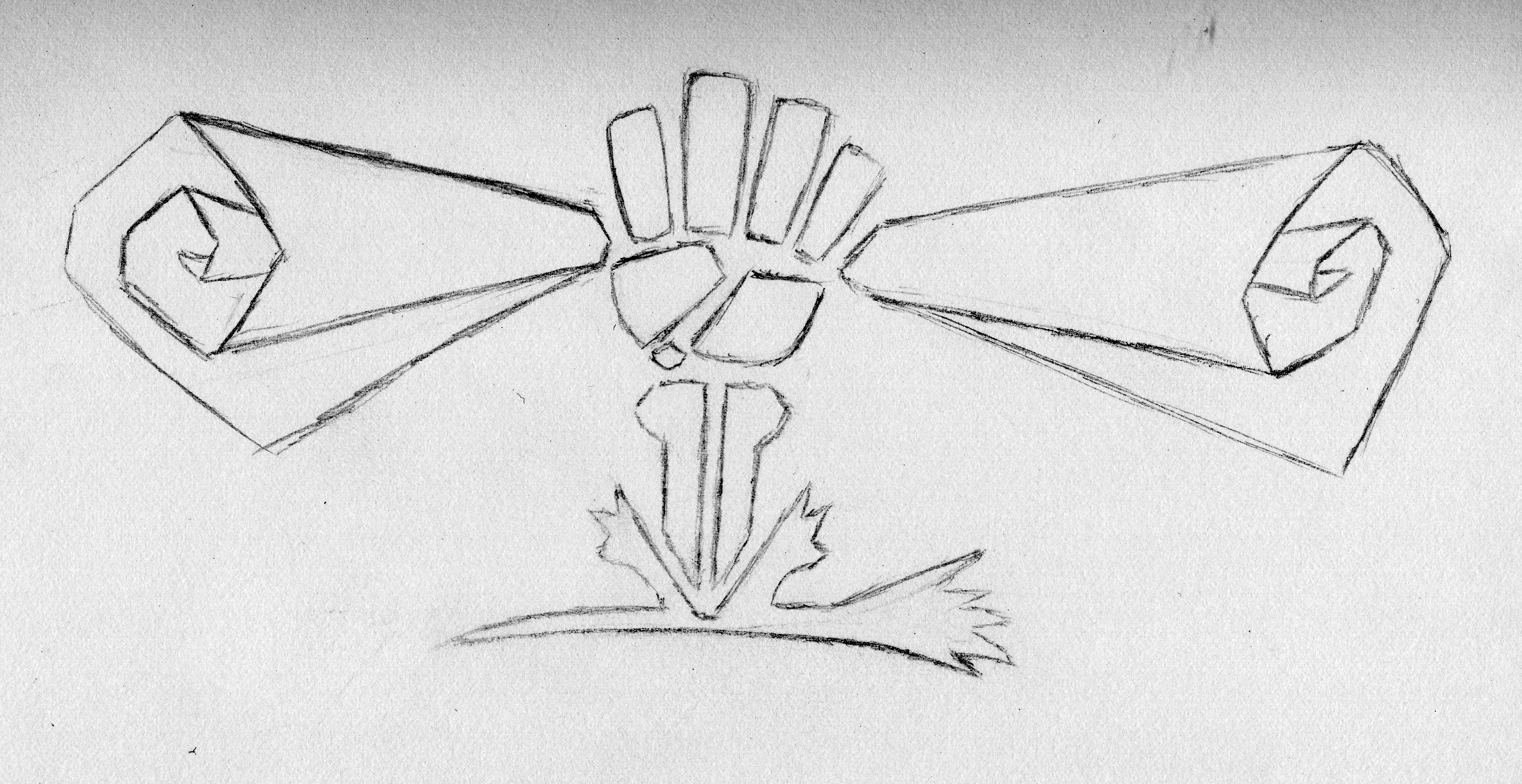
Revenant Publications Logo
The original RevPub Logo

This is the original Revenant Publications logo I designed by hand.  I knew this venture would need a brand of some kind and I had the concept early on, the fist punching through the earth, rising from the grave to reclaim creativity!  These are the lofty goals of RevPub and made for a simple logo graphic.

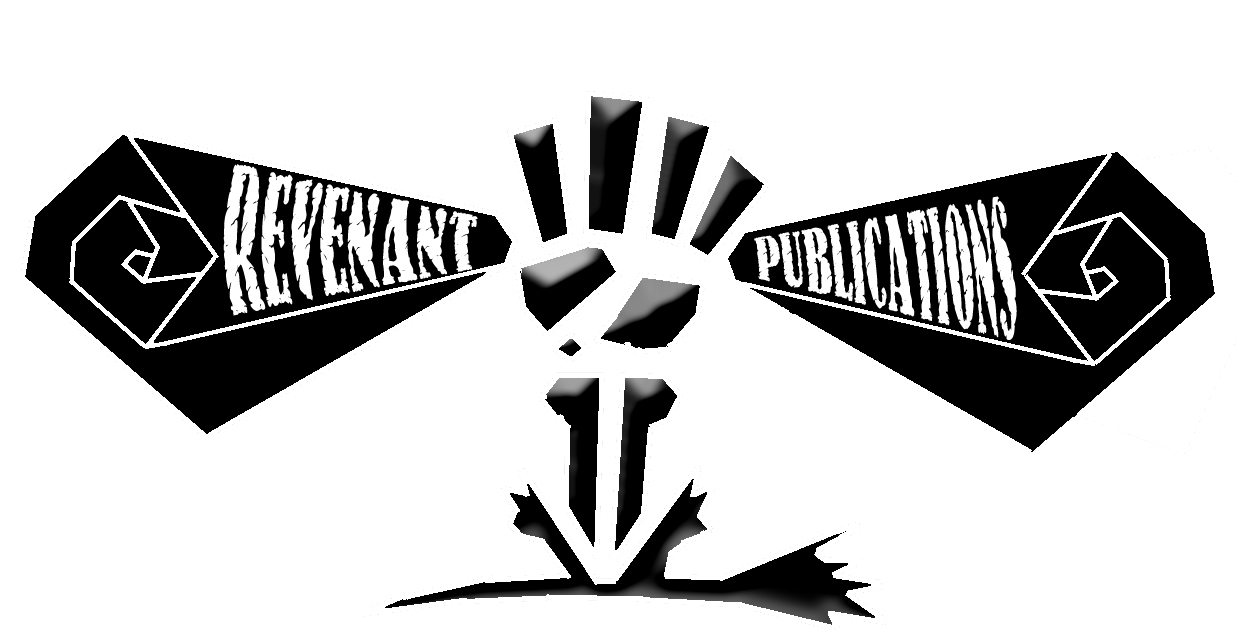
I eventually took this drawing through vectoring software and created a messy vector that was virtually useless.  I designed it again in Photoshop to create this:

Revenant Logo in Photoshop
Photoshop isn’t designed to do logos as well as Illustrator. The final version can be seen in our header!

Even for objects best done in software, where clean lines can be created easily, polygons can be made sharp, and objects lined up perfectly, I still start from paper to create something new.  It’s been an interesting progression to take designs from the page, through one software, then through another.


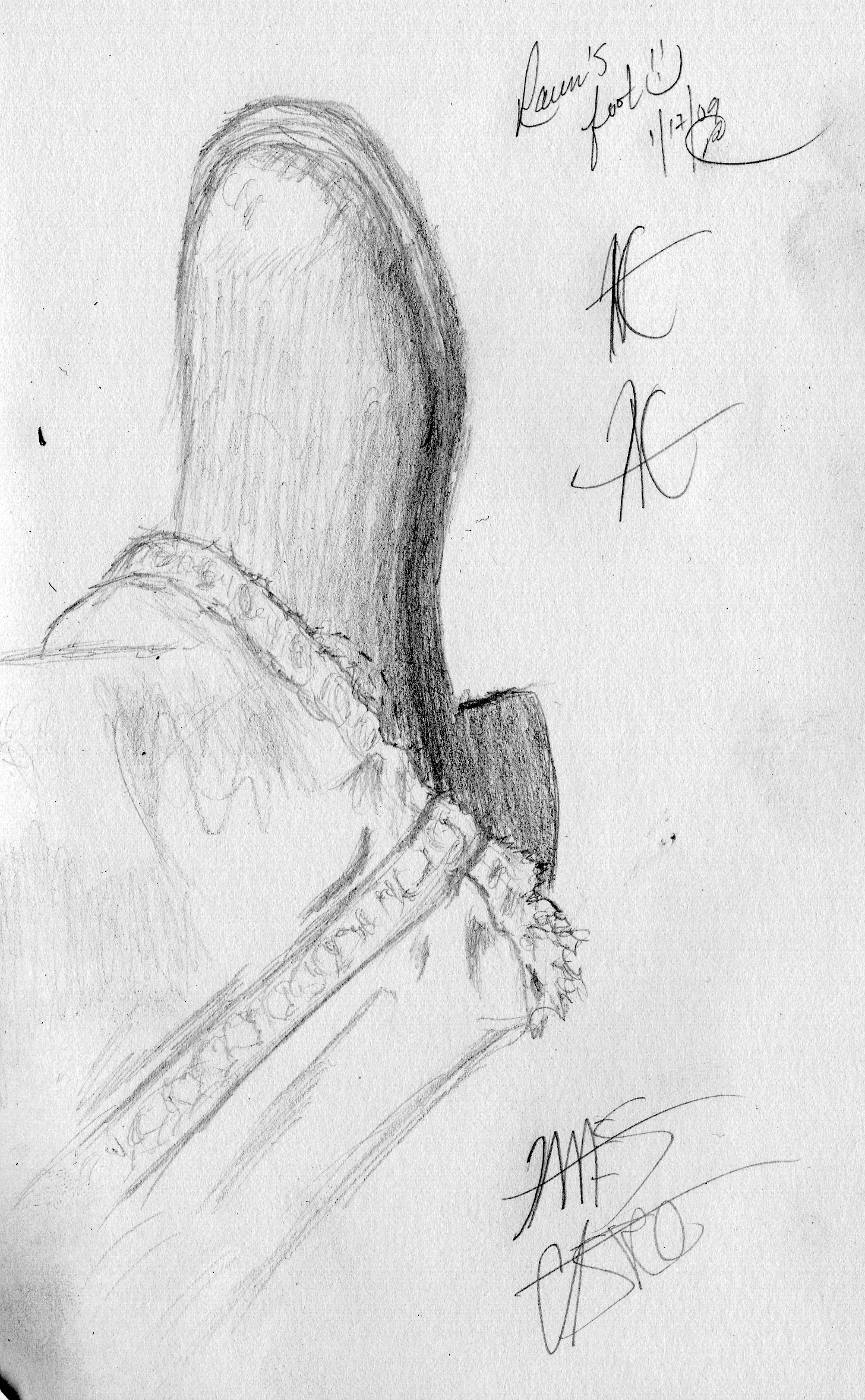
The last drawing is a bonus.  Back in 2009 I was in the midst of a creativity drought and the other half of RevPub was determined to prove that it was something I could easily overcome.  So she told me to draw anything and suggested her boot.  So that’s what I drew.  It took a little while to completely break down the creative block that stood in the way of actual production, but this began the process.  And it represents the first of many recent collaborations, the most important of which is this blog!

Raven's Boot
That’s Raven’s boot alright! She even signed it for me!

Writing for Web: Style

Beethoven had style. He was one of the most famous composers and pianists in the world, and I quote a dear friend who said Beethoven was, “the heavy metal of classical music.” This week I attended Beethoven’s Ninth Symphony at the Schermerhorn Symphony Center and was inspired to tie in the experience into this week’s topic.

Style is different from grammar. It’s not about comma rules and parts of speech, it’s about consistency and professionalism. Felder advises Web writers to create a style guide or use a well-known one. Which style you use depends on your audience, but I recommend the following:

The Associated Press Stylebook and Briefing on Media Law (for articles and reviews)

The Chicago Manual of Style (for articles and reviews)

MLA Handbook for Writers of Research Papers (for scholarly writing or research-based projects)

The Elements of Style (creative writing or any of the writing types above)

This may seem like a hefty list of sources, but pick one and stick with it. However, proofreaders should be fluent in all of the above to make themselves more marketable and knowledgeable.

So why is style important?

Imagine sitting in the symphony hall. The musicians and chorus members are wearing whatever they could find. Some are in sweatpants, others in gowns, some are wearing bright neon shorts, and others have flashy jewelry. The audience is so distracted by the performers’ attire they are not able to focus on or appreciate the music.

This is what readers experience when reading content with inconsistent style. In one sentence you may see website, in another Web site, somewhere else 7, then seven. If you are inconsistent, your readers will think you are indecisive and unprofessional. Where there are inconsistencies, there is chaos.

Now imagine the symphony hall where the female musicians are in white tops and black bottoms, and the men are in tuxedos. The chorus above them is dressed all in black, and everyone is performing in perfect harmony. You not only have organic flow, but the main focus is the music not the wardrobe.

Most companies need and have a style guide to keep readers focused on the content and product. This also shows you care about the content, therefore, you care about your audience’s ability to understand it.

Another topic Felder discusses is personal style. This is important because you want your readers to connect with you. So, before you start writing, answer these questions first:

1. Will you use text lingo? Will everyone know what the emoticons and acronyms mean?

2. Are clichés okay? What age group are you targeting? Will they understand the meaning if you use them?

3. Is profanity acceptable? Many writers agree this is only okay in creative writing and projects.

4. How will you address your audience? Will you write to them or about them? For example: one must write well in order to succeed OR you must write well in order to succeed.

Once you address the questions and start to create a style guide, you are ready for the world to see your personal style. It doesn’t matter how cool, trendy, or professional you are; if your readers have to work to understand you, they won’t come back. Remember to keep it simple, and make your content the best it can be. We can’t all be Beethoven, but we can show our audiences we care what they think.

Off the Artboard #1: Byte Me

Since my previous post ended up being a brief novella due to the desire to express my inexhaustible love for Dragon Warrior I thought I would use this as an opportunity to be more graphical and less textual.

This concept came from my friend Ron Peaks at my day job who thought “You can megabyte me” would make a good t-shirt.  He’s a comedy assassin; the humor always comes from nowhere and slays you instantly.

I made these graphics based on the concept and thought (since I go back far enough) it would be amusing to see the history of “bytes.”  These images used several different techniques in Illustrator, two used 3D effects, two used the perspective tool; they all used various combinations of polygons, shape-builder, and gradients.  They represent a lot of what I learned in my first two months of dedicated Illustrator-ing, were fun to create, and made for nice bright graphics.

So here they are!  He was correct, they probably would make good t-shirts…

Kilo Byte Me
With 5.25 Inch Floppy Disk!
Mega Byte Me
With 3.5 Inch Floppy Disk!
Giga Byte Me
With DVD!
Tera Byte Me
With a Hard Drive!
2D Formats
These were the base graphics I created to build the logos. It was fun to revisit the all the various storage media of my past…

Writing for Web: Writing Succinctly?

For the first time since reviewing Writing for Web, I disagree with much of what Felder discusses in chapter 7. Reviews and discussions wouldn’t be as interesting if we agreed all the time 🙂

In the chapter Writing Succinctly, Felder explains her tips for achieving tight, easy-to-read content that your audience will enjoy. A few of her tips suck the fun out of using language, and if you follow these tips 100 percent, your writing will read like a book report.

I assigned a win or fail rating to each tip as you go through these. They are all important, but use your common sense and own style. That’s what’s most important.

Tip 1: Stay Focused

Win – Read your content and ask yourself, “What does that sentence mean?” You will feel the flow as well to ensure you’re not rambling.

Tip 2: Be Positive

Fail – If we were positive all the time, the world would be boring. Some of the best content, movies, art, etc. are not positive and provoke debate. Sometimes you have to be negative. Where would the Internet be today if people were always positive?

Tip 3: Trust Your Reader

Both – Don’t over explain something or break down every sentence. Although, in technical writing you have to. You know your audience, so trust your instincts.

Tip 4: Choose Anglo-Saxon Words

Fail – Felder recommends using simple, one syllable words over French or Latin/Greek counterparts. For example you would use ‘end’ instead of ‘finish’ or ‘conclude’. This takes the fun out of the language, and if your writing is clear and entertaining, it doesn’t matter what words you use. If you fine-tune your work for meaning and intent, your audience will understand and appreciate it.

Tip 5: Eliminate Excess Words

Win – Take out unnecessary words and find shortened words. Read your writing aloud, and you will hear what you can cut/change. Examples are: that, got, has gotten, all of a sudden.

Tip 6: Keep Verbs Alive, Cut Adjectives and Adverbs

Win – Avoid ‘to be’ verbs. Review the post for Chapter 2 if needed, and remember that descriptive words are not always needed, nor do they make your writing better.

Tip 7: Don’t Use Arrogant and Snooty Words

Fail – Some words Felder uses as examples are: indeed, certainly, of course, and exactly. These are not snooty words, and writers who use these are not trying to be better than their audience. Keeping these words may not tighten your writing, but if you lose your voice or personality, what’s the point? Just be yourself.

Tip 8: Avoid Happy Talk and Sales Pitches

Win – Don’t be over-the-top nice or try to sell your readers. If you follow tip 3, you should trust your readers to see through you and think you are fake. People want to enjoy reading, not feel like you are trying to buy or patronize them.

Tallied up, the score is 50/50, and I will continue to use ‘indeed’ and ‘question’ if those words fit the bill. Don’t forget, you are the final judge.

Life Lessons Learned from Video Games #3: The Dragon Warrior Skill Set

During my early NES days I considered platformers and action games to be my favorites.  I bought nearly all of my games used from a local hobby store and only ever got new games for Christmas or my birthday.  Contrary to popular belief, the price of games has always been high.  It’s only gone up with current generation games and then only $10 up from the glory days of NES and Sega Genesis.  Because there was no internet and I didn’t have any magazine subscriptions the only way I could find out about games was from other kids talking about them or renting them from the local video store, The Video Place, which is long defunct and had a limited quantity.  Because of this I never owned some of the most popular games of the time.  Despite my love of platforming games and action games I never owned Super Mario Brothers 2, Double Dragon, Ninja Gaiden, or Contra.  I did own Mario 1 and 3, Double Dragon 2, and Mega Man 2, but I also had some weird/bad stuff like Narc, the Predator game (based on the movie) and some from the now infamous LJN movie series, Nightmare on Elm Street and even worse…Jaws.  Since I didn’t know what was out, good, or popular, I went with what was familiar.  I liked Freddy so I bought the game.  Narc was cheap and available.  I loved (and still love) the Predator movie so I bought that one too (though it sadly didn’t work…talk about one disappointed kid…).  Not only did I go with what I knew, but I was also usually restricted by what the local comic book/used media store had in stock.  Often this meant buying obscure titles but sometimes I lucked out; like when I wanted a Game Boy for my birthday but they only had Game Gear which was both in color and awesome to the 12 year old me.  Another lucky find was Dragon Warrior.

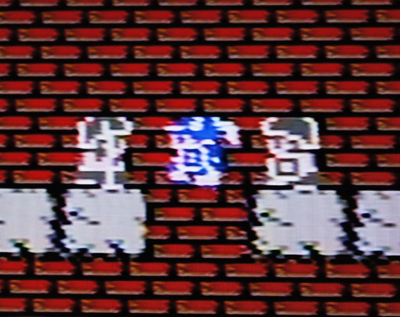
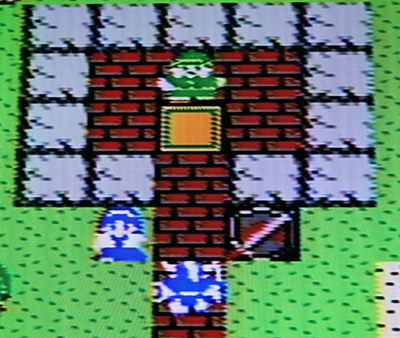
I bought Dragon Warrior (or Dragon Quest to Japanese fans) because I thought it was a Legend of Zelda-style adventure game, or hoped it might even be a Double Dragon 2 style beat ‘em up.  I played the hell out of Double Dragon 2 and hoped for something similar in a fantasy environment.  Shockingly, when I put the game in I saw the most rudimentary graphics I’d ever seen on the NES.  My character was a barely animated sprite.  Most of the game was text.  And then there was the game play…  Why am I talking to guards?  Who are these people?  Is that mass of blocks with the brown square a shop?  Is that smiling blue thing really a bad guy?  Is the ghost making a face at me?  Why don’t they move?  What am I doing?  Why doesn’t this damn bamboo pole do anything?!  Why is it in the game if it doesn’t do ANYTHING?!  These were my first thoughts on Dragon Warrior.  And I hated it.  Or at least I said I did.  But for some reason I kept playing it.  And kept playing it.  I had no idea what I was doing so I wandered randomly, kept fighting creatures, leveling up, and collecting money.  I died.  A LOT.  I wiped every couple of hours and was magically transported back to Tantegel Castle where I was robbed of my gold and forced to walk back to where I died where, if I was still too low in level, I would wipe again rinse and repeat.

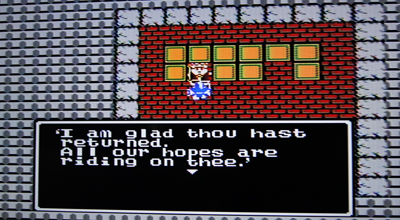
Dragon Warrior Castle
When I first played this game ye olde timey dialogue was easily mockable. It eventually grew on me to become some of my favorite video game text. Which is good…since most of the game is text…
Guards in the Castle
“Who are you people?! Why do you keep repeating the same unhelpful advice ad infinitum?!” That accurately expresses my initial feelings on NPCs in Dragon Warrior.

Because I didn’t play any of the table-top RPGs I had no concept of RPG conventions.  Character traits, character status effects, enemy levels, listening to NPCs, attack-misses, and running away…it was all a mystery.  So I wandered aimlessly for hours and hours.  I had no idea I was actually power-leveling and grinding.  Every now and then I’d come across a new town, village, or environment texture and was thrilled to see something new.  As I progressed further into the game I started to figure out the methodology.  I listened to all those guys who said the same thing over and over (and over and over) again.  I started following their advice, and found Erdrick’s Sword and armor and figured out how to defeat the Golem.  It was immensely rewarding to easily best the Green Dragon and save Princess Gwaelin and get my status updates by using her “love.”  There was nothing more satisfying to a young gamer than to eventually grind your way (on purpose!) to the Dragonlord’s Castle.

The fight with the Dragonlord was harrowing.  I remember my heart pounding in my chest as the music came up and he changed from a warlock into the massive dragon.  Beating Dragon Warrior was by far the most memorable video game victory of my youth.  In most games of this era, once you figure them out you can beat them quickly and easily again and again.  This was the first game I ever played that required as much toil to beat again as it did to beat it the first time.

It is still the best RPG I’ve ever played.  Its simplicity and design taught me patience in gaming, strategy in tactics, how to listen to characters, to pay attention to the surroundings, to remember details, and even how to “trick” the game to make things easier.

Shop
Yeah that’s a shop-pe. More specifically a weapons shop-pe. You can tell from the little sign. Simple and clear!

Modern RPGs have abandoned many of Dragon Warrior’s “slower” tendencies.  Most of them now play more like action games to compete with flashier titles and more instantly gratifying games.  Everything happens quickly, fighting is rarely turn-based, and few necessary story elements require serious problem-solving.  To me (and yes I’ll show my age here) there is something far more entertaining and rewarding about going through a game line-by-line to dissect the correct course of action.

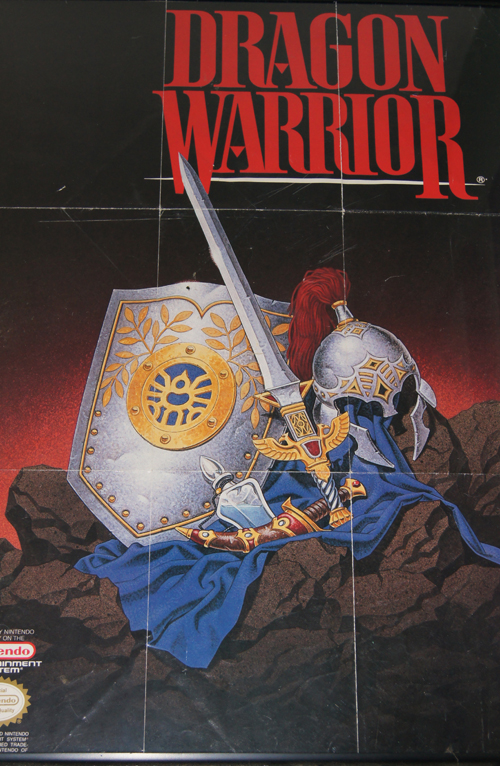
As was stated in my “Value of Life” post, success and failure meant something in this era.  Often it meant starting over from the beginning (or in this case the beginning place which was punishment enough based on how slowly you moved…)  This required you to get good at the game.  It rewarded you for your progress with little short cuts, power ups, and story elements.  Even in the many Dragon Warrior remakes they’ve removed many of these elements to make it a “faster” more “friendly” game.  Give me standard NES Dragon Warrior any day.  There’s a reason I still have my original poster (with map on back!) framed on my wall.

It’s still my favorite game of all time and perhaps the one that taught me some of the best traits to add to a gaming/personality skill set; patience, attentiveness, strategy, problem-solving, plus text swordsmanship/”HURTMORE” spell mastery.  If you get the chance, break out the cart and play it.  Even today it might teach you a little something.

Dragon Warrior Poster
My original Dragon Warrior poster. I thought it was lost forever and found it folded in a book. It’s hanging in a place of honor next to my High School Diploma and College Degree In many ways it represents my entertainment media education!

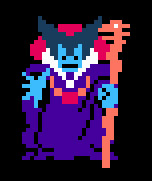
Just don’t join the Dragonlord…seriously…don’t do it…

Dragonlord
“Join me for instant game over…”