Life Lessons Learned from Video Games #4: A Love Letter to Old School Sega

Though I have very little time to just kick back and play games like when I was a kid, I still follow the culture and play when I can.  I do have a current-gen PS3 but I find the most joy playing the games from my youth.  As I said in previous posts, I started with an Atari PC (and was roundly mocked by all the Nintendo kids), but eventually got an NES for Christmas.  I loved the system and played its games religiously.  Nintendo was so dominant, I didn’t even know what the “Sega Master System” was until I got a Sega Game Gear and it came with an attachment that let me play Master System games.
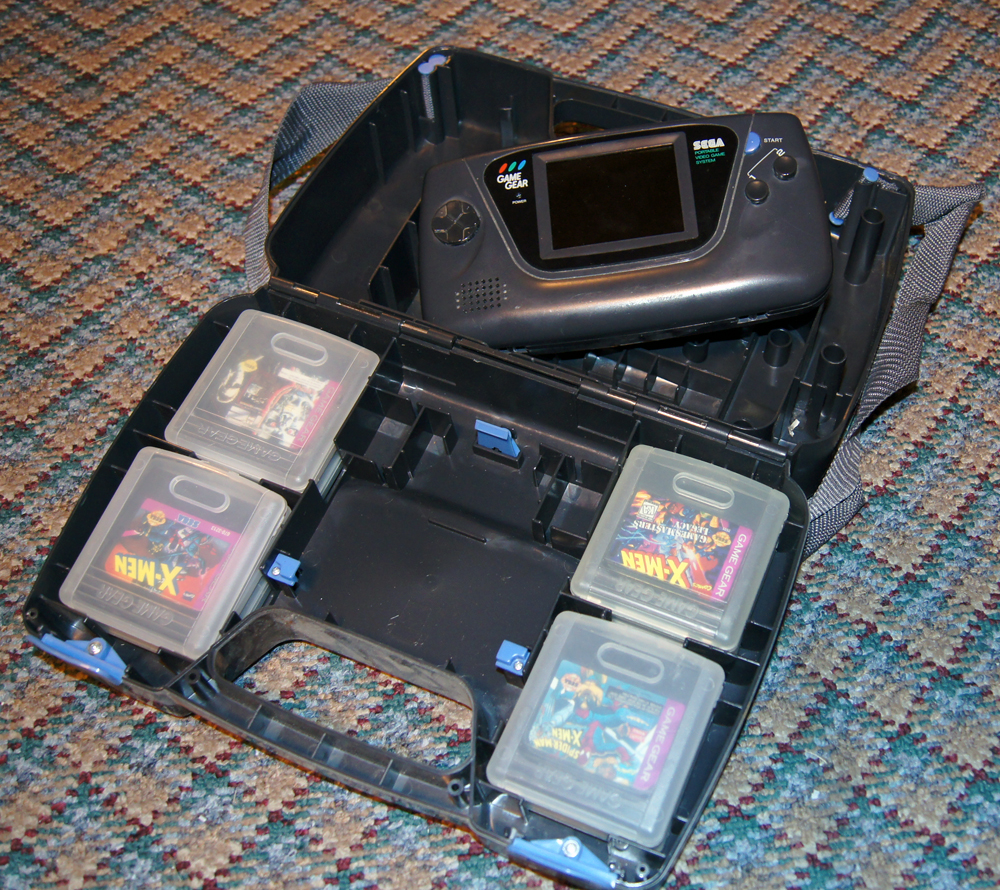
Game Gear
This IS my original Game Gear. I fell in love with Sega after playing it.

Shortly after acquiring my Game Gear in the early-mid 90s I discovered the Sega Genesis.  Unlike many, I don’t recall ever seeing the “Nintendon’t” or “Blast Processing” commercials.  I do remember seeing Sonic the Hedgehog and Streets of Rage 2 on the demo unit at Target.  The Genesis looked cool and the games were a lot of fun in the store.  I was sold.  I pawned my NES, all my games, and used some birthday money to buy a Sega Genesis (with Streets of Rage 2 included!!)  I loved the system, and began a rabid support of Sega.

Genesis Games
NES fans…I have nearly every great, classic NES game…and I think this collection is every bit as classic and no where near as complete…

In the early-to-mid-90s gamers were divided into Sega people and Nintendo people…I was a Sega person.  I played the fighting games, the Mutant League games, I LOVED the Genesis Shadowrun, and fought viciously with those who compared SNES franchises and graphics.  I so supported Sega I got a Sega CD one Christmas, and a 32X the next.  And I even enjoyed those systems.  I played and beat Sewer Shark; I was obsessed with Sonic CD and it remains the best Sonic game EVER in my opinion.  I had Doom on the 32X and a great little unknown game called Kolibri, a horizontal 2-d shooter where you and a friend can play as hummingbirds.  Don’t laugh…it was terrific…  I eventually bought the Saturn, which for its time was by FAR the best system out there.  It was well-supported and had great tech-specs, but lost out eventually to the N64, and eventually was crushed utterly by the new Playstation.  I even bought a Dreamcast…and only ever played Resident Evil: Code Veronica on it…before the PS2 did it in.
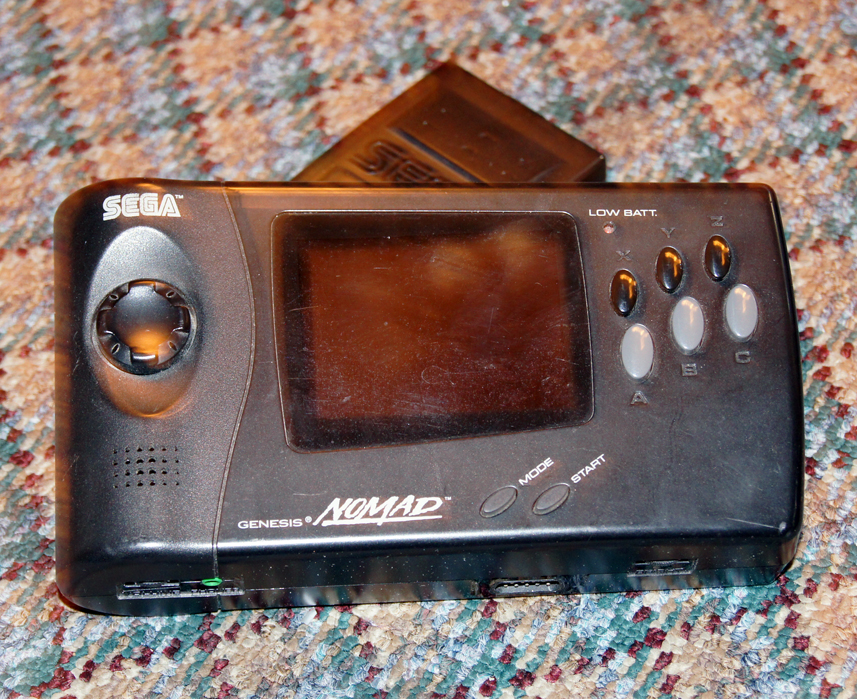
Sega Nomad
My handheld Nomad Genesis system.
Sega CDX
How I currently play my Genesis and Sega CD games on my TV. And a Slime PS2 controller. Because that’s where he lives and he’s photogenic.

Despite all their mistakes in business (Sega was obsessed with hardware and put games and software support secondary, blinded by competing with other companies they forever sought the “best tech” and rushed it out before the market was ready…barely supported it…then rushed out the next one and barely supported it) I have a lot of love for Sega.  After I set up my PS3, I played some Oblivion then, while filing the game away I found my Sega Nomad and spent the rest of the evening playing…you guessed it…Streets of Rage 2.  Still beat it too.  Sega lives in my gaming consciousness.  I still remember the Mortal Kombat blood code (Down-Up-Left-Left-A-Right-Down…memorizing codes from magazines in the grocery store…those were the days…), and playing as a raptor in Jurassic Park.  The GREAT X-Men Genesis games are still loads of fun to play and I still plan to invest time into eventually beating Shadowrun…if it’s possible.
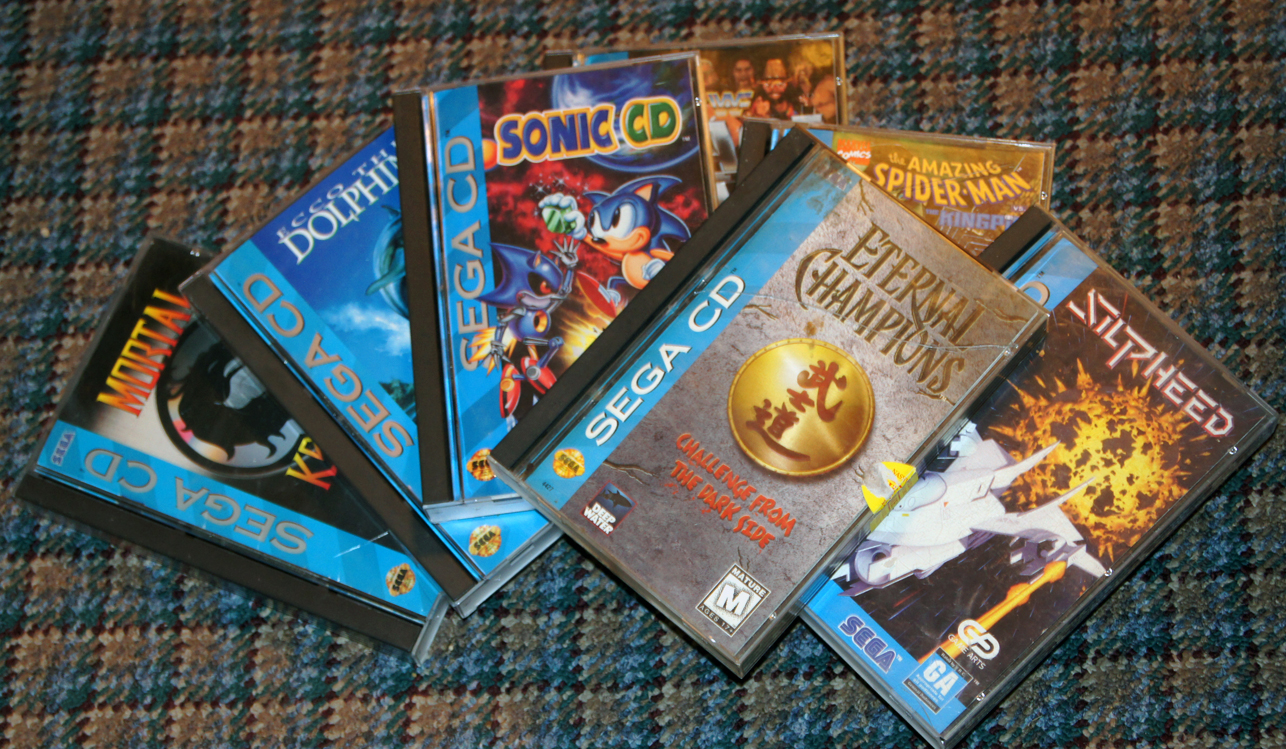
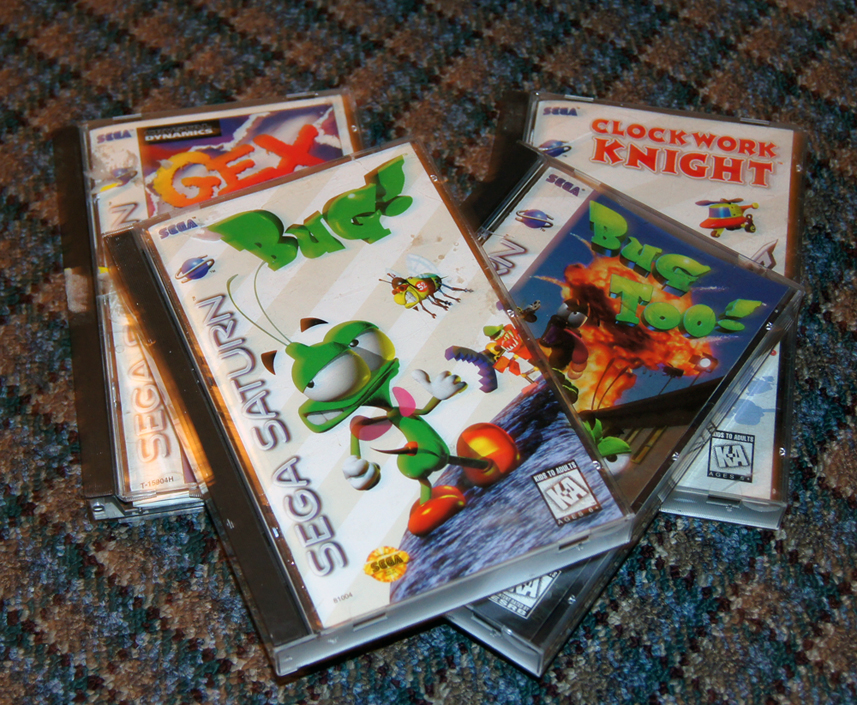
Sega CD Games
To all those who criticize the Sega CD I thought I’d produce a STACK of some great Sega CD games. This pile doesn’t even include the great Terminator game…
Saturn Games
Some of my Saturn games. I don’t have the Panzer Dragoons (though I beat the first one in high school) nor do I have the fantastic “Children of the Atom” X-Men fighting game. I put plenty of time in on that in the 90s too.

Sega is now in software only and is a shadow of its former self.  With the Sony vs Microsoft competition dominating the market now it seems like history is repeating itself.  Sides are being chosen, graphics comparisons are appearing in articles, libraries are being compared, and tech specs have appeared in countless posts and forums.  What seems to be lost is competition is actually good for the market.  I see posts on game sites where rabid fanboys declare their hope that their side puts the other out of business.  Does anyone think that would be good?  A monopoly on game technology would only reduce quality and innovation.  The Wii’s motion control and rapid sales incited Sony and Microsoft into motion controls as well.  The handheld war continues with new innovations like 3d, HD graphics, and wi-fi capability.  Social gaming has gone from a second controller and split screens to worldwide gaming.  I for one am hoping the “big three” continue to produce successful systems and franchises for several “next-gens” to come.  And here’s hoping that none of them, like Sega, become lost relics, sacrifices to the gods of greed and commerce.

But for now I say, long live the memory of Sega.  Plug in some 16-bit fun some time.  The Genesis is every single bit the great, classic console the NES is.  And I’ll GRAND UPPER anyone who says otherwise!
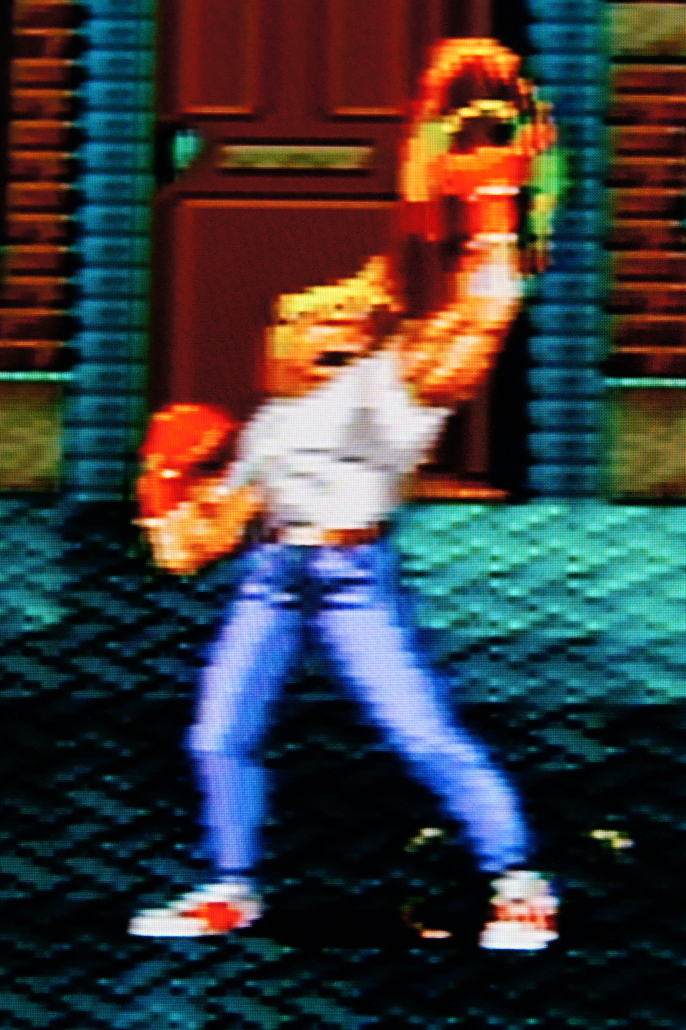
Grand Upper!
GRAND UPPER!  Forward-Forward+B. You can beat the whole game with this one…
Mutant League Hockey
And I don’t care who you are…this is AWESOME…

Writing for Web: Rhetorical Modes

Have you ever heard the phrase, “Write what you know?” Well, let’s challenge that advice. What’s wrong with researching something you don’t know and writing to learn about it and teach others? The important question is: What is your goal?

Chapter 10 discusses rhetorical modes: narration, description, explanation, and argument. These ancient ideas have worked for centuries, but how do you apply it to 20th-century Web writing? It is true that most writing crosses over into several modes, but practicing them separately will give you a better understanding of how they work and how they are effective.

In chapter 10, Felder repeats a lot of ideas from previous chapters, so it’s a little redundant. A better way to present this information is to define what your goal is, and use the rhetorical modes in order to accomplish that goal. If you’re not sure where to start, try these ideas from the chapter:

Narration – Tell the reader what happened. This is great for personal experiences, and try with who, what, where, why, and how?

Description – This mode explains how something happened. These are the nitty-gritty details that can either bore your readers or keep them wanting more. There is a fine line, so make sure you find a happy medium.

Explanation – This makes your writing easier to understand. This mode is more common in explaining processes, cause and effect, and used to compare and contrast ideas. Think simple. Your readers will understand your ideas and find you more credible.

Argument – Who doesn’t love a good debate? Whether it’s a political debate or an argument written for entertainment or discussion, arguments get people talking. Use this mode to persuade your audience to think on their own or side with a particular viewpoint.

Point of View

Another important topic in this chapter is Point of View. POV is very important, but not for reasons you may think. For example, have you noticed this post is written in second person? If so, kudos. If not, it’s no big deal because many people do not pay that close attention.

The important thing is consistency. If you bounce between I, you, and he/she, you will irritate your readers and lose their attention. Here’s a cheat sheet:

First person = I, me, we, our, etc.

Second person = you (Yes, I am writing to you the reader)

Third person = he, she, they, them, etc.

So, before you try only writing what you know, try a topic you know nothing about. Some ideas could be fly fishing, biotechnology, BASE jumping, fashion, teen movies, auto mechanics, sea dragons. Then choose your mode(s) and point of view, and see what happens! You will learn something new and teach someone else through your writing exercise.

And remember, it’s not what you know, it’s what you’re willing to learn.

Off the Top of My Head #2: How I Spent My Summer Vacation, Painting and Warhammer 40k

Off The Top of My Head

As I mentioned in a recent “artboard” post I’ve recently become interested in the intense, deep, gothic sci-fi table-top wargame and fantasy book series Warhammer 40k.  I love it.  The lore, the races, the strategy.  It’s everything I’m interested in all rolled into a compact expressive, creative package.

Admittedly I only became interested after playing the excellent Space Marine on PS3 (my favorite game of last year) and became more obsessed after I played through the Dawn of War series, read some Black Library books and an old 3rd edition rulebook from a local used book store.

Like Hans Gruber from Die Hard (maybe not the best role model…) I always enjoyed models as a kid but hated painting them.  All those tiny parts with horrible paint that never went on cleanly…  I just wanted to put my tank together.  Putting together Citadel miniatures has been a new experience.  Not only do I like putting them together but I actually enjoy painting them.  It requires a lot of focus, steady hands, and patience, which thankfully I do actually have (thanks to years of drawing and old-school gaming…)  Though I have a couple of battleforces in boxes ready to emerge onto the battlefield, I started with the easy-to-put-together miniatures that came with my starter paint set.

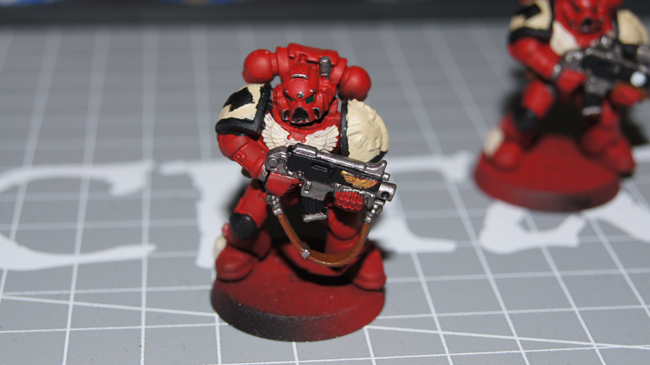
These guys were supposed to be Dark Angels but because I grew to love the Dawn of War Blood Ravens characters I decided to go with that paint scheme.  They aren’t finished (I haven’t put any wash on them and I plan to print off some chapter-specific insignia) but I thought I’d share my progress!

It’s my first time painting anything like this…definitely anything this small so there’s nothing but room for improvement but I’ve enjoyed it and I hope the future models will only get better.

Marine
This was the first guy I ever painted. I primered in Chaos Black, air brushed in Mephiston Red and layered from there!
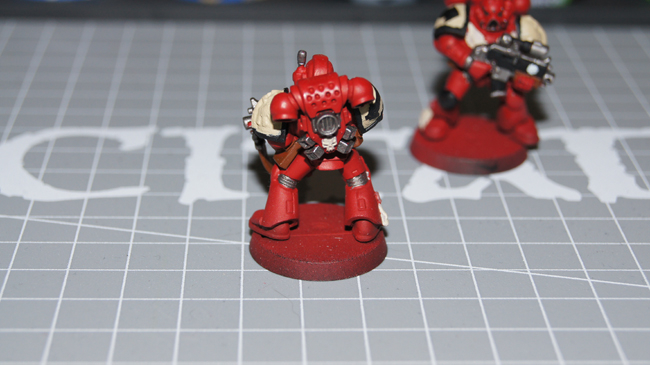
Marine Back
The backpack.

The Dawn of War series also introduced me to the Orks and I love those guys.  Their gruff, simple demeanor.  Their remarkably descriptive slang.  Their ultimately unruly appearance and junkyard tech.  Gotta love orks.  Because I’ll mostly be playing with myself (hey, you in the back, stop laughing.  Care to share what you thought was so funny with the rest of the class?) to learn the rules and get used to the complicated ins-n-outs of the game I bought Assault on Black Reach at a local hobby store and started painting the Orks as well.  Not only are they a lot more details in their equipment and appearance than vanilla marines, but they also present a lot of variety and possibilities in painting.  I’ve only painted some of them so far, but I feel my abilities and techniques have improved from what I did with the Marines.  They are still very beginner but I’m happy with them so far!

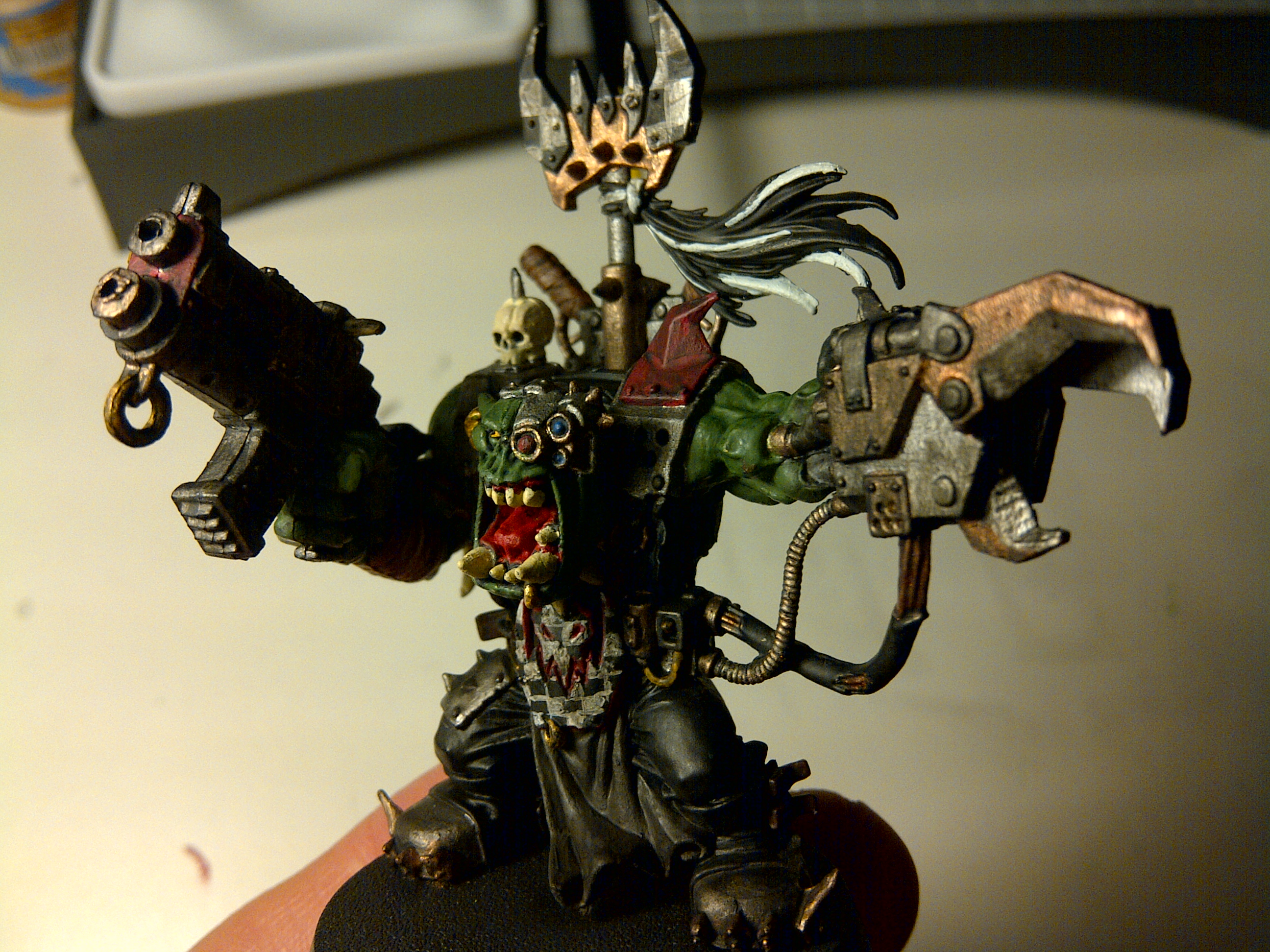
Warboss1
I didn’t follow the model in the Black Reach book and went my own direction on a few aspects, like the checks on his orky belt buckle.
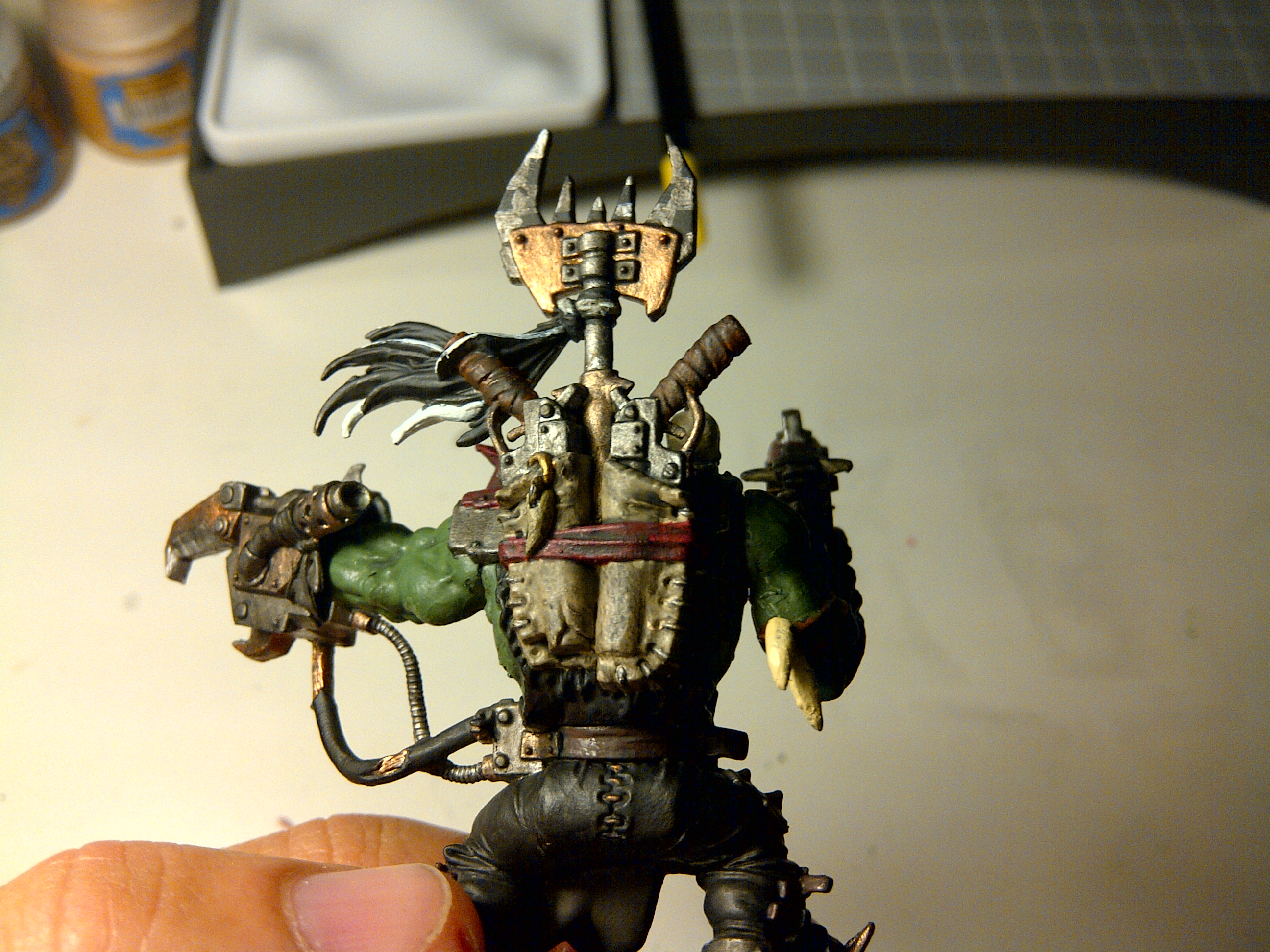
Boss Back!
The twin guns and boss pole on the back of the warboss. I used the new Citadel paints as well as a couple older ones. Then drowned them in Nuln Oil. I figure I’ll get the hang of shades by the time I get to my Zagstruk finecast…
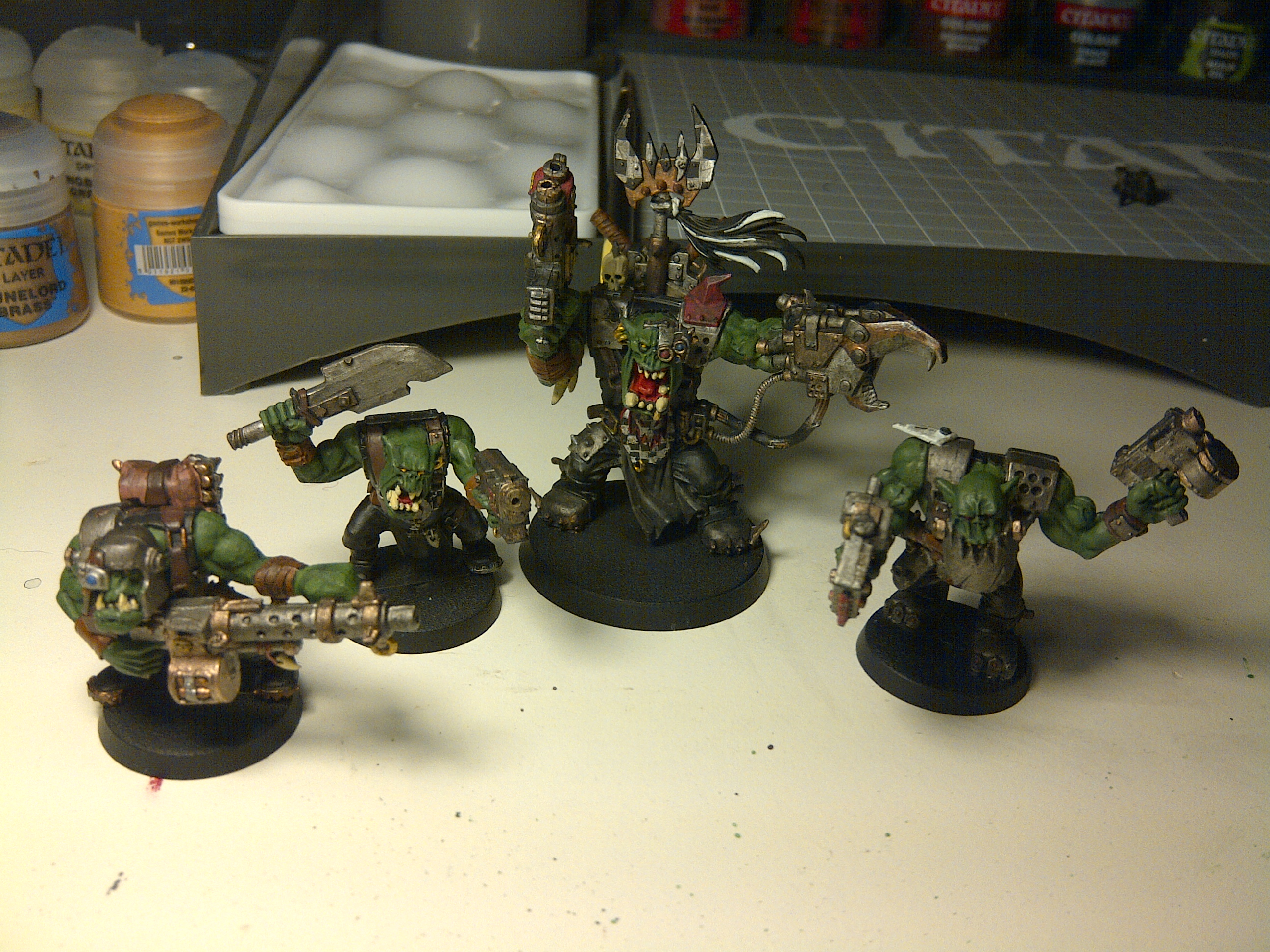
Orks Mob
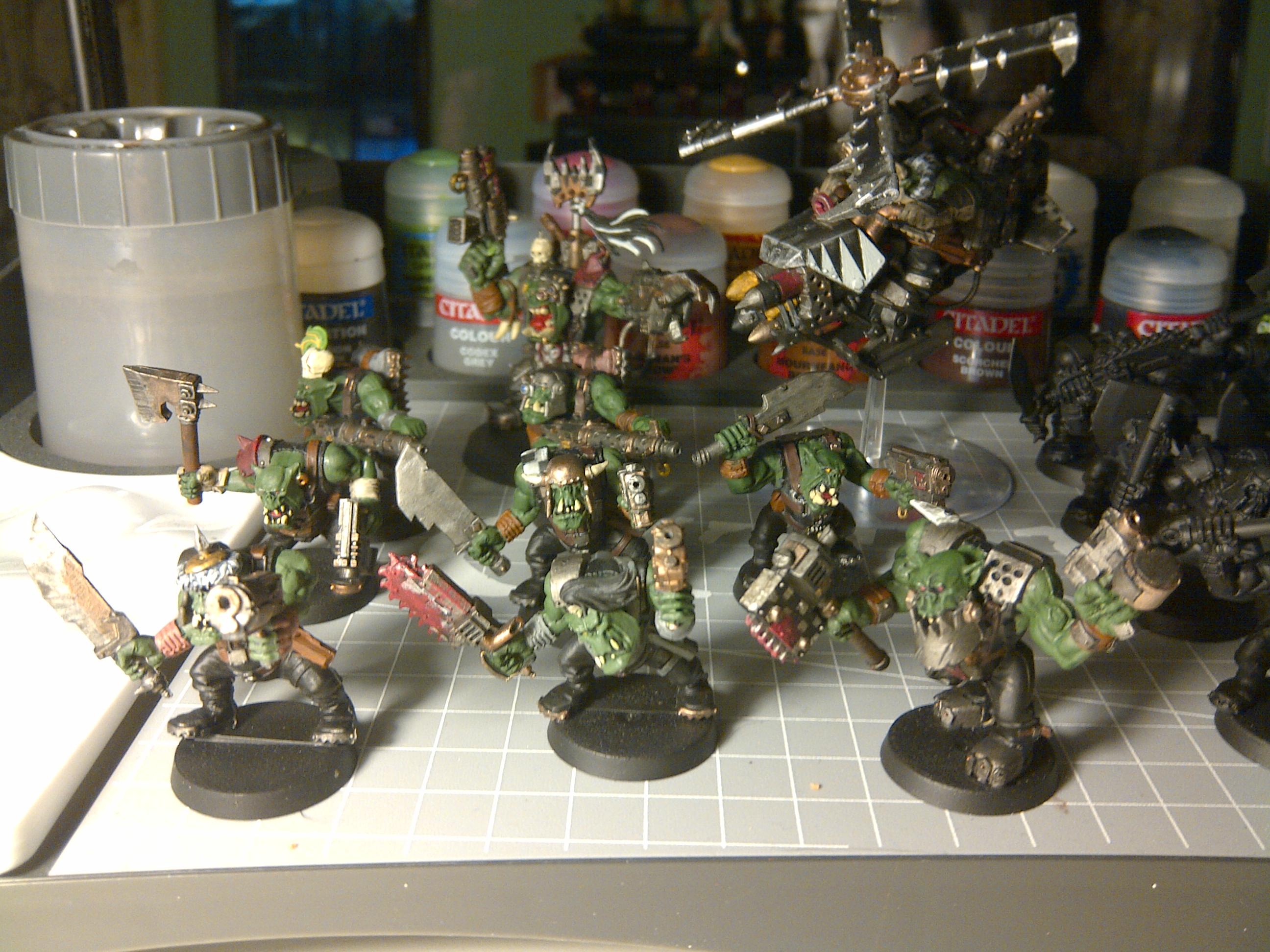
The start of my little Waaagh! The warboss, a couple of boyz (one wiff a big shoota) and a nob.  I decided to make them Goffs, not only for the color scheme but because I like the idea of a horde of infantry.
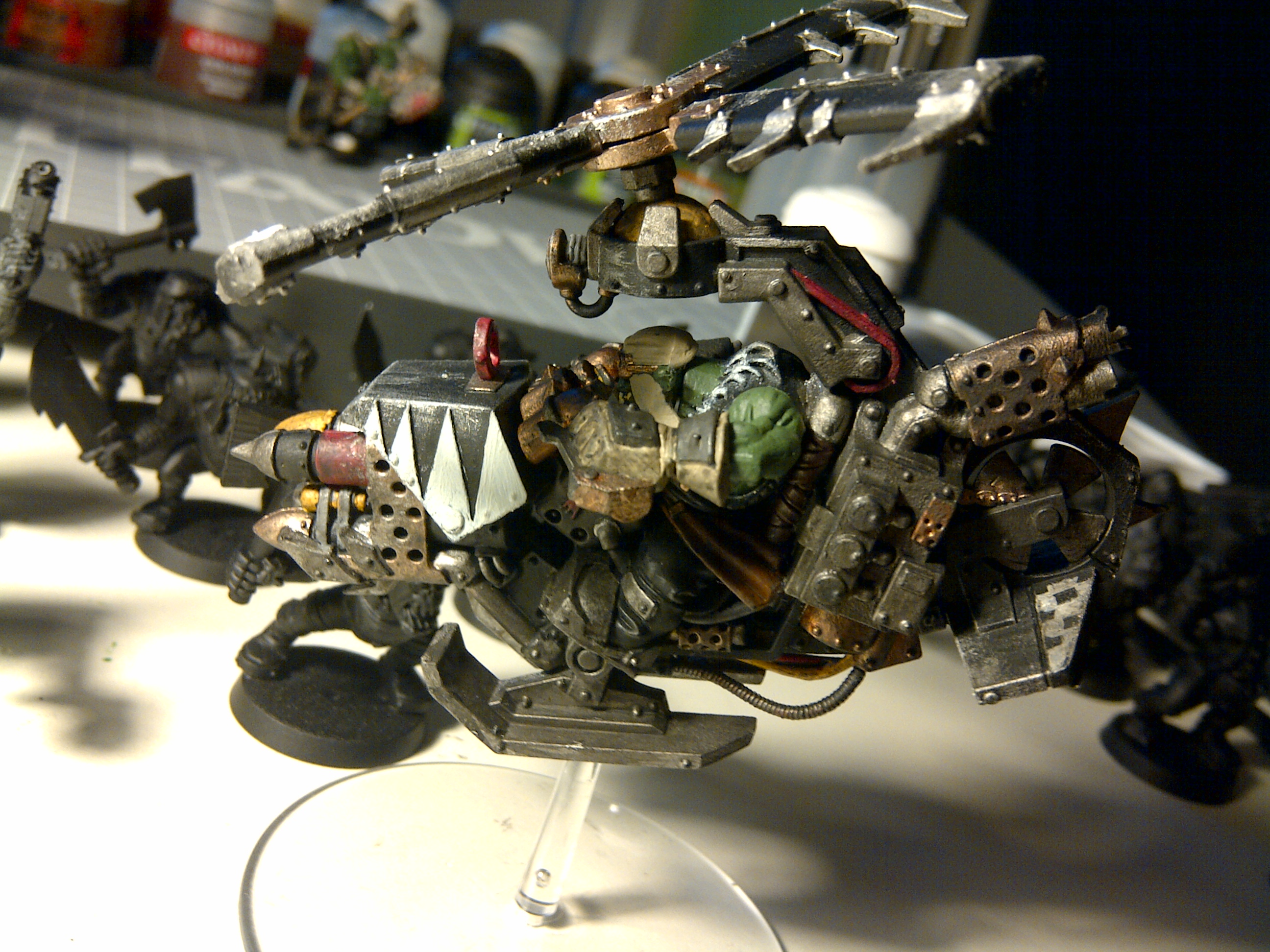
Deffkopta
The side of my first deffkopta. This one took some time and didn’t come out perfectly…but I was still pleased with my first vehicle effort.
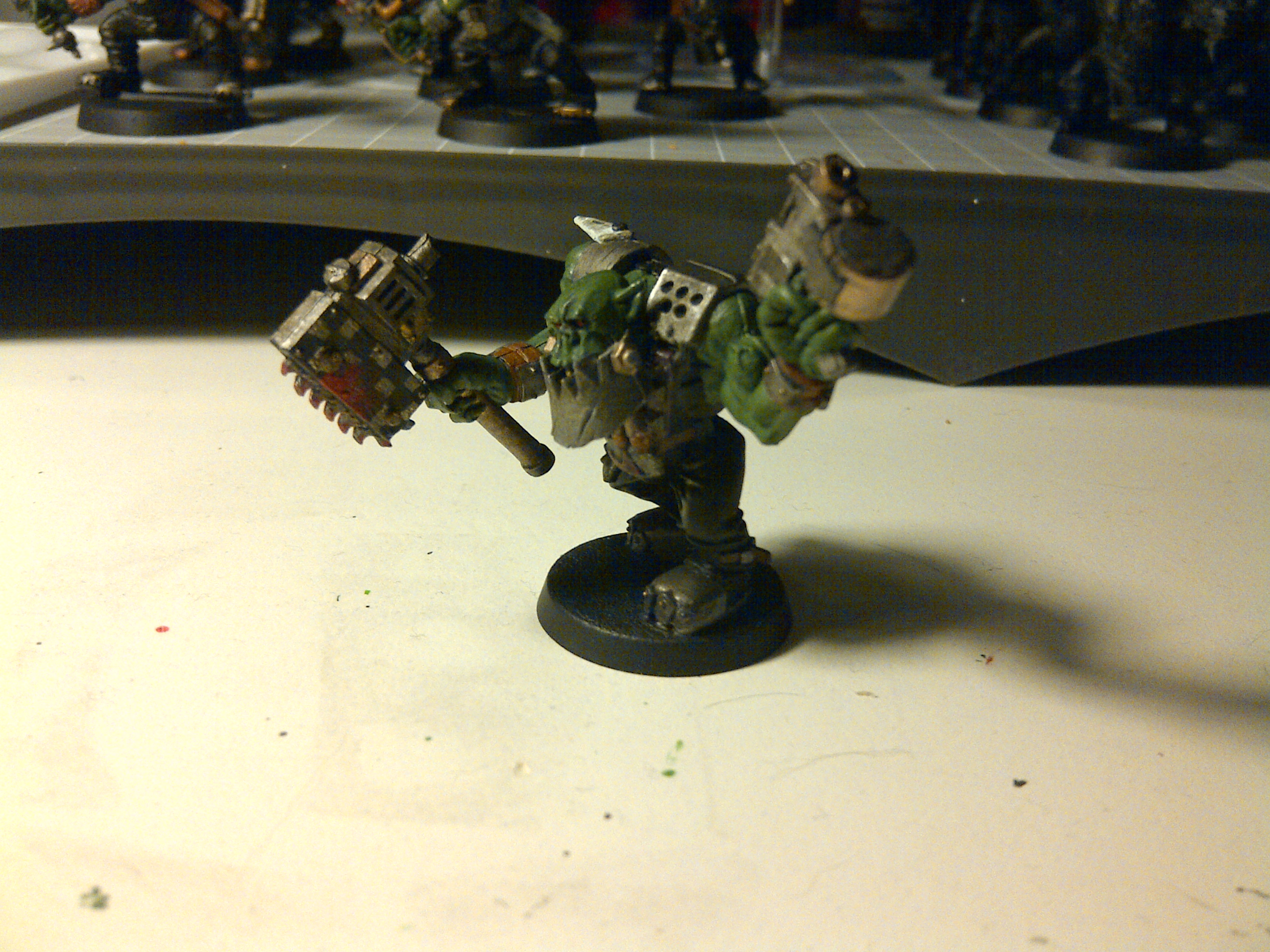
Nob
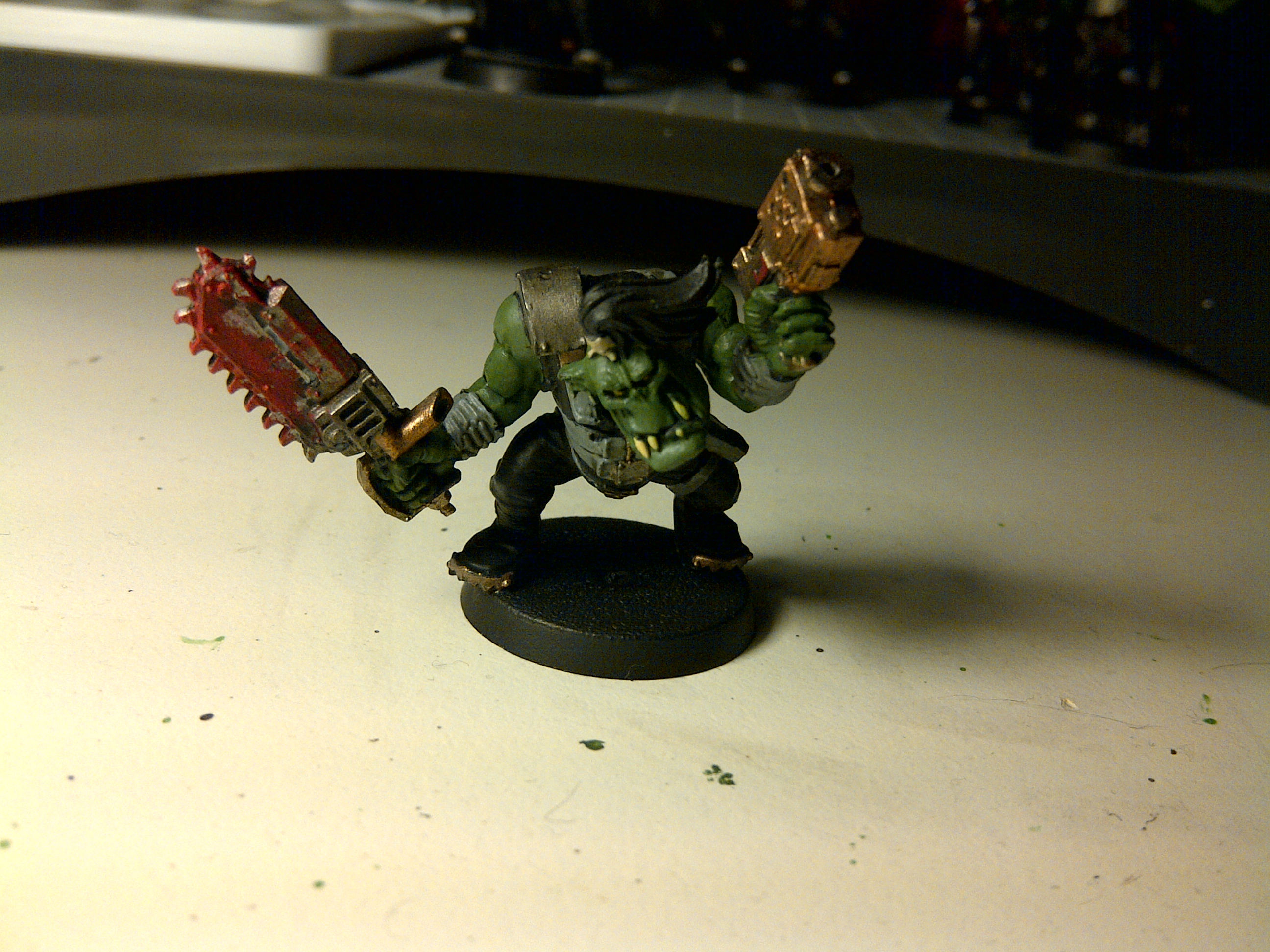
A pic of my Nob (you again? I said stop laughing!) It was the first chain weapon I painted and I liked the messy splatter effect.
Boy with Chainsword
Drawing inspiration from the bigger ork, I painted this littler guy up to match him.
Ork Horde
My Waaagh! so far.

I hope you enjoyed my first painting attempts.  As I go on and get a little more experienced I plan to share more.  Once I get into live firefights I’ll be posting on those as well!. It’s been a fun, and fascinating entry into the 41st millennium so far!

What I Learned from Independence Day

Inspiration hit again this weekend as I came across a movie I cannot resist watching: Independence Day. I have seen this movie dozens of times, and it gets better, and worse in some cases, every time.

I realized during this viewing that Independence Day was my first alien invasion film. It was my first “aliens are not our our friends and will kick our ass” Sci-Fi movie.

A lot of people may scoff because I had not yet seen classics like Alien, War of the Worlds, or Invasion of the Body Snatchers, but I loved slasher films and Pulp Fiction more than anything at that age. Independence Day actually inspired me to watch the other alien movies.

I remember seeing Independence Day and being mesmerized by the shots, the White House being destroyed, and it was during this movie I came to love Will Smith.

So, for a fun Sunday read, here’s what I learned and loved about Independence Day.

1. Special effects could look real. This movie sucked me in from the first strike to the final escape from the mothership. After the first assault, there was something so disturbing and admittedly cool the Statue of Liberty laying face down in the ocean. The effects were not over-the-top or goofy; they were almost too believable. I guess that’s what earned Independence Day an Oscar in 1997 for Best Effects, Visual Effects.

The Statue of Liberty lies face down in the ocean after the alien attack.
Photo courtesy of Pop Culture Ninja

2. Will Smith was awesome. I watched Fresh Prince with everyone else, but it wasn’t until this movie that I appreciated his smart/bad ass side. He punched an alien after taking it down and talked trash to it. You don’t get much cooler than that.

3. Bill Pullman is not a very good actor. No offense, I love him in this movie and While You Were Sleeping, but he forces emotion. The script was well written, but Pullman did not bring me to tears or make me pull for human survival. I love watching him, but I am convinced it’s his eyes and smile.

4. The world needs heroes. In this movie, there were regular people doing amazing things for survival. Who could forget Russell (Randy Quaid) telling his kids he loved them as he helped save the planet? Or Jasmine (Vivica Fox) trying to get her crew, including the First Lady, to safety? In an alien invasion, there are no super heroes, only real people.

5. Jeff Goldblum made being a computer geek cool. I wanted to block cell calls, decode weird signals, and help save the world. The Smith-Goldblum team was movie magic as they raced off to to the mothership.

6. Not all aliens are like E.T. These aliens were intelligent, huge, well defended, and not playing around. They were not cute, would use your body to take the planet, and they did not care. This movie showed with enough fire power, a city could be destroyed in a matter of minutes.

So, what do you think? Where does Independence Day rank on your list of Sci-Fi alien movies? It may not be a Sci-Fi/horror movie, but it’s a good action flick that makes you realize we’re not as tough as we think.

Off the Page #2: The Weird World of Oz

Off the Page

There have been a number of projects with which I’ve been involved that haven’t really panned out.  Reasons for this vary, from simple lack of enthusiasm to too many similarities to other projects.  Most of the time I can take these ideas and wrap them into the creative concepts that will pan out, but this is one that kind of dead-ended.

The premise came from my friends and frequent creative collaborative partner, Brandon Combs who is now pretty busy with Glitz and Grime.  During one of our many editing/review sessions he brought up how twisted the Wizard of Oz story really is and how much fun a darker, psychotic version would be.  We planned to use his unconventional story-telling and my artwork to create a graphic novel using the base story and producing it.  Unfortunately right after we began developing the concept “Weird Oz” hit everywhere.  McFarlane Toys began to produce it’s own line, various comics, books, and TV shows started to riff on it, and we both decided we would like like we were the soft, backing iron on the blade instead of the cutting edge.  So we dropped it.  Fortunately I still have the artwork and with the new “Oz: The Great and Powerful” film coming out I thought it was a good time to share:

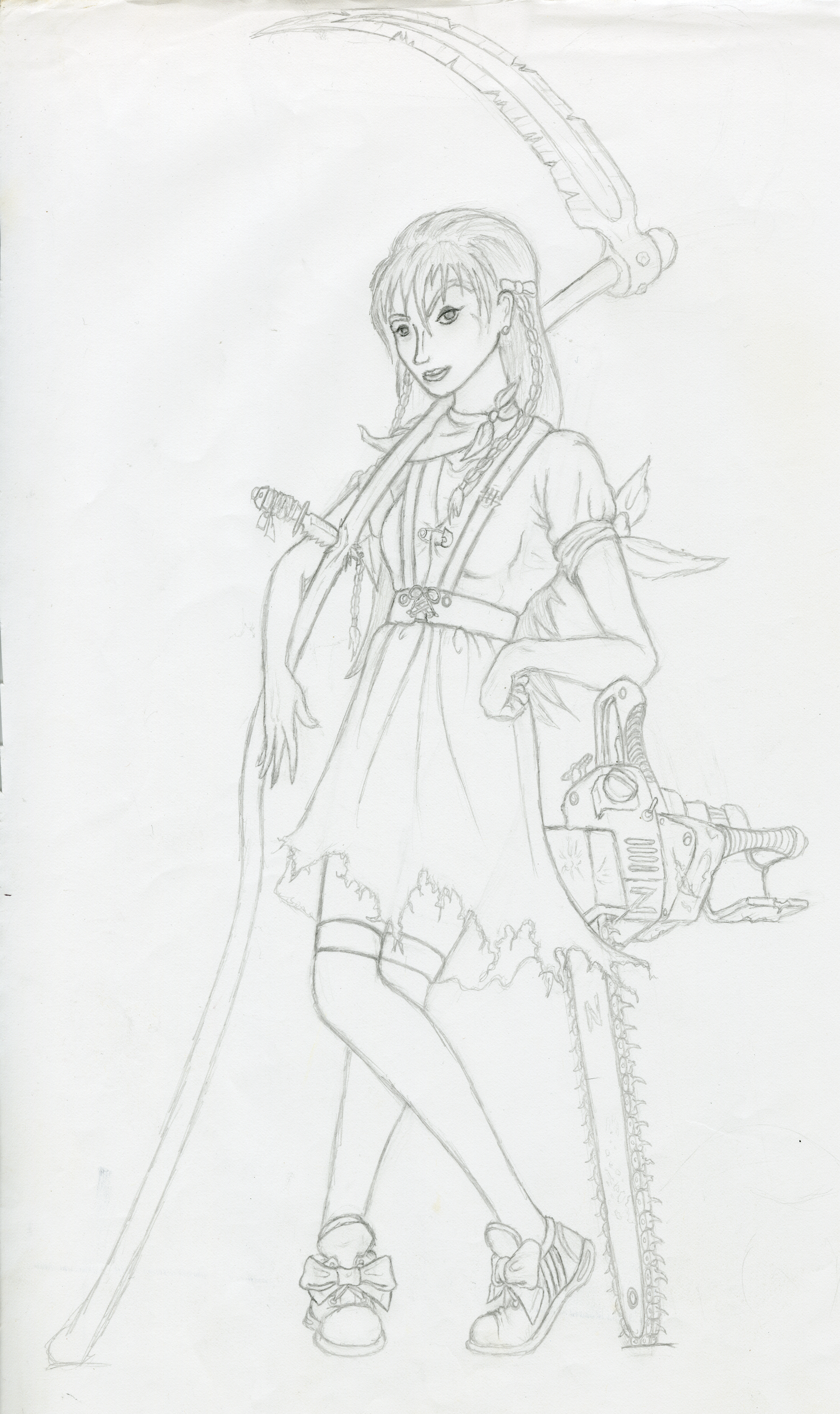
Dorothy
My Dorothy. I gave her “farm girl” weapons and Ruby Sneakers just to mix things up. I wanted her kind of hot-girl tough.
Tin man
This is my Tin Man. In this concept the Tin Man is made up of various armor parts that he finds and collects from enemies. His REAL body can be seen underneath sections of the armor and looks like iron bands. He would replace his “armor” sections during the story. Which sounds great but would create lots of problems if I had to draw this series for an extended run…  Oh and I. Hate. Chainmail.
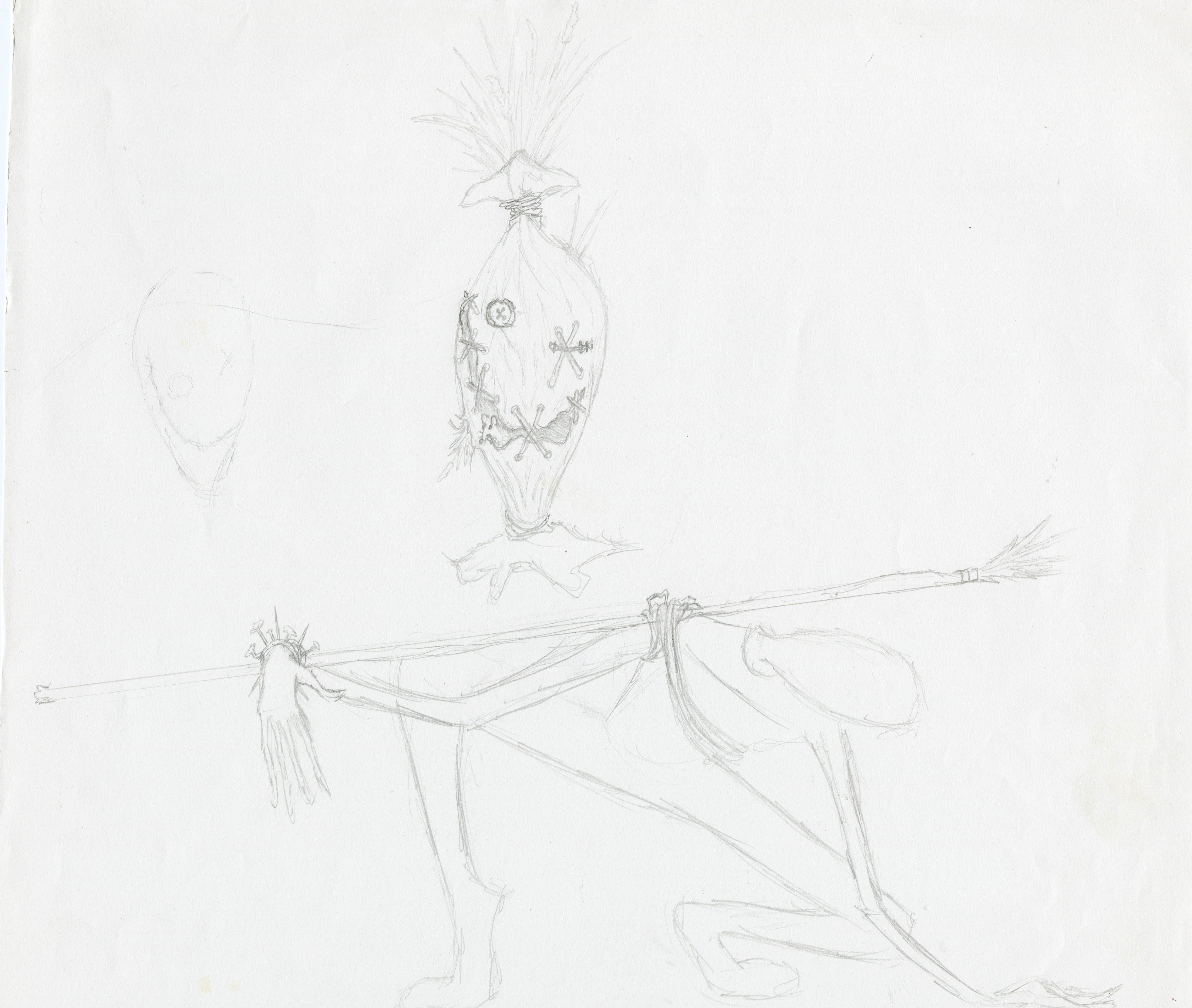
Scare Crow
I called him “Scar Crow.” It was in the midst of this drawing that we decided to nix the project. He was going to look like a torture victim, with that beam permanently tied to his body.

Maybe someday I can finish concepts on these just for fun, but I hope they still show that the idea was a little cutting edge when we came up with it!

Writing for Web: Telling a Story

Once upon a time there was a writer typing on a laptop while sitting on the couch. Or maybe at a desk or at a table in a coffee shop?

R. Petty with her laptop (in cartoon format)

However you write it, that opening sentence begins a story. It may lead to a fantasy land full of talking animals or vampires, or to a place familiar and realistic. Either way, it’s a beginning.

This week discusses how to tell a good story. I am not a creative writer, so this chapter was helpful as Felder explained tips on how to write a story. Of course there are the basics, such as plot, character development, and conflict, but I want to zoom in a little closer.

How do you start a story?

Many writers feel this is the hardest part. I know I do, and I will put a book down if I get 50 pages in and I am not interested. The beginning is just as important as the rest of the story and can make or break your content.

New writers may feel they have to set everything up before starting the action, but Felder believes this is a mistake. Her advice is to jump in! Start with a hook. These are the first two to three sentences that start your story, and here are a few ideas to help guide you through them:

  • An exciting event. Maybe you dump your reader in the middle of a race, a robbery, a love scene, or an adventure.
  • An interesting character. Someone who is unusual, someone who thinks unlike most people, or someone who a reader will immediately sympathize with are all ways to use a person as a hook.
  • Put a character into real trouble. Immediately, start with a conflict to create suspense.
  • If you haven’t developed characters yet, what about a strange event? An event that stands out and urges the reader to keep going to discover the outcome.
  • Many authors love to set a scene. This gives readers a chance to envision a world that may be different from their reality. Think Charlie and the Chocolate Factory or Narnia.
  • Love and learn the language. Don’t use the Thesaurus for evil just to replace words; think about how you want to say it. What do you hope to express with your opening? What do you want your readers to see? Set the scene without being too wordy and long-winded.

You may be wondering how this all applies to Web writing? I wondered the same thing, and unfortunately Felder only gives one example of how this applies: Your home page should hook your readers. As I read more, I realized this was it. So, I looked at a few other sites for ideas and discovered you can use a hook to start an article, short story, or simple blog post. And, you can use more than words. Your hook can be a picture, video, slide show, or podcast. In fact, with Web writing you have more options than in print.

So, as you think about your next great idea, think of a good hook. How will you draw your readers in and keep them coming back? If you’re struggling for ideas or just need inspiration, check out some of my favorite stories with solid hooks:

An Occurrence at Owl Creek Bridge

The Black Cat

A Little Cloud

The Lottery