Call it Cap: The Winter Soldier

The First Avenger was a great period piece about America’s first superhero in the Second World War.  The problem is you can really only tell that story once.  The big question hovering over the franchise after Cap’s unexpectedly terrific introduction was: where does the character go from here?

The answer, to the surprise of many, was a tight political espionage thriller.  With some shield-throwing tossed in for fun.

This isn’t freedom…this is fear

The most important aspect of the film is the character arc of Steve Rogers.  Typically seen as the biggest flag wavers in all of comic books, Captain America is profoundly misunderstood.  Something the Russo Brothers tackled in The Winter Soldier.  Captain America doesn’t represent the American government but the traditionally accepted values of its people.  Freedom being the most important.  And freedom gained through fear is not his idea of a perfect society; a concept that puts his philosophy directly in contrast to that of Hydra, who hope to co-opt the fear their plan will create into a new world order.  Their concept is freedom through fear and pain.

“If you want to stay ahead of me, Mr. Secretary, you better keep both eyes open…”

It looks like you’re giving the orders now, Cap

Once Hydra is revealed to be a parasite inside SHIELD it’s easy to make Captain America the hero standing up to the evil bullies the way he always has.  What’s interesting about his character, and what makes him possibly the most interesting Marvel film character, is his willingness to stand up toward “good guys” he thinks are being bullies too.  You see this in the conversation with Fury quoted in the first section.  You see it again when he advocates tearing the entire SHIELD infrastructure down; a scene in which he’s so convincing all of those present, including Maria Hill and Nick Fury, agree with him.  It’s the transportation of the skinny kid he was in 1941 to the present and the continuation of Dr Erskine’s last request that he always remain a good man.  He’s virtually incorruptible; but he does have weaknesses…

I’m with you til the end of the line…

In case you’ve been in cryo-sleep yourself for the last couple of years there is a spoiler here.  The Winter Soldier is Steve Roger’s best friend, Bucky Barnes.  In my comments on the first film I discussed how I thought Bucky’s character arc would go.  That he would become envious of the new Steve and this would lead him to villainy.  It turns out he was led to villainy but rather than be turned to the dark side by a selfishness it is against his will…and it is Steve’s unflinching loyalty to his friend is just another example of who he is, refusing to really fight back against him once he knows who he is.  Throwing himself on another grenade, figuratively this time, as he drops his shield against a super-powered version of Bucky who could very well literally beat him to death.  He’s the only link Steve has to his original life, but more than that it’s Cap’s best friend who never gave up on him so he certainly wasn’t going to give up Bucky.  Sebastian Stan’s performance also needs to be commended here.  Not only is the Winter Soldier menacing (he’s become my favorite antagonist of the MCU so far) but also sympathetic as you see what Hydra puts him through to maintain control of him.  Something expanded on in the next movie.

Before we get started…anyone want to get out?

Character work aside, this film has some of the best sequences in the entire MCU, standing up easily (though on a more personal scale, which works remarkable well) with the now-famous “Avengers Assemble” scene in the first Avengers film.  The opening battle on board the Lemurian Star (“Was he wearing a parachute?” “No he wasn’t…”); the ferocious close quarters combat in the elevator; and one of the best car chase sequences that isn’t in Mad Max Fury Road (though ironically containing another “Fury”) as Sam Jackson’s Nick Fury races his way through a massive assassination attempt.  Couple all that action with more terrific character sequences; the “On your left” scene introducing Anthony Mackie as The Falcon (a breakout character for sure); Steve meeting with a 90 year old Peggy Carter and seeing all the emotion he still has for her; Cap and Widow on the run a segment filled with multiple peeks into their characters and bolstered by the fact that the two actors know each other well and have actual chemistry; and the marvelous scene with Arnim Zola (“First correction, I am Swiss.”) all add up to one of the best action thrillers in recent memory, out-Bourne-ing Bourne movies at every turn.

“It kind of feels personal…”

Winter Solder still may be my favorite MCU film (though the third installment of te franchise is a close race).  It’s a perfect continuation of the original, an advancement of the characters and concepts, a major movement in the entire narrative, and just a great film on its own.

Next week a pair of mini reviews as we look at the Captain in the Avengers films.

Call it Cap: The First Avenger

In the hands of lesser creators Captain America: The First Avenger could be a cheesy, jingoist, propaganda film about a true-blue hero who goes through the motions of gallant cliché and beats up bad guys while draped in national colors.  Because it was made by people who not only understood the character but seem to love what he is, it turned out to be not only a great superhero movie, but a great period movie, a great war movie, and a great character piece.  The last point is really what made this film shine.

Chris Evans as Steve Rogers

Many of us first met Chris Evans in the original Fantastic Four movie but we didn’t really appreciate what he could do until his terrific performance as skater Lucas Lee in Scott Pilgrim vs the World.  I won’t go too far into Steve Rogers’ character, as last week’s post pretty much covered it, but Evans’ performance as Steve Rogers is pitch perfect, maybe even out-shining Robert Downey Jr’s Tony Stark due to the nuanced complexity of the Captain’s persona.  He has to be tough but gentle, ferocious but innocent, and passionate but not obsessive.  You catch just how impressive Evans is during a scene where he’s watching his own propaganda movies, his sheepish smile insinuating both pride and embarrassment, without a word of dialogue or broad action.  I can’t see anyone else as Cap now, and I can’t imagine the MCU without him.

Hayley Atwell as Margaret “Peggy” Carter

Peggy Carter could have been a cop-out character.  I actually expected her to be.  Met during his early training (while he was still a 95 pound recruit), I assumed she would be either a hard-bitten, no-nonsense, tough girl…OR…she would be a virtually useless, damsel in distress love interest.  In most difficult fashion Peggy Carter is neither, is a bit of both, and is one of the best characters I’ve seen in a while.  For some reason (I’ll go with laziness) writers tend to write “tough” female characters in a certain way, giving them the dull traits of toughness and stoicism.  Peggy Carter markedly does not do this.  She’s a woman, she’s tough as can be, but she’s also still feminine and doesn’t mind putting on her red dress any more than she minds donning combat gear.  She’s not a master sniper (for some reason a lot of tough female soldiers are master snipers…I have no idea why) but she’s a whiz with her pistol and doesn’t mind rushing in to the raids herself, Tommy Gun in hand, to blast some Hydra super-soldiers.  She’s no-nonsense in her job, but it’s insinuated she does know how to have fun, and her persona is one of someone who is damn good because she’s worked to be damn good.

The writers had a narrow path to walk with her and I’m amazed they pulled it off.  The problem is that you don’t want Agent Carter to suddenly warm to Steve only after he becomes the 6’2” 240 pound Chris Evans.  It would make her seem shallow and quite unlikable.  Instead the filmmakers worked in subtle hints that Peggy Carter actually fell for Steve at the same time her fell for her, when he was still a frail, good-hearted kid just wanting to change the world.  You see this in her final moment of the film, where she finds a photo of little Steve in his training dossier.  In the later Agent Carter One Shot you see she has that picture in a frame she keeps with her.  NOT any of the macho news reel pictures of Captain America, but the little, noble kid who just wanted to stop the bullies.

Atwell’s performance (even if I hadn’t developed a major league thing for her during the course of this movie) is stunningly impressive.  A personal favorite piece is during a moment of levity; Howard Stark asks Peggy if she’d like to get a “late night fondue.”  The now enhanced but still socially awkward and painfully innocent Captain America asks, “So do you two…fondue?”  And her response, again just in her expression, communicates bemusement, confusion, and flattery (she can tell he’s a bit jealous or disappointed) all at once.  It’s great stuff.

Sebastian Stan as James Buchanan “Bucky” Barnes

Bucky Barnes is another character who could have easily fallen into the worst chasm of film cliché.  When he was introduced I arrogantly mapped his entire arc: he is Steve’s friend and protector but once Rogers becomes Captain America he’ll become jealous and resentful, eventually turning on him in the end and becoming some kind of villain.  I think the fact that none of that happened the way I thought it would is a most impressive part of the movie.  Barnes, at first, represents everything Rogers wants to be, good-natured but strong in his convictions and has the physique to do something about it.  Once Rogers becomes the Cap, Barnes at no point expresses any resentment of anger toward Steve.  This is, in part, because of how Rogers is portrayed; as described last week, he’s just a good guy and Bucky knows it.  So when Rogers comes to rescue Barnes and his fellow captured soldiers it’s Barnes who genuinely leads the “let’s hear it for Captain America” cheer.  The banter he and Steve share during his rescue is wonderfully genuine and he joins the Howling Commandos because he’s following “that kid from Brooklyn too dumb to back down from a fight.”  The only moments where Barnes shows a tiny bit of (and I hesitate to even use the word) “envy” is when Rogers’ gets the girls’ attention instead of him (though he makes a genuine joke about it, clearly holding no ill-will toward his friend) and when he tries to use the Captain’s shield, the latter more a sign of self-determination (“I can do this!”) than actively trying to show Steve up.  Barnes is a great character and the next film just reinforces how great he is…

Hugo Weaving as Red Skull

A great good guy needs a great bad guy.  Unlike Loki, Ultron, or Maleketh Red Skull is not a misunderstood or seemingly and justifiably bitter.  He’s just bad. He’s bad bad.  He’s “too evil for the Nazis” bad.  He is perfectly created in this story as Captain America’s antithesis.  The serum brought out his worst qualities turning him into an even bigger monster, yet he still fervently insists that he has “left humanity behind.”  Weaving has a talent for making characters hidden behind masks express far more than they could have.  There isn’t any over-complicated depth to the Red Skull; he has no ambitions beyond using his power to dominate the world.  And only wishes to do so because he is a selfish bully, exactly the kind Rogers wants to stop.  In what could have been a one-dimensional character, Weaving makes the Red Skull a fully formed being, driven by the base cruelty, but three dimensional.  It’s just that all three dimensions are, well…BAD.

The supporting cast also helps establish the world, Tommy Lee Jones as Colonel Phillips, Dominic Cooper as Howard Stark, and even a nice cameo by Natalie Dormer.  And this colorful cast is what makes the world of First Avenger feel authentic.  Yes the costumes, surroundings, and set dressing help keep you invested but it’s the characters that make you believe you’re in the 1940s.  And also almost make you forget this is a Marvel Comics movie about the hero with the biggest Boy Scout reputation this side of Superman.

It’s a testament to the character, the actors, and the franchise that the next installment of Captain America would be drastically different but still maintain its heart and stay true to the character while catapulting the narrative into exciting new places.

Call it Cap: Why Captain America is My Favorite MCU Character

Cap

I recently enjoyed an MCU marathon this weekend just to prep for Civil War and it occurred to me that not only, and completely surprisingly, are the two previous Captain America films my favorite sub-franchise in the MCU, but that Cap himself is also my favorite character as well.  Something wholly surprising.  I thought I’d take a look at why both he and his movies have become my favorites.

I’m….Captain America…

What makes the Captain and Steve Rogers almost unique in his films is his personality is entirely heroic.  In the first film Rogers is physically frail but has a hero’s heart.  He’s genuinely a good person, something that most superheroes and superhero movies lost sometime in the 90s.  I can remember in the original Men in Black Will Smith’s character mocking the rigid, goody-two-shoes soldier as “Captain America.”  A term that has been largely pejorative as angry, anti-heroes started to co-opt the protagonist landscape.  The idea of the “truth and justice” hero was passé and viewed as simplistic.  Heroes needed to be dark and laconic; almost as bad as the villains to be “cool.”  There was a movement in all of entertainment to shift from the classic “babyface and heel” dynamic (god help all of us who remember the “Attitude Era” of pro wrestling…) to ALL heels, just some are fighting with us and some against us.

It’s a mood that has both carried forward and evolved as films have.  Look how dire and cheerless the Christopher Nolan Batman movies were compared to even the abstract mind of Tim Burton’s.  Even Marvel’s character, who are by-and-large a lot more dynamic (meaning capable of more than two emotions often displayed in DC movies, those being misery and rage) tend to have these traits.  Let’s just look at Rogers’ fellow Avengers at the end of Phase 1.

  • Tony Stark is a chaotic, self-obsessed narcissist who, while lovable, is also capable of profoundly selfish and bad decisions.
  • Thor is literally a god who did some growing up in his first outing but managed to remain a bit of a bull in a China shop man-child for a lot of his story lines.
  • Bruce Banner is simmering with mass-destructive rage, so much that he can be used by villains as effectively by heroes depending on the circumstance.
  • Natasha Romanoff and Clint Barton both filling in as socially mal-adjusted killer agents trying to juggle regular human life with decidedly non-regular daily activities.

Essentially they’re all deeply flawed people, “good guys” but the kind of good guys we’re used to seeing nowadays with mixed motivations and lurking dark sides.  Even the Guardians of the Galaxy, who I adore, are all maladjusted outcasts ranging from thieves to murderers, whose negative personalities are mitigated through the humor of the storytelling and their charming personality quirks.

Then there’s Steve Rogers.  We know from the first film he selflessly wants to volunteer for combat in WWII, specifically in the unit in which his father served and died in during WWI.  His motivations are clearly stated as “men are fighting and dying, I got no right to give any less.”  He’s beaten up for his early attempt to stand up for what’s right, even if it’s just to shout down a movie heckler, and throws himself on a grenade during training.  You get the impression that there is a sadness lurking in Rogers and that maybe he’s eager to die heroically after losing his parents and being the little guy in a big mean world.  His obsession with inadvisably joining the army and even volunteering for an experiment with potentially catastrophic consequences shows he has kind of a “nothing to lose” attitude.  And that could have been the “dark side” motivation assigned to him by a lesser team of filmmakers.  There is, however, one statement that proves this aspect of Rogers’ character to not be his main impetus.  So what does drive the First Avenger?

I don’t like bullies…I don’t care where they’re from.

When poignantly asked by Dr. Erskine if he wants to go kill Nazis this is Steve Rogers’ response.  He’s been a victim of bullies.  He doesn’t have a desire to kill them, or even to fight them, he just doesn’t want anyone to get pushed around.  That sentimentality doesn’t change from when he’s a scrawny fellow being punched in an alley to when he’s a super-soldier going toe-to-toe with an entire rogue Nazi Science Division.  And what a sentiment to have.  Having been the little guy he’s always just wanted to be the one standing up for the little guys and through the narrative gains the ability to do so.

Dr Erskine reminding Rogers that no matter how powerful he may get he HAS to remember to be a good man. A message as powerful as “with great power comes great responsibility.”

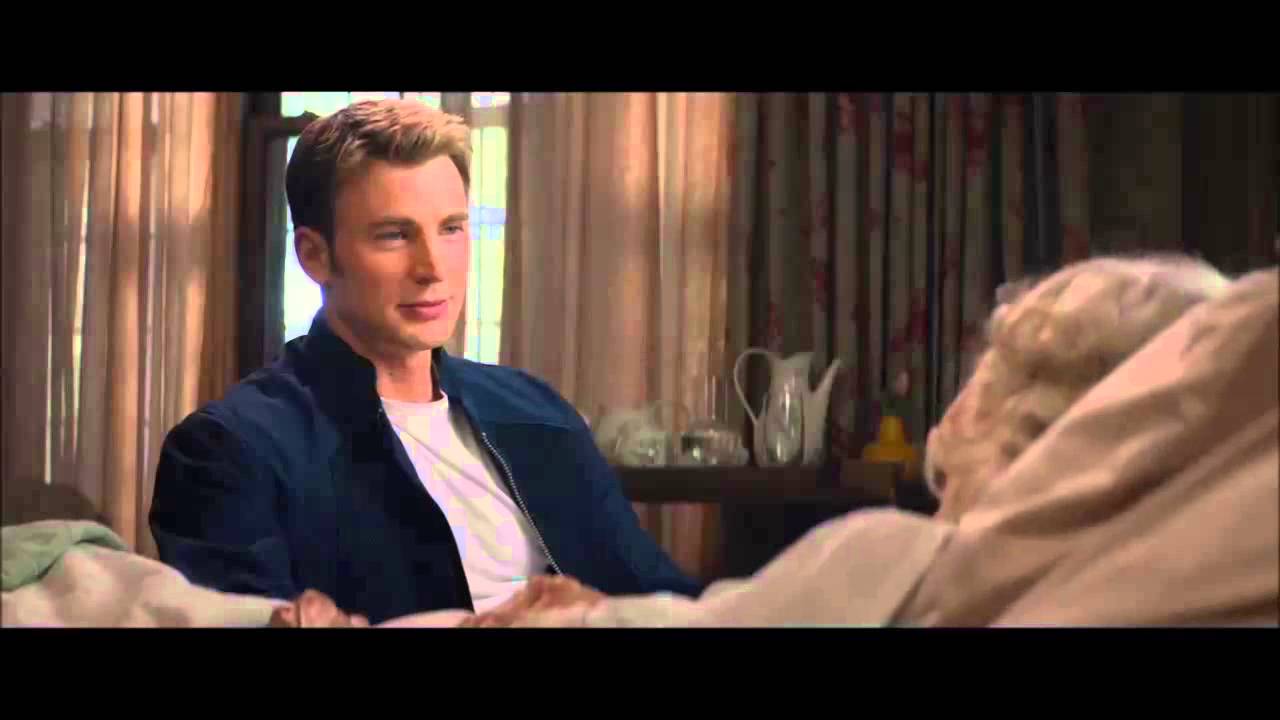
Rogers is an optimistic hero.  Not one born to be a hero or who goes through a startling 180 degree revelation that provides his heroic compass, like many of the other Marvel characters.  He starts with the moral compass and finally gains the power to act on it.  This isn’t saying he doesn’t deal with tragedy.  He’s an orphan, his mentor and the first person to really believe in him dies.  His best friend becomes a casualty of war.  He never gets his dance with Peggy Carter.  And yet…none of this tarnishes his beliefs or changes his motivation.  It would have been easy for him to chase down and ruthlessly kill the Hydra spy who kills Erskine, if it weren’t for the latter’s last request being a reminder to Rogers to stay a good man.  It would have been simple for his drive against the Red Skull to be motivated by vengeance for his fallen friend, instead he acts completely selflessly again to save the world not seek revenge on the bad guy.  Even though he misses out on perhaps the love of his life, it doesn’t stop him visiting her decades later and still call her “his best girl.”

The look on his face says it all. 70 years later she’s still his “best girl.”

In a world of miserable, po-faced anti-heroes I find Captain America breathes life into the classic concept of the hero.  Not because he’s “good at everything” because he’s clearly not (becoming a super soldier didn’t make him any less socially awkward and he plays in a certain league; Asgardians can still knock him for a loop) but because despite everything he goes through he still tries to be as good as he can and to do what’s right.  And that’s ok.  We need that to offset the number of heroes who have been made brooding and dark.  We need Leonardo to offset Raphael.  Too many heroes suffer from deep emotional issues and have been turned into shadowy, twisted versions of themselves in a desperate effort to be “edgy” in the perverse belief that it makes them more “complex.”  It’s refreshing to see good guys can still be good.  Hell even, Superman, the cultural icon of truth and justice, is a wretched, blue-tinted, humorless bastard in his latest incarnation.  It’s a palpable relief to see Captain America be, well Captain America.

So we know why it’s refreshing to have an old-fashioned hero on film, but why are his movies so good?  We’ll take a look at that next time.

Scare Zone: A Pleasant Horror Surprise

One day while scrolling through my digital movie library, I came across Scare Zone, a delightful little movie. It’s not the greatest horror movie ever, but it’s tons of fun and definitely worth a watch. Here’s a quick review (very few spoilers):

Photo: bloody-disgusting.com

Scare Zone Premise

Have you ever wanted to work in a haunted house during the Halloween season? I have and plan to one year. I think I’d have a blast on the other side of the scenario scaring other people. Scare Zone has a believable premise and plot that show what it would be like to work in a haunted house. A group of people come together for a few nights of ghosts and mayhem, but problems arise when they start getting knocked off one at a time. Yep, it’s a slasher movie!

Characters

One of my favorite things about Scare Zone is when Oliver (Simon Needham) assigns everyone their roles. The writers use this opportunity to show the audience each character’s personality and label them in roles you’d find in traditional slasher movies. This is a fast, fun way to introduce a large group of people without going into unnecessary detail and backstory.

I don’t really love or hate any of the characters, which is different because usually I want to see someone get killed. (Trent in the Friday the 13th remake comes to mind.) However in Scare Zone, all the characters are tolerable and most even likable. I will warn you though, some of the acting isn’t amazing. Again, these aren’t huge names, but for the kind of movie it is, everyone plays their part well and you can overlook the quality of the acting.

Likes and Dislikes

Scare Zone is fun. It’s not too dark, it’s shot pretty well, and it honors other slasher movies. The pace usually moves quickly, and you feel like you’re part of the gang. The movie feels real — but not in a doom-and-gloom way, more like a this is what the job would be like, and Oliver is the coolest boss ever way. The kills aren’t overly gruesome or gory, and there’s no suffering. It’s just a good little slasher movie.

With every fair review comes the bad. I only have one real complaint about the characters, and it’s the awkwardness between Claire and Daryl (Arian Ash and Chris Burns). Neither actor stands out, so when they develop a “love interest” relationship, it’s very awkward to watch. I blame this mostly on Claire, and I can’t decide if she’s trying to be awkward or if she’s just not a stellar actress. My other issue is the ending. Scare Zone ends on a positive note, which I’m happy with, but a certain “transformation” seems a bit extreme. I don’t want to spoil it, so just pay attention to hair color and you’ll understand.

Scare Rating

Low if you’re an avid horror movie fan. I didn’t find it scary, but it has its suspense and jump scares. So, if you’re looking for a laid-back, entertaining watch, check it out. At the time of this post, the full Scare Zone movie is on YouTube, and it looks like great quality. Happy watching!

The Ghostbusters: Trailer to Trailer Comparison

So we have a new Ghostbusters trailer and, unless fate intervenes, a new Ghostbusters movie to contend with. My RevPub partner has already addressed the issue of potential sexism with the film, so the intention of this post is to analyze the new trailer, compare it to the original 1984 trailer, and see why the new trailer fails so spectacularly.

What is the purpose of a Film Trailer?

Quite simply to sell or hype a future movie. While it can be argued that sometimes trailers are used to obfuscate a film’s nature or even to misdirect an audience into thinking a film is in a different genre that’s actually not too common. Mostly a trailer is designed to represent the film being advertised and bring the target audience for a film to that film. So what makes a good trailer versus a bad trailer? Let’s look:

Ghostbusters (1984)

The 1984 trailer is a product of its time with Narrator Voice Guy, and general plot set-up voice over, but its tone, substance, and characterization are excellent representations of the film being advertised. Knowing the film like I do (it was one of the only two VHS tapes my family owned for about 4 years after buying our first VCR) there isn’t a moment of wasted time or much content that isn’t relevant to the story of the movie. There is one line I recognize as not being in the final film (Venkman’s statement about being a chairman) but by and large the trailer is the movie. Cut together from pieces of the film, using the film’s now iconic music and symbols. Ghostbusters is known as a comedy but how many comedic elements are there actually in the trailer? We know Bill Murray and Dan Akroyd for their comedic roles and Harold Ramis for his comedy writing and directing but they are shown playing it largely straight in the trailer as they do in the film.  Ernie Hudson is just a fine character actor and Sigourney Weaver a natural leading lady. The tone and narration is that of a horror film, with just a few of the movie’s subtle jokes thrown in (for example the definition of “bad” and the exchange between Zuul and Venkman). But overall the mood and tone are actually quite gritty and serious. No characters are introduced by name and the specific plot isn’t spelled out. It’s about the characters shown in uniform catching ghosts used to entice an audience who would like to see them doing that for 90-plus minutes.

Ghostbusters (2016)

The new trailer starts with promise, though it makes a mistake off the bat stating “four scientists saved New York” (it was three scientists and regular working-Joe Winston Zeddemore). The musical tone is accurate, even if the visuals do the modern trailer trend of dipping into black for every scene change. We see a neon ghost, but who wasn’t expecting CGI ghosts (even though the projected ghosts at Disney’s Haunted Mansion in 1987 looked eerier…) The trailer does the other modern trailer trend of dropping all backing music for a joke then… vomit take, which like my RevPub cohort mentioned is rarely funny. What follows is a character-by-character “here’s what role you fill” sequence with some “here’s the plot” voice over interspersed with…well lame jokes of people hurting themselves, characters involved in some flat comic sequences, and some slapstick routines…

Now perhaps the new trailer is just a bad trailer. But taking this as representative of the film it makes us wonder who is targeted by this film? Original Ghostbusters fans? I can’t imagine. Most of the ones I know who go way back to the GB obsession from the 80s are severely put off. Not by the casting, but by the use of the cast and tone of the movie. The original film as captured accurately by the 1984 trailer, was first a movie about two dorky but brilliant scientists, one slimey but lovable scientist, and one level-headed normal guy pooling their various abilities to stop a catastrophic supernatural event in New York. During the course of that story funny things happened, but usually in subtle ways. (One of the best moments in the film is when Ray demands Gozer the Gozarian leave New York as though her car was illegally parked). Even the famous Slimer moment was…yes think about it…off screen. We hear the scream, saw the ghost charge, then cut to Ray running to Venkman’s aid to find him on the floor covered in ectoplasm (again some subtle humor here as Ray responds to Venkman’s “he slimed me” with “that’s great!”) Almost no gross out humor, some nicely executed entendre, and a story tone that put the spooky side of ghosts first accentuated the seriousness of the situation (people could ya know…die…disaster of biblical proportions ‘n all…) and left the humor to the personalities of the Ghostbusters and their responses to situations.

“Is it the wig or the hat?” – Everything Wrong with the New Trailer

When I think of everything wrong with the trailer I think of this sequence. Kristen Wiig’s character, Erin Gilbert, walks by a display and Kate McKennon’s character, Holtzmann, is posed like one of the items in the display wearing a ridiculous wig and goofy hat. So the question is…what is this sequence doing in the trailer? What does the represent about the movie other than a Scooby Doo level of sight gag? Any logic applied to this scene makes you scratch your head…it’s clear the Ghostbusters are on a call here…so during this case one of their number stopped hunting ghosts to put on a wig, put on a hat, then pose for another member of the team? Maybe the full film will put the scene in context and describe the Holtzmann character as one who really has an affectation for wigs, or hats, or nonsequitors…but in the trailer it’s Lowest Common Denominator humor. It’s designed for a cheap joke that defies the logic of the story and characters (one is a brilliant particle physicist the other a brilliant engineer) established in the very same trailer. And that’s the impression it leaves me with. It’s not a Ghostbusters story like the original film was, but more a series of loose plot points designed to set up joke sequences with the story elements a road map from one joke set piece to another.

Like my RevPub partner I have no intention of seeing this movie. Especially when I learned of all the great ideas (two by Dan Aykroyd) that were passed over to make this one. Many news sites have posted the general public reaction to this trailer and the studio and film makers seem to already be in near panic over the fan response. I’d never wish anyone’s career ill will. Some talented actors, comediennes, and filmmakers are involved in this movie and hopefully their next projects will be better received, but with this project all involved seem to have fundamentally missed what made the original film such an instant classic. Future trailers or the film itself may prove those of us who watched this first trailer with absolute disgust wrong. But I doubt it. And right now this version of bustin’ certainly don’t make me feel good…


Ultipro Connections: How to do a Conference

Off The Top of My Head

Like most young adults I’ve been to my fair share of conferences for work. I’ve attended them across the street from my office. In East TN so east it’s almost in North Carolina. I’ve had to man booths, I’ve had to sit through boring talks, and even had to give boring talks. But I can honestly say I’ve never been to a good one until the Ultimate Software Connections Conference in Las Vegas, NV 3/7-3/11.

They did some things that I think other event organizers could stand to do, and while it wasn’t perfect (there were a fair few sales pitches, but you come to expect those kinds of things), it provides a good template for how to do a good convention.

20160307_173931

  • Book A Nice Location: Connections was at the Bellagio. It’s a little pretentious and pricey (especially if you’re doing the reimbursement thing) but staying in a good room and having nice surroundings for daily meetings and breakout sessions made for a much better experience. I don’t even gamble (I lost!) but the variety of locations and the excellent accommodations (I could spend the rest of my life in that bathroom) made for a perfect event atmosphere.
  • Have Good Speakers: If you’ve got a keynote make sure your keynote speakers are effective and entertaining. If you have breakout session instructors make sure they are comfortable and interesting presenters. The first keynote was Mike Rowe of Dirty Jobs I had no idea what to expect but, he turned out to be a terrific story teller and had the crowd roaring with laughter in minutes. Even the self-help presenter, Chester Elton, did a good job. The session presenters were experienced speakers, and one in particular (Jarik Conrad on the neuroscience of human behavior) actually worked the audience and made for an intriguing session.
  • Provide Breaks: I’ve been to too many conferences and conventions that are planned like a ten-year old’s birthday party; scheduled event from beginning to end, and the sessions contain waste-of-time “getting to know you” sections. In a city like Las Vegas, the programmers were smart enough to give essentially two evenings to the attendees to pick what they wanted to do. It let us explore the city, try non-conference food (which was good but you can only have hotel buffet food so often…) and see a few sites. Also between each session there was usually (I planned badly for lunch on Wednesday) a good thirty minutes to take a break.

20160310_201240

  • Good Entertainment: This is where the convention did its best. Along with Mike Rowe they had Catapult on Wednesday morning and A Cappella group Home Free on Wednesday. Even their appreciation night dinner was good stand up food with a decent DJ. And on the subject of Entertainment…

20160310_203944

  • Having Journey Play Your Appreciation Night Doesn’t Hurt: First of all no conference I’ve ever been to has had an “appreciation night.” Secondly they had Journey play the show. The new lead singer, Arnel Pineda, worked the crowd like a good front man should and with Steve Perry pushing 70 he might have a bit more power in his voice than the original front man. At least when you could hear him over the crowd singing. At one point the girl in the glasses next to me and I were belting “Don’t Stop Believin’” to each other at the top of our lungs. She was a rockstar in her own right. How often do hear of that kind of performance at a business conference?

It was the first time I ever felt the experience of being on site was actually worth it and it made me appreciate a company that would actually put all this on for their customers. It gives everyone in a cubicle in every industry hope that maybe there next work conference might be a little less manila folder and little more Rock n Roll.