Are You Afraid of the Dark?

Revenant Publications 90s banner

In the middle of the woods, a group of teenagers sit around a campfire telling ghost stories. They start each tale with, “Submitted for the approval of the Midnight Society, I call this story…”

Recognize it? It’s the opening of my favorite 90s show, Are You Afraid of the Dark? by Nickelodeon.

Last Saturday, I realized that Are You Afraid of the Dark is streaming free on Amazon Prime. All six seasons. Free. And I was so excited I could barely contain it – like buying my 350Z excited!

Back in the Day

Are You Afraid came on Friday nights, and I watched in my grandparent’s room because we didn’t have cable at my house. I closed the door, turned out the lights to watch it in the dark, and shut out the world – much like I do now with Psych. That was my time.

It was never scary, especially considering I grew up watching horror movies, but it was just creepy enough to make you feel uneasy. Most of the characters are teens acting, thinking, and speaking like teenagers. It’s believable and sold the story.

Does it still hold up?

Absolutely. If you’re looking for gore, sex, and loud jump scenes, you’re out of luck. The show’s tales are pretty clean, but they address adolescent issues such as fitting in, family, and dating. However, it being the 90s, some of the costumes are pretty ridiculous; this was before the everything-must-be-CGI era.

Looking Back

Now that I’m more mature and somewhat grown up, there are a few things I found noteworthy:

  • We were way more lax in the 90s. In one episode, there was real fire in a fun house hallway, and a kid gives someone a box of cigars he somehow bought. As a kid, I never questioned those things, which shows we’re way too nit-picky about stupid crap. Nowadays, parents would have rioted.
  • The show promoted adolescent creativity. Are You Afraid of the Dark was better than shows like Goosebumps because the kids wrote the stories (that’s the premise, anyway). Each kid wrote a story and brought it to the group to share. It’s a wonderful example of imagination, comradery, and keeping an open mind. Similar shows were based off books or stories written by an adult – these tales are straight from the kids.
  • We need a show like this now. I love some modern shows like iCarly and Victorious, but some, Pretty Little Liars, Secret Life, and Degrassi, are way too serious. Adolescents have it pretty tough, so why should we show more drama? The world has more than enough. A good scary tale helps us release tension when we scream or jump, and these episodes always taught a lesson. Reminding kids how to be kind and tolerant (in a fun way) never gets old.
  • It doesn’t always end well. My favorites are the one with a twist. Everything doesn’t always end happily ever after, and some episodes are pretty disturbing.

With that said, here’s one of my favorites. I declare this meeting of the Midnight Society closed 🙂

The Pilkington Experience: The Ricky Gervais Show (HBO)

PilkingtonLibrary

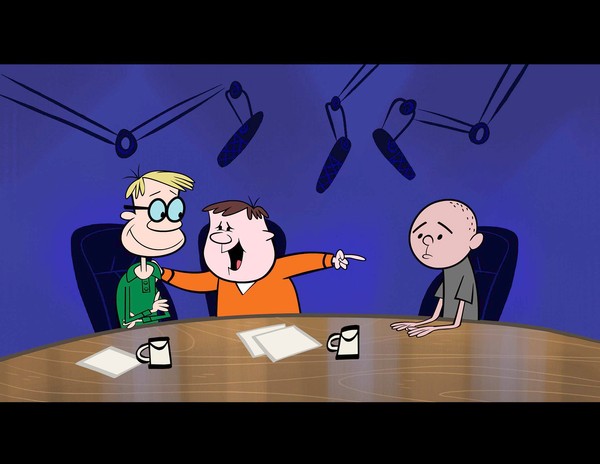
The Ricky Gervais Show on HBO

The XFM shows had a real unpolished, by-the-seat-of-the-pants feel to them.  There were strange errors, failed games, and awkward conversations.  Those shows really did feel like you were listening in on three buddies who were only vaguely aware that you’re listening.

I haven’t had a chance to listen to all the podcasts yet (though I have several of them on order) but they are a far slicker version of the XFM radio shows.  I saw the HBO cartoon version before I listened to the XFM shows and I was surprised at how many of the features and conversations are slightly repeated.  Though the podcasts are clearly as unscripted as the XFM shows.  Like many good friends, I think they just like to hear some of the same stories again.  We’ve all been sitting around with our friends and said, “Hey tell that one again!” always to the same raucous laughter.  Also, since XFM was a local London radio station, the podcasts opened up stories that only the limited radio audience had heard to a wider audience.

RGShowTitle

As before here’s my list of favorite aspects of the show:

1.)    The Animation: The cartoon representations of Ricky, Stephen, and Karl are terrific.  Slightly inaccurate, beautifully simple and exaggerated caricatures of what are now well-known celebrities with great expressions and classic style (no spikey-angled anime look here, much more Hanna-Barbara).  The animations of the stories they tell are equally terrific.  Seeing cartoon Karl act out his famous fight in the bathroom (over a “woman” at the age of seven) or Stephen’s experiences at carnival in Rio are priceless.

2.)    Themes: I’ve not listened to the podcasts, but the HBO shows tend to revolve loosely around a theme.  It could be philosophy, crime, war, metaphors, films, sports, or history.  It’s interesting to watch the conversations meander from topic to topic, and go WAY off topic, always with hilarious results.  Surprisingly they do tend to bring the very loose threads back together in some way.

3.)    Monkey News: Monkey News made a “triumphant” return on the podcasts and also on the HBO cartoons.  The ones in the cartoon are slightly less ridiculous than the original XFM examples.  In fact Karl’s news about the chimp that went into space isn’t too far off the mark.  It IS off the mark, but not “there was this monkey, right, that stole a car and went to Spain” ridiculous.

4.)    Karl’s Diary: This is the best feature on the Ricky Gervais Shows I’ve heard.  It’s far better than Monkey News, Rockbusters, or any of the various features they put together over the years.  This feature was simply Stephen reading from Karl’s Diary, with commentary from Ricky and further explanation from Karl.  Highlights include: Karl and Ricky at a work meeting (Ricky tries to wrestle him); the “mirrored wall” in Karl’s flat; Karl’s opinion that ultrasound infants look like frogs; Karl’s vacation to the Cotswolds; and of course Karl’s first poem.

5.)    One-Shot Features: There were several little vignettes that appear during the show that are priceless.  These include: Desert Island Discs (what would you take to a desert island? Karl’s bringing a dictionary…); a tricky puzzle involving identical doors to heaven and hell; Karl and the problem of free will (featuring the brain’s “Onion Lobe”), a virtual reality flotation tank that simulates real life; and my favorite, Karl’s Future Predictions, which not only has one of the funniest lists I’ve seen, it also has one of the funniest conclusions in comedy history.

52300310

My next big project is listening to all the podcasts to see how much they’ve edited out for the animated show.  I’m looking forward to seeing what I’ve missed.

If you are a fan of Idiot Abroad and don’t want to listen to hours and hours of XFM radio shows (which are brilliant but can be hit or miss at times) and want an impression of how Ricky and Stephen first started with Karl, the HBO shows are brief snippets of how they got their start together!

Enjoy Karl’s Future Predictions!

The Pilkington Experience: XFM Shows

PilkingtonLibrary

Several of my previous posts have exposed my enjoyment of all things Karl Pilkington.  I think the man is a perfect mixture of creativity-LACK of creativity, over-complexity, and simplicity all rolled into one.  I started with Idiot Abroad Series 1, watched Series 2 and 3, have read his books, watched the HBO animated Ricky Gervais Show, and have since listened to all the old XFM radio broadcasts that started his association with Ricky Gervais and Stephen Merchant.  For a few posts I thought I would review everything Karl-related I’ve read, watched, and listened to in case others are interested in what else Karl can offer besides being annoyed around the world.  I’ll start from the beginning!

The Ricky Gervais Show on XFM

Hearing Ricky discuss the conditions of broadcasting on XFM you’d think they were producing a show out of someone’s garden shed.  Despite the supposed conditions, this show produced countless terrific moments and truly introduced the world to Karl Pilkington.  This show, more than any of the other shows Ricky, Stephen, and Karl have done, feels like a true, unedited chat between three mates sat in a room for long stretches at a time.  In fact many of the topics, conversation, and features show up again in the podcasts.  There are lots of terrific moments and segments in this show, but here are the best reasons to listen in:

1.)    Karl: Just experience how strange Karl sees and thinks of things.  Some great moments include Karl Getting his GCSE results (I won’t ruin it.  It’s worth the surprise), his desire to “educate Ricky” with pun-entitled facts, and his various misunderstandings of what he’s heard, read, or seen are always hilarious.

2.)    Karl’s Observations: Karl has a unique view of the world and can often focus on something you would never give second thought to.  For example Ricky told him a story of a chimpanzee son that got into an argument with his chimpanzee father and ran away.  Karl’s response was, “What were they arguing about?”  Some of his observations are even stranger, such as Chinese people not aging well, or his theoretical plan on how to shorten the queue for those attending the visitation of the Queen Mother.

3.)    Monkey News: This feature carried over into the later podcasts, but this is where it got its start.  Not only does it include the classics of the monkey who robbed a bank, the one who drove a car into Spain, and one who got a job in a hair salon; but it also includes the “Victorian Ape Woman,” a monkey porn film maker, and a chimp who got arrested in Russia for vagrancy.  While the stories themselves are hilariously unlikely, almost as good are Ricky’s explosive reactions to them usually ending with the show’s unofficial catch phrase “You’re an idiot! Play a record!”

4.)    White Van Karl: This concept was taken from the Sun newspaper that went to various “working class” individuals (who drove white work vans) and asked them their opinions on the week’s news.  Stephen turned it around to ask Karl what he thought of the news.  Some of the best are thoughts on celebrities coming out, Zoe Harris (Karl’s childhood girlfriend, he put a hole in her dress and dumped her), and (maybe my favorite moment of all time) the cloning of “man-moths.”

5.)    Rockbusters: Ricky and Stephen truly seemed to dislike this contest (Karl gives a “cryptic clue” that relates to the name of a band and the initials of the band, the listeners email answers to win lousy prizes, i.e. “exploding pet,” the band has the initials “AK,” the answer was “Atomic Kitten”) but some of his clues were absolutely brilliant.  And most of the bad ones made for such hysterical moments they were worth it. The best ones include “She has her husband’s gloves and a pair of her own,” band “HH,” answer “Herman’s Hermits;” “Do you think your kid will get that strawberry for me?” band “WP,” answer “Wilson Pickett;” and “the Scottish fellas can’t get into their emails,” initials “KL,” answer “Kenny Loggins.”  The worst ones: “The people from the East Midlands swear a lot;” band “TTD,” answer “‘Tourette’s’ Trent D’arby,” “Why are the Jamaican fellas twirling fish around their heads?” band, “DS,” answer the “‘De-trout’ Spinners,” and finally “a couple of people were arguing at the fruits and vegetables in the supermarket,” band “B,” answer “Banana-drama.”

6.)    Ricky and Stephen Stories: It’s important to remember whose show it is.  Ricky and Stephen have moments of pure comic gold as well.  Ricky’s training in boxing and Stephen’s terrific story of being tricked into picking up a pig after a party to impress a girl, then crying in the backseat after he got the car stuck and another guy had to move it.  It’s hard not to laugh at all of them.

7.)    Karl’s Childhood: Ricky and Stephen often comment that Karl grew up in a fairy tale.  Not in a good way, more like he grew up in a land filled with strange, mystical beings.  The magpie he tamed as a pet, the two boys at his school with big heads and webbed hands, the woman with a head “like a sack of potatoes,” the family with the horse in the house.  It’d all be too much to believe except I don’t think Karl possesses the guile and wherewithal to lie…

And that’s just for starters. There are also the shows where Karl is out and Claire Sturgess serves as producer.  She does an excellent job and is more like a “regular” producer.  Letting the show-runners talk and only adding comments occasionally.  It provides an example of what the program would be like without Karl…and it’s still funny!  Just not as…odd.

There are also several uncomfortable moments in the show, like all good friends Ricky, Stephen, and Karl have arguments.  They pick on and at one another (Karl at Stephen being very tall, with big “goggy” eyes, and unfortunate luck with women; Stephen on Karl being stupid, lazy, and with a head like an orange; Ricky…constantly picking on both…all the time…for everything.)  It can get too far and, in fact, the end of Series 2 Karl says he’s tired of working with the two of them and doesn’t want to come back for Series 3 (he does…negotiated an extra day off, for which Ricky and Stephen brutally mock him).

Not every show is equally strong, but when it is good it is some of the best humor you’ll ever experience.  If you like the podcasts and/or Idiot Abroad check them out. Almost all of them (I listened to 97 episodes) are on YouTube and are well worth the time!


Off the Edge #4: Issues with Next Gen Gaming

Off the Edge

I’ve maintained a console through every generation of gaming, NES, Genesis, Saturn, Playstation, Dreamcast, Playstation 2, XBOX, Gamecube, Playstation 3, Wii, XBOX 360.  I’ve owned (or still own) all of these at one point or another and I just assumed I would always have a console.  I have to say the recent pre-launches of the upcoming PS4 and especially the XBOX One have kind of put me off buying either next gen system.

The first question I have is, “why?”  Though I jettisoned my 360, I have to say the PS3 and 360 are still both strong systems.  They can get loads of life out of them and provide years of games with the “current” gen technology.  I know there are loads of gamers out there who always want more and more in terms of graphical capabilities but they can squeeze so much out of the hardware it seems unnecessary that new hardware is needed to make games look better.

The second objection is the threat of DRM control.  Most of us are familiar with the gaming industry in general and have heard that, despite shaky economic conditions and various natural disasters, the game divisions of most of these companies are turning profits, and in some cases are helping keep the rest of the company afloat.  So why are game companies so concerned about “piracy” or the used game industry?  It isn’t about their economic viability at this point it’s just greed.  As a cartridge-gaming kid I never had more than a handful of games.  My friends were in a similar situation.  So we borrowed and traded with each other.  Broke kids could play lots of games that way.  When your friends wanted it back you had to either do without or, more often, sell some of your old ones and buy the new one you wanted.  Buying used and trading has always been a dynamic part of the culture.  The new plan is to DRM all games.  To borrow a game from a friend you still have to pay for a game.  This makes trading useless.  All so companies already turning profits can make more money.

Even worse is the method in which they verify the DRM, specifically the XBOX One seems to have adopted the atrocious method used for Diablo III and the latest Sim City, always-on online server verification.  It reminds me of the first time I put in my copy of Empire Total War and it made me install Steam.  At that time Steam had to connect to the internet.  I had a dodgy wi-fi connection.  I couldn’t play it.  A similar problem occurred when Diablo III came out, despite all the server preparation they didn’t have enough to allow the first-wave rush and people who pre-ordered the game couldn’t play it.  The same happened with Sim City.  Companies are now forcing you to be online even when you just want to play single-player games.  I exclusively play one player so this is a barrier; as they focus on their marketing on online gamers and ignore what I’m guessing companies feel is a less-valuable customer.  Microsoft can tout the number of servers they have ready for launch.  There will be people who can’t get on.  They will crash, and those gamers who want to just basically play a game won’t be able to.

They’re watching us…but they aren’t paying any attention to what WE want…

And my third major objection, can we have a game machine that really just plays games?  Both Sony and Microsoft seem to be obsessed with all the other stuff their dream machines can do.  It can connect to their proprietary networks to play proprietary movies!  It can constantly keep connected to social media!  It can control your TV!  It watches you while you sleep and checks your vitals like HAL from 2001!  Ok.  All well and good…and well-and-creepy, but does it play games?  Are the games any good?  Do they do anything new and worthwhile?  It doesn’t seem to be the case just yet.  They look slightly better from what I can tell.  The question really is do they look good for what they NEED to do?  Sonic the Hedgehog and Double Dragon II still look amazing for what they need to do.  Make it HD and it doesn’t add much more.  Make it 3D and it doesn’t make it better.  Add motion control and it generally gets in the way…  Do they do anything worthwhile and new?  Or is it just “here’s the single player game (with maybe some motion control stuff) and here’s the multiplayer game.”  At this point I’m not sure how much innovation can be put into games, but typically the innovation comes from designers and writers not the hardware.  Get some good, creative ideas and you can make 8-bits look amazing.

I once read a book called The Pentagon Wars by Air Force Colonel James Burton.  In the book he describes the major issue with weapons development in the Pentagon (in the 80s and it’s probably still true) is that weapons manufacturers use military funding to create new technology that was ridiculously overpriced and entirely unnecessary.  The developers and consequently the Pentagon top-brass, made the weapons they wanted to see using the new technology they wanted to play with.  In doing so they totally ignored what the soldiers and pilots wanted and needed.  He discovered pilots mostly dog fight with enemy planes via sight…in response the Pentagon and weapons industry produced a missile that can fire from miles away and missed far more often than it hit.  A troop transport vehicle was requested to carry troops and instead it was outfitted with so much hardware it doesn’t carry enough troops and can’t do anything well, it just does them “good enough.”  While reading about next-gen consoles I thought of this book.  The console manufacturers are spending WAY too much time trying to shoe horn the newest technology into their latest plastic box.  All the cameras, TV-internet connectivity, social media functionality, 3D gimmicks, motion control, and voice activation won’t be worth anything if the newest, fanciest game machine doesn’t have good games or play let you play them easily.  There will be decent games on it, but to me, it won’t be worth what we’ll be paying for all the technology I don’t want or need.

The only way to send a message to the gaming industry would be to NOT buy their latest over-engineered next-gen system or let them know NOW what we really want in a new system.  The economic system is all on its head; it should be what the market desires not what the industry mandates we will have.  I won’t be getting one any time soon after launch.  But I have a feeling the market will buy it.  They’ll buy it, complain about it, and continue to support an industry that cares more about doing what they can do rather than doing what’s needed; and increasing profits via absurd protection methods rather than simply making products their market wants to buy.

I’ll have fun with Mega Man 2 and Streets of Rage 3 in the meantime…

I’d take almost any one of these any day at this point…

The Best Things About Mean Girls

You know them, or you have been one. Maybe you still are. It doesn’t matter though because at some point, most women have been a mean girl.

Photo from : meangirls-confessions.tumblr.com

As I’ve admitted, I have a weakness for good teen movies. And I LOVE this movie. I have seen it so many times I can quote it, and even though she’s somewhat crazy now, I still have a soft spot for old-school Lindsay Lohan.

Mean Girls (2004) is dead-on when it shows how girls – and oftentimes women – treat each other. That is the primary reason I hang out with guys. I never have to worry about guys gossiping behind my back or trying to secretly sabotage me while acting like my best friend. I have been a mean girl though, so I don’t blame anyone for not liking me either.

The movie truly tells the story of a group of high school friends who are obsessed with body image, their social and sexual lives, and terrorizing each other to look good and gain popularity. Mean Girls confronts trends, cliques, and all the horrible things teen girls do to each other, and why it shouldn’t be that way.

Aside from the movie’s obvious themes of forgiveness, girl power, support, and unity, I take a lot of other things (some silly) from the movie:

  • I know, right? Thank you, Rachel McAdams (Regina George). I didn’t realize I picked up this phrase from the movie, but I know I did. I’m not sure if that’s a good thing though.
  • Plastics. I’m not sure if the term derived from the movie, but it’s a great word for the high-fashion, fully made-up types. E.g.: The ones who look like Barbie dolls.
  • Amanda Seyfried. According to IMDB, this was her first movie. I want to personally thank the casting director for picking Seyfried to play the stereotypical really dumb blonde. Who knew she’d turn into the young star she is now?
  • School faculty. This movie reminds us that teachers and principals have real lives and problems. The ones in this movie seem to say what you know every faculty member wants to. Two of my favorite quotes, “I cannot tell you how happy I am this year is over,” and “Oh, hell no. I did not leave the South side for this!” Tim Meadows (Mr. Duvall) says.
  • Girl-on-girl crime is self-destructive. Not only does Mean Girls teach you that you can ruin your best friend’s life, it proves you can ruin your own. You will be exposed, and people will hate you.
  • People you torture will have the last laugh. Lizzy Caplan (Janis Ian) delivers a fantastic speech in the end where she simply confesses trying to destroy McAdams’ life. She falls into the crowd as they chant her name. Be careful who you’re mean to; they often find a way to retaliate.

Do you have a mean-girl related story? Feel free to share below!

90s Shooters: The Joy of the Wolfenstein – Doom Era

Though I was a video gamer from a young age, playing Atari and NES, I didn’t get into PC gaming until I was in middle school.

My first home PC was a simple IBM with no hard drive.  I played games directly off a 3.5” diskette and could only play shareware versions of Where in the World is Carmen Sandiego? and use Print Shop Pro to print on the DOT Matrix Printer.  As time went on it became difficult to find games I could play that only had one disk…luckily we eventually upgraded our PC to one with a moderate hard drive (I think around 120 mb or so) and a whole new world of gaming opened up.

This was when I was introduced to shareware versions of Wolfenstein 3D, Blake Stone, and eventually Doom.

These represent the first person shooters I ever played, and some of the earliest entries into the genre.  My friend Mike provided me with Wolfenstein and eventually Blake Stone.  We played both shooting games on the 8th grade newspaper computer instead of actually working on the school newspaper (I don’t know if we even had one) until we got caught.

Wolfenstein Title Screen

Wolfenstein 3D was fascinating, killing all those Nazis in castle hallways.  Hearing their low-fi German shouts (“Halt!”  “Guten Tag! Mein Leben!” “Schutstaffel!”) and eventually working up to fight some strange version of Adolf Hitler in terminator armor.

“Halt!”

Blake Stone is almost forgotten now, but it was a sci-fi game of the same making.  I remember the blue-green gun and the mad scientist and green alien bad guys.  Blake Stone was another one Mike and I played in English class (right behind the teacher if I recall…) and, though I never played it at home, it really got me into the corridor shooter game.

BlakeStone

When Doom came out it changed the dynamic for me.  Released from the corridors, you now moved through expansive locales and multiple-story levels.  I played it on shareware, only the first few levels and I played them over and over.  It’s the first “god mode” I ever used (IDDQD!) and even more often I’d use IDKFA for all weapons.

I played Doom relentlessly.  I was one of the few individuals who bought a Sega 32X and even though it didn’t have a lot of games I truly enjoyed the ones it had.  I listened to Use Your Illusion I & II and played Doom for months on my 32X as a middle schooler.

Once my PC could handle it I finally got a copy of Ultimate Doom and Doom II at the local Media Play and swapped the dozens of disks to install them.  It was this era when you could play a game for months…even years.  Turn on some midi music and play Doom for hours just as a time waster.  I can’t even remember how many homework assignments I blew off to kill the Cyberdemon yet again…

I’m pretty sure the Imp sound effects are actually camel sounds. Weird to think about it now….

I actually remember it being a controversy at the time: did Doom make kids violent?  It was ludicrous to me.  Doom was as realistic as a cartoon (though a tad gorier than most I’ll admit) and it would follow that kids would only learn how to kill cacodemons with a keyboard while wielding a pixelated plasma rifle…  How that equates to loading a pistol I’ll never understand.  I’d say unless you’re a spiked imp throwing fireballs on screen and I’m a crew cut face wielding a video-chain gun society should be safe.

Doom really stands as the last first person shooter I really loved.  Others came along (Duke Nukem 3D shortly after the Doom era…Kingpin when I was in college) but none really captured that WolfensteinDoom feeling for me.  Now it’s one of my least favorite genres, burdened with a heavy emphasis on multiplayer (I’ve said it a million times…I deal with idiots all day in my real life…I don’t need to deal with anonymous idiots during my leisure time…) and less on long campaigns I could put on some music and kick back to they haven’t appealed to me.

So here’s to the 90s first person shooter.  Turn on the game, turn off your brain, and enjoy some mindless (but entirely harmless) violence!