Story of the Month: Godzilla and the First Movie in a Lifelong Library

StoryoftheMonth

I once heard that the sense of smell is the sense most tied to memory. Strangely one of the smells that I found to be universal no matter where I went was the smell of a video rental store. Though the concept of movie rentals died out in the last decade, my family visited them frequently in the 80s and 90s in Louisiana, Nevada, and Tennessee and they always had the same scent. It’s an acrid, vinegary smell of plastic and commercial electronics cleanser. It’s the bitter, stale smell of recycled air and electric servo motors slightly burned from overuse. It‘s tied completely to my childhood so, despite its seemingly negative description, it’s one of the sense memories I find the most comforting.

Being born in the early eighties, home video technology wasn’t exactly new but it also was still a luxury. I remember our first massive silver Pioneer VHS player. My mom bought a VHS copy of Ghostbusters as our first movie and for perhaps a year or more it was the only movie we owned. A military family, I remember distinctly the video rental store near base in Louisiana. It was tiny, even to a three-year old, and had model airplanes hanging from the ceiling. And it had that smell… We rented a ton of movies, and especially cartoons, for my sister and I so it was a place we visited frequently.

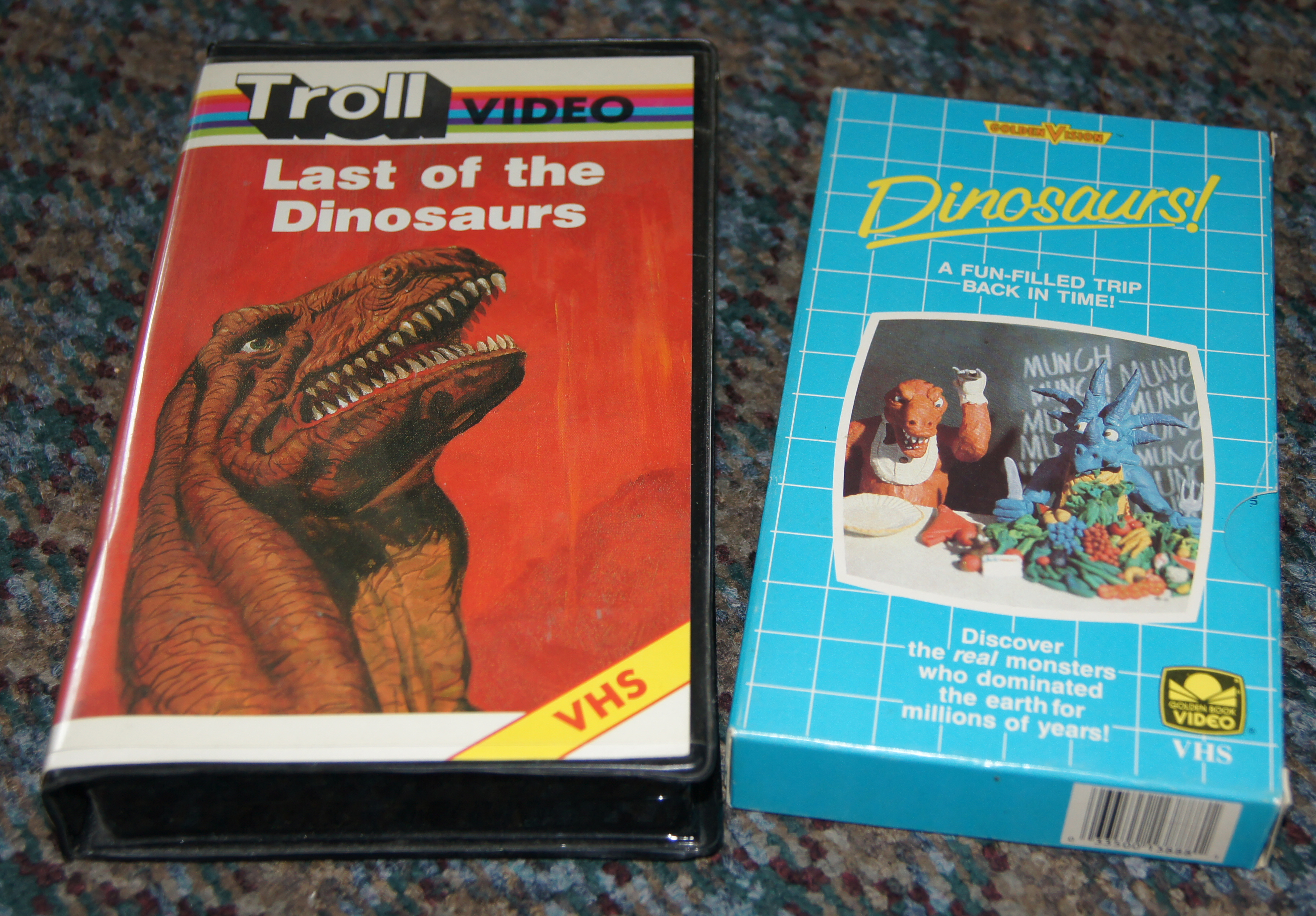
When I was five we moved to Las Vegas and soon my mom added Crocodile Dundee to our video library expanding it to two tapes. For my birthday that year I received two dinosaur tapes, both less than 30 minutes long but I still have them and still love them.
SONY DSC
Two of the first tapes that were ever mine. I got them for my birthday around 1987.

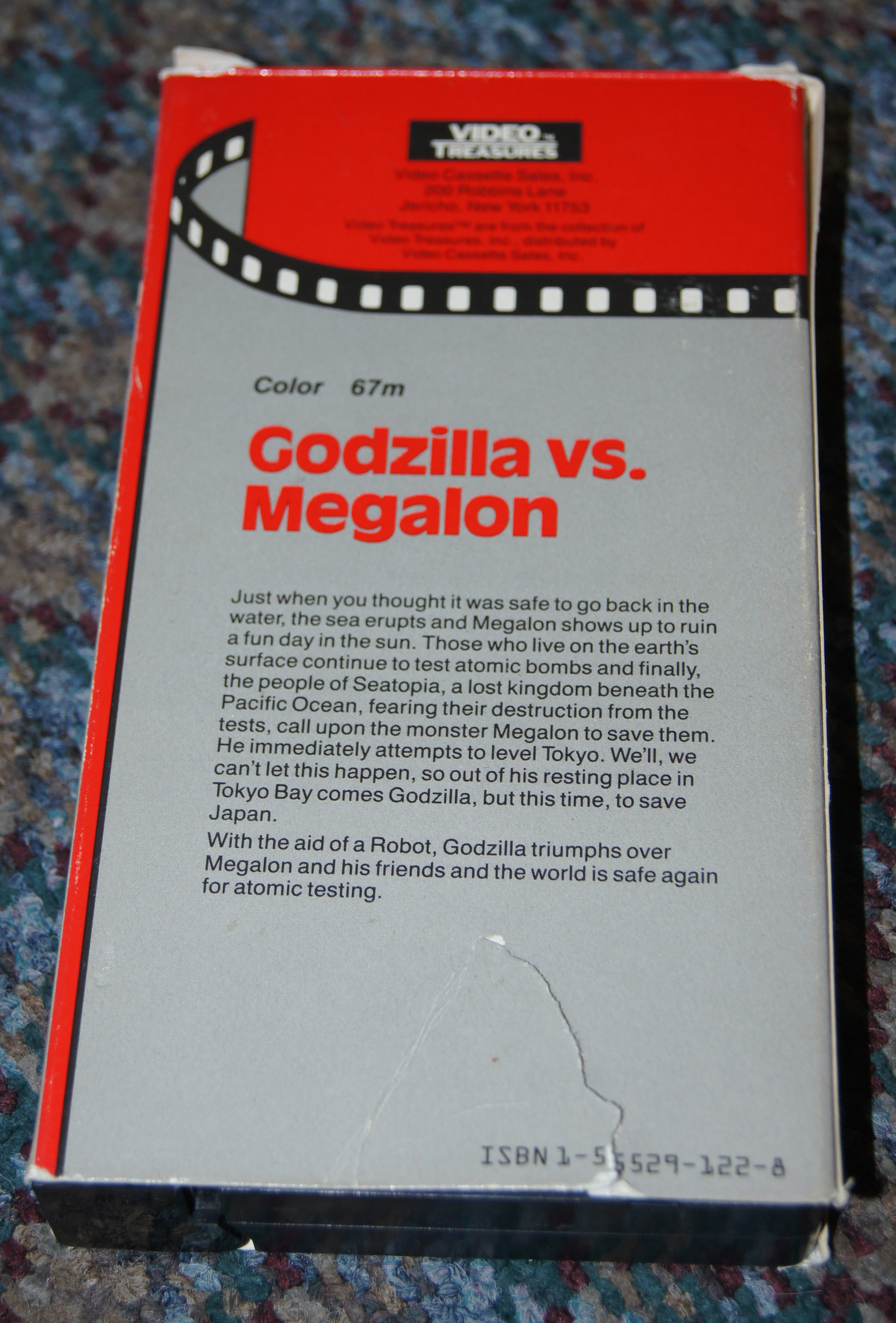
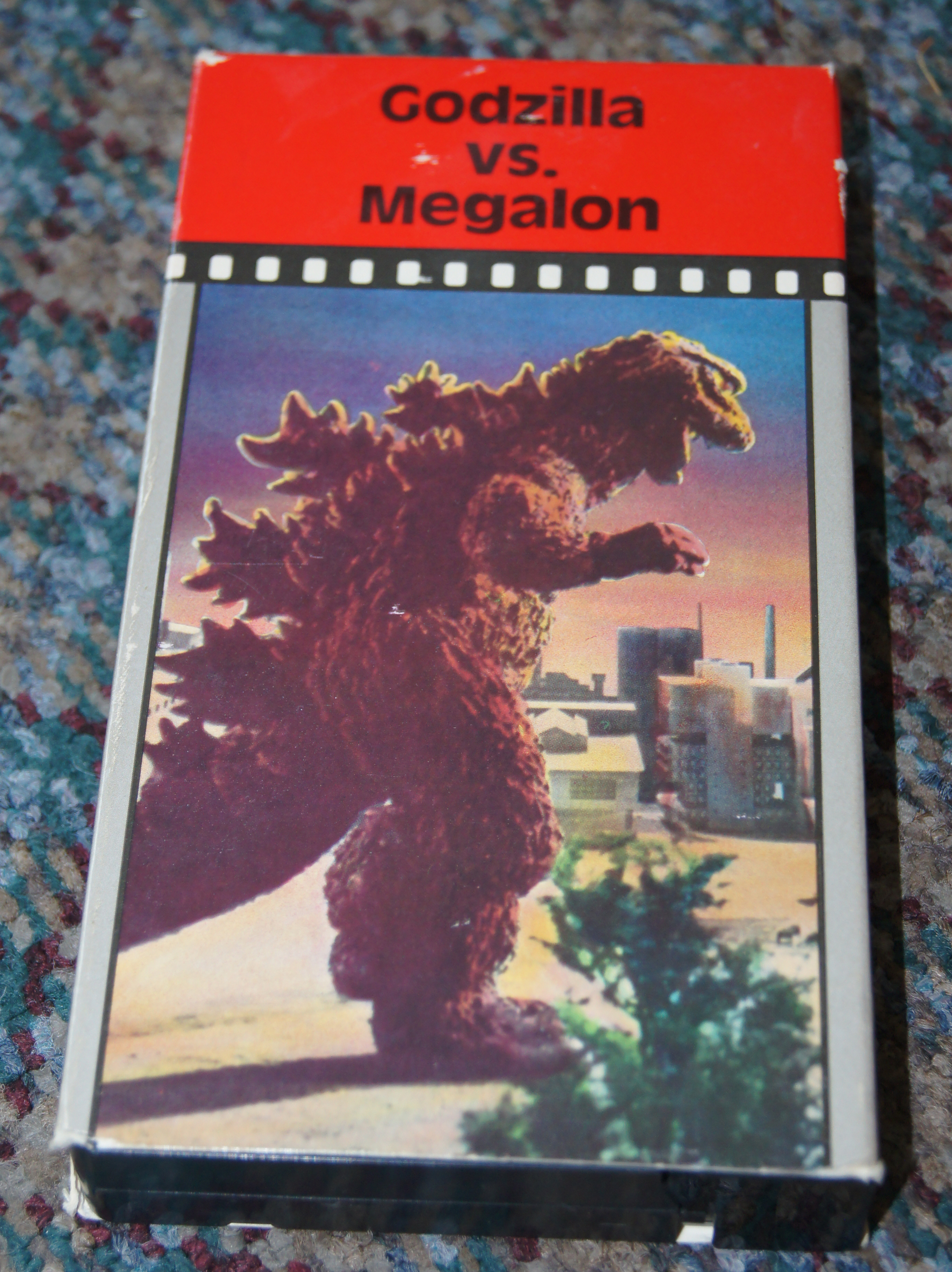
It was in Las Vegas that my mom let me pick out the first movie I ever chose to add to the video library and I got it from a video rental place. I remember how wide open and bright it seemed compared to the one in Louisiana. We’d been there plenty of times and it housed one of my first disappointments in media, discovering the My Pet Monster video I was dying to rent was only available in BETA… I never got to see that episode! But this day my mom let me pick a movie to buy; one that I could add permanently to our collection VHS tapes and we could keep and watch over and over. As a huge dinosaur fan, and having just been introduced to the Crestwood Monster books series I picked one. The first movie I ever bought: Godzilla versus Megalon, the 1986 Video Treasures public domain release.
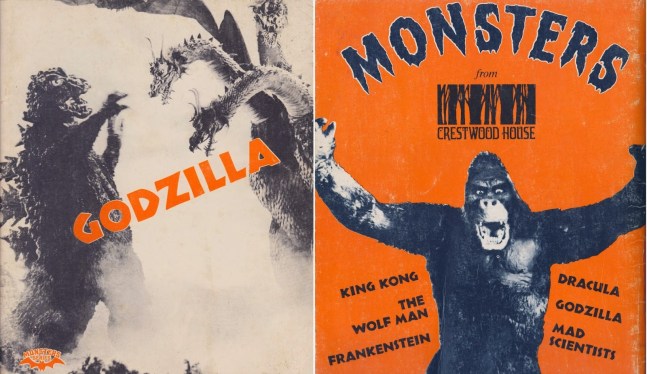
Crestwood Monster Series books. These were in the Gragson Elementary School Library and I checked them out frequently. They were largely inaccurate but a good intro to monster movies.

It was after seeing this movie that my love affair with Godzilla began. It is without a doubt one of the strangest of the Godzilla movies; and the version I saw was a heavily edited cut. It features a weird robot (Jet Jaguar), underground civilizations, two big monster villains, and some of the zaniest Godzilla moments ever. I remember the beginning with the kid in the paddle boat and the moment where Godzilla slides across his tail to drop kick Megalon being held by Jet Jaguar like they’re a pro-wrestling tag team and the ref is scolding Megalon’s partner (Megalon actually DID have a partner, another great monster, Gigan). Watching it now it is one of the most ridiculous of the Godzilla movies. It was when Big G was aiming for the kid market, and luckily I was a kid. I loved it. I still do. And I couldn’t be prouder that my first movie was this one, as ridiculous as the movie itself is. It takes me back to that place and those feelings of joy and wonder I had watching it as a kid. I can almost hear the industrial tape rewinders and smell that video store smell.

With The King of the Monsters arriving in a genuine updated form in theaters this past weekend it got me thinking about that movie. The first movie a lifelong film fan ever bought, and a memory of simpler times when all we needed was a VHS player and a fun movie to be at our happiest.
SONY DSC
My original VHS copy of Godzilla Vs. Megalon. The first movie I ever picked out.
SONY DSC
It was considered an “adventure” movie judging from the serial number and genre logo.
SONY DSC
This public domain release was heavily edited from the original theatrical version but even so they gave away results of the plot on the reverse blurb!

Bullet Point Review: Turbo

BulletPointReviews

This is a new feature I thought up to give reviews of things I just feel like reviewing in a short, sweet way.  I started with a great little animated feature I caught on Netflix that seemed to get lost among the big-budget, sequel-happy world of modern cinema.

Bullet Point Review: Turbo (2013)

  • Title: Turbo
  • Premise: A snail name Theo (aka Turbo) is addicted to speed and racing despite his being, ya know, a snail and wants to enter the Indy 500.
  • Protagonist(s):

o   Theo (Turbo): Main character/Racing Snail (Neverending Story shout out)

o   Chet: Theo’s disapproving Brother

o   Tito: Snail-racing taco vender at Van Nuys, CA mini-mall “Starlight Plaza” who finds Turbo. They work together to achieve their dreams.

o   Whiplash, Smoove Groove, Skid Mark, Burn, and White Shadow: Starlight Plaza racing snails. Whiplash is voice by Samuel L. Jackson and Smoove Groove Snoop Dogg, which means this movie has both a Samuel L. Snail and a Snoop Snail)

o   Paz, Kim Ly, Bobby: Starlight Plaza venders who sponsor Turbo in the Indy 500.

  • Antagonist(s):

o   Evil Mower: Turbo’s first racing opponent.

o   Guy Gagne: Turbo’s REAL racing opponent and Indy 500 Champ.

o   Crows: They eat snails…a lot…

o   Mother Nature: Made Turbo a snail and thus…not very fast…

  • Conflict: Turbo’s addiction to racing affects his job, his relationship with his brother, and dominates his life.
  • Twist: Turbo accidentally Bruce Banners himself with NO2 and gains super-speed! Stan Lee would’ve been proud.
  • Moment I was Hooked: Somewhere around the line “You’re trashtalk is needlessly complicated!” delivered as only Sam Jackson can…
  • Journey: Turbo finds his speed; finds his dreams; and finds that, maybe like Dorothy, he had what he needed all along.
  • Surprisingly…: This movie has a kick ass soundtrack.  Good licensed and original music.
  • Most Relatable When…: Turbo becomes popular by going “viral” from a kid’s random video, including a catchy remix version.  It felt like it could happen because it’s happened oh so many times in the past with oh so many cats…
  • Final Thoughts: I’ve been on a bit of an animated feature kick. Mostly because they are a lot of them on Netflix. I’ve always liked snails so this one called to me. I didn’t have high hopes due to some of the kids’ movies of recent vintage (i.e. Kung Fu Panda…) but was surprised by how much I enjoyed this. Ryan Reynolds, though I’m not usually a fan of his live acting, turns out to be a great voice actor, the supporting cast is also excellent, the story is solid (though cartoonishly fantastical), and the message truly inspiring. Very creative, great fun, and better than most “serious” movies I’ve seen recently.
  • Rating: Four and a half snail shells outta five.

Rating

Turbo Artist
Portrait of the Artist as a Young Snail

Rattle and Hum: A Lifelong Journey

Music documentaries are a great way to learn about a band or artist, but have you ever learned something more? Has one ever exposed you to more than the band and forced you to dig deeper? Rattle and Hum did that for me.

I was six years old when it came out and saw it for the first time when I was eight. I watched it at a friend’s house, and we watched it loud – over and over again.

Rattle and Hum is much more than a U2 documentary. Sure, the focus is the band, but it truly is about the journey. And not just their journey. It’s about a journey of exploration and discovery, a journey about learning more. I received a crash course in culture during this movie, and here’s what I came away with:

  • Charles Manson. Maybe the most famous serial killer of all time, and my first reference to it was in the opening song Helter Skelter. I had no idea such people existed or how and why they did the things they did. I lost a little innocence and gained some much needed cynicism.
  • Harlem. I’m a Nashville native and still haven’t made it further north than Maryland. This was my first experience with Harlem, which led to me learning about the Harlem Renaissance. I remember feeling a connection with those scenes. Maybe it was the poverty or the soul and passion, but something resonated with me. The church choir singing I Still Haven’t Found What I’m Looking For is still one of my favorite parts.
  • Billie Holiday. Growing up with a parent in an 80s metal band, I wasn’t exposed to jazz. Angel of Harlem opened my eyes to jazz singers and African American musicians.
  • B.B. King. I wasn’t exposed to blues either. Recently, a friend jokingly said to me, “You don’t know anything about B.B. King.” I pshed and explained I knew about B.B. King – thanks to Rattle and Hum. The movie introduced me to the him, the blues, and the sound.
  • Graceland/Memphis. I’ve always loved Elvis, but I didn’t know what Graceland was or want to visit Memphis until I saw this movie. It’s also inspiring to see Larry sit on the bike, even though he wasn’t supposed to. Rebelling isn’t always a bad thing.
  • America. When you live it every day, you overlook the beauty around you. Taking a few moments and looking at it through a camera lens allows you to see it for what it is. Beneath the traffic, aholes, and pollution, we really do live in a pretty amazing place. Even in the 80s, America was a melting pot of culture.

Rattle and Hum taught me more history and culture in two hours than any history class ever could. The movie touched on people, cultures, and politics, and inspired me to learn more. I can still sing every word to every song. I still laugh and pause when it gets heavy. Remember, it’s not just about the music – it’s about what we take from it.

Trends in Modern Storytelling in Film: Conan – Conclusion and The Riddle of Steel

OffTheCharts

What is the riddle of steel?  The 1982 film asked this question in some of its first spoken dialogue, in 2011 it is asked in the forge, in both films it is posed by Conan’s father.

In 2011 the answer is given in the same scene “fire and ice” provides the strength of steel.  Meaning of course that as heated/quenched steel is best tempered, a spirit that consists of equal parts furious passion and level-headed temperance is indomitable.  A fine lesson for the young Conan, but one he has trouble mastering throughout the film.

Ron Perlman as Conan’s father in the 2011 film teaching his son about steel.

In the 1982 film the answer is provided but never written down on a piece of paper, tied to a rock, and thrown at the audience’s collective forehead so the audience must interpret the answer, and not everyone’s is guaranteed to be the exactly same.

Conan’s original solution is to rely on the strength of steel.  He blunders from place to place, hacking and slashing, until he comes face-to-face with Doom, whose legion of followers catches him easily and Thulsa Doom provides him another answer: flesh is stronger.  Steel is fine, but with his horde of fervent acolytes succumbing to his false prophet-eering, some willing to turn on and murder their own parents, Doom can overcome steel.  Was that the answer then?  If so Conan and the world were doomed.  But that wasn’t the answer either.  During the last battle with Doom’s lieutenants Valeria keeps her promise, that not even death could stop her from fighting by his side, and aids Conan when he most needs it.  Then, renewed with strength, Conan rises to his feet, shatters his opponent’s sword, his father’s sword, and destroys the High Priest of Set, a man bigger, stronger, filled with faith in a false prophet, and with steel forged by the very man who provided Conan the riddle.  Then looking at the shattered sword, he crosses his weapons in his battle-pit salute and bows his head to the Valeria’s funerary altar.  This battle was for her, and she gave him the answer at last: steel is weak, flesh is weak, but the strength of true belief and true purpose can overcome greater steel, greater strength, and any false beliefs no matter how powerful in the brutal world of Hyboria.

Conan then takes his father’s broken sword and kills Thulsa Doom and burns his temple to ash; neither taking his place as a new demagogue nor slaughtering his followers.  It is at this point that James Earl Jones suggests Conan becomes a hero.  By destroying the cult of Set and Doom he does something “for the whole world” not just himself.  For the betterment of everyone, not just for his own revenge.  Meaning there is a progression of the character, from wrathful to heroic.  And doing it all not as a “chosen one” but just driven by his own will.  Not a god nor a giant.  Just a man.  Finding the answer to his riddle.

Where does this leave forging a narrative in modern filmmaking?  Without sounding as old-mannish as shouting “things were better when…” I would like to at least silently mouth it.  Mostly because this trend has exploded into all forms of media; popular books, movies, music, video games; a trend where the narrative is so simple and closed it leaves no room to grow and has been dropped to the lowest common denominator.  Plots now have to be obvious, spelled out, and blatant.  Scenes have to be short, colorful, and loud.  Characters have to be broad and exaggerated.  Nothing can be implied in a character’s personality or purpose; it must be shown in excruciating detail (lengthy sequences of flashbacks, voice-overs, and “childhood” scenes instead of effective montaging done in older films) or spoken in needless expositionary dialogue.  To quote the Robot Devil from Futurama, “Your lyrics lack subtlety! You can’t just have your characters announce how they feel! That makes me feel angry!”  So why do the various industries want to remove all nuance and just have their characters simply announce how they feel?  The answer is simple: it’s easier and they have very low opinions of us…

This is definitely not an indictment to say “all new movies bad, all older movies good” but there is something to the reduction in intricacy of a lot of newer media.  I for one would like to see less hand-holding and provide room to let the audience divine its own answers or at least take the narrative training wheels off.

I never again want to have a roadmap explaining all the stops during a tale of high adventure!

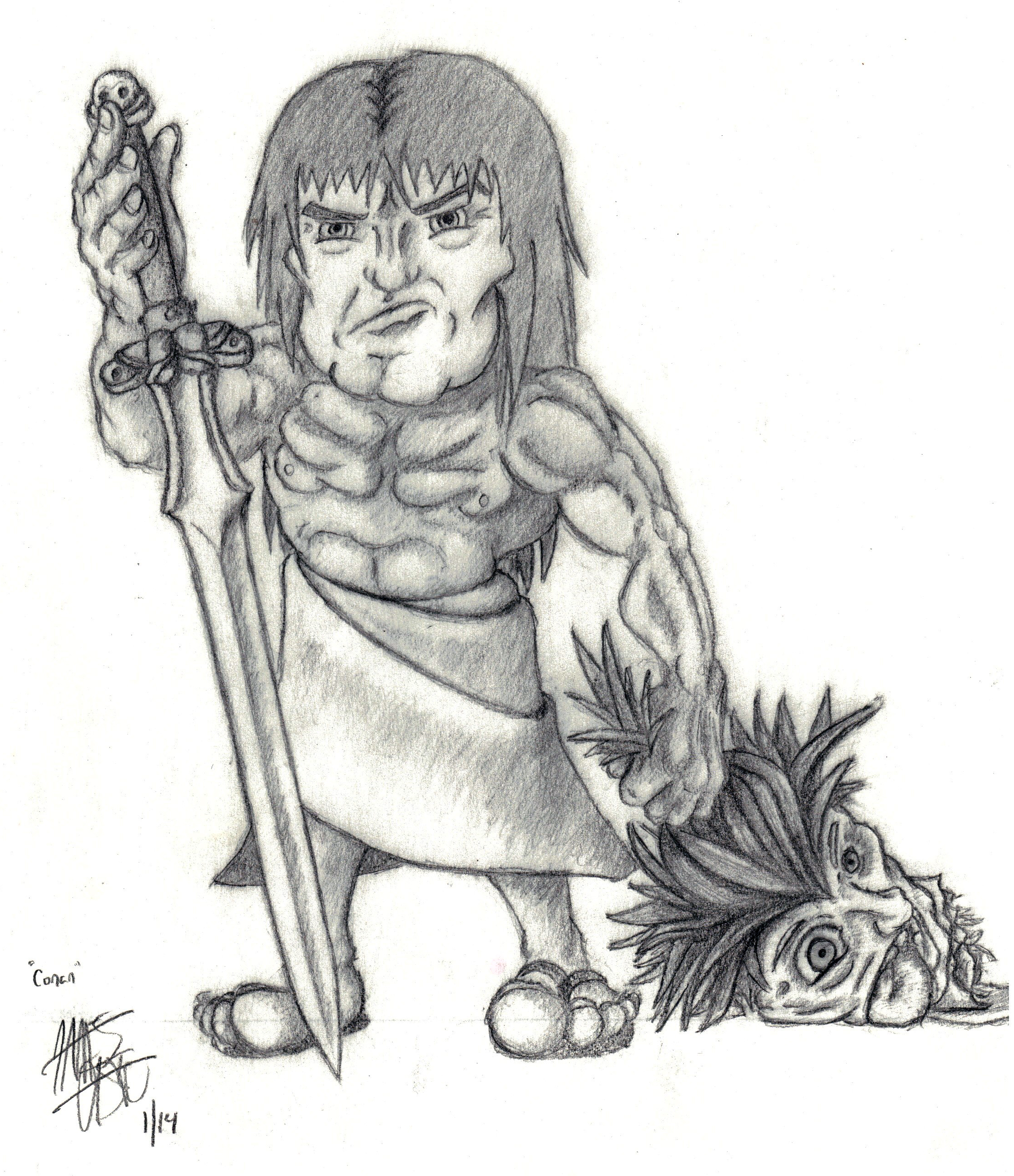
The author's take on mini-Conan
The author’s take on mini-Conan

Trends in Modern Storytelling in Film: Conan – Actors and Characters ’82 & ’11 Comparison

OffTheCharts

So in comparison, what do the films and their characters tell us of how narratives were forged in 1982 compared to 2011?

In 1982, they relied on persona for casting first.  Arnold was a name then, not much more, but one known and larger than life.  Conan was more than a grunting thug and would take some ability to perform, but it wasn’t Hamlet so it was well within his purview of early skills.  The filmmakers wisely chose similarly talented actors to act beside him most of the time (Bergman and Lopez are very good, but they aren’t master thespians) so as not to outshine him, and added veteran screen virtuosos von Sydow, Jones, and Mako to be solid feet on the acting floor to make sure there was some balance.

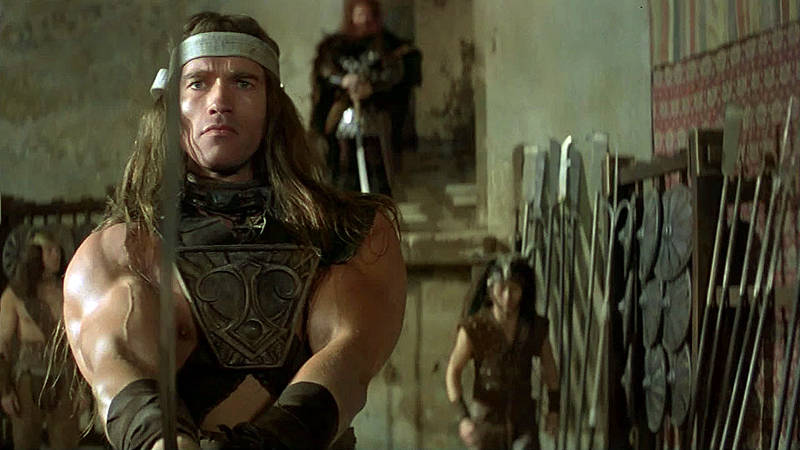
Conan 1982 learning his swordsmanship.

In 2011, they seemed to rely on the look more than the persona.  Momoa played a good-looking barbarian in Game of Thrones, a character very Conan-like, so since he’s the kind of guy that would bring young women to a hack and slash movie usually audience’d by young men he was a win for them.  The other “good guy” characters seem to appear more out of convenience than necessity, the possible exception being Artus, Conan’s friend.  Tamara is the pretty damsel in distress and El-Shan is a sneaky thief who comes in handy because they need a sneaky thief.

Conan 2011 wielding his own sword.

Zym as a villain is far more in-your-face than Doom; bashing, smashing, and slashing his way through the film seeking revenge…much like Conan really, except he is basically wearing a t-shirt that reads “I’m evil and I know it.”  Doom’s perspective is far more gray, as proven by a speech he gives:

Purging is at last at hand. Day of Doom is here. All that is evil, all their allies; your parents, your leaders, those who would call themselves your judges; those who have lied and corrupted the Earth, they shall all be cleansed.

Like any kooky cult leader Doom sees himself as righteous, not wicked.  Not for some personal wrong (“You killed my evil wife!”) but because as the last Atlantean he is clinging to a time when his people were the power of the world and he longs to go back to those halcyon days.  But the movie doesn’t need to spoon you that – it’s just part of the back story, insinuated by dialogue, mood, and Jones’ performance.

Overall, it gives the newer film less complexity, but not really in a good way, just in a “this-is-just-a-sword-swinging-hack-n-slash-adventure-for-fun-so-let’s-not-do-any-more-than-that” kind of way, which really is the trend of narratives now.  If something can be simpler it is made simpler.  Or often “darker” because much of the audience automatically feels “darker” is “better” or “more real” (See Star Wars I-III).  “Real” has come to mean everything has to be shown or explained directly.  Nothing has nuance or subtlety.  Many narratives’ most powerful points are either spelled out and/or done so blatantly as to provide little interpretation or analysis, thereby robbing the audience of some of the intensity of personal realization.

Next time will be the  summation, one best provided by a riddle…

Trends in Modern Storytelling in Film: Conan – Actors and Characters (2011)

As I mentioned previously, the 2011 version’s star Jason Momoa actually looks the part of Conan far more than Arnold.  He really does resemble a Vallejo painting quite well.  His choices for his portrayal of the conqueror aren’t bad at all.  He laughs heartily, drinks, brags, threatens all with believability, so why is it that when people say “Conan” the vast majority will say something in an Austrian accent?  Charisma.  Momoa certainly has the attitude and the look but he doesn’t have that “special quality” that Arnold possesses.  It’s no shame, few do, but it’s one of the strongest reasons I think Arnold made a superior Conan.  His presence and persona in the part are just overwhelming.  Add to that the voice, and yes, range Arnie gives his Conan (his exclamation of “you killed my people!” in rage and despair is far more effective than the many anger-filled tirades in the new film voiced in a grumbling hiss through clenched teeth) and this it becomes relatively clear why 1982’s portrayal will endure while 2011’s is classified as more a popcorn film.

Momoa looked very Conan-esque as Drogo in Game of Thrones.

Furthermore since we see so much of Conan’s childhood (a trend I think the film industry needs to start doing without…we see how Michael Meyers, Hannibal Lector, Darth Vader, and Conan become who they are rather than providing glimpses of a backstory and letting either good dialogue flesh them out or leaving it to the audience’s imagination) we see he has changed little from when he was a warrior boy to when he was a warrior adult.  Leaving only modest room for the character to grow and removing the mystique provided so well through montage in the first film.

Momoa’s performance is quite good, but not as larger-than-life as a guy who’s entire life is “larger-than-life” but what of his cast mates? Nonso Anonzie is great as Artus and wins the prize for the secondary character I’d most like to see in a spinoff.  Said Taghmaoui is good as a stereotypical thief but his character is in it with such unusual irregularity you don’t get nearly as attached to him as you do Subotai.  The main female character, Tamara, played by Rachel Nichols is done well, but she falls back into the “chosen one” category that so many characters are in (though “chosen for sacrifice” is less appealing) and has none of the bad-assery of Valeria.  Which only leaves our villains.

Of course Khalar Zym is our bad guy, played well with manic ferocity by Stephen Lang, however when comparing villains we see how much simpler he is as a character to Thulsa Doom.  Not only did his back story require a long pre-title narration, but he IS a skull-smashing, sword wielding, wildman.  He’s the Sonny Corleone of Conan villains to Thulsa Doom’s Michael and it makes you wonder how a cell-block boss like him could maintain power in the intervening decades between Conan’s village being burned and adult Conan’s revenge.

Zym looks more like a crazy villain than did Jones’ Thulsa Doom

This film’s scene is clearly stolen, as was mentioned previously, by Rose McGowan as Marique, who is a far more fascinating villain than Zym.  Not only is she a wicked sorceress with serious Elektra issues, but she is played somehow both as a incredibly creepy and still somewhat sultry by McGowan, who really has to try not to be full-on sultry just standing there in most of her roles.

Rose McGowan is great as Marique, possibly the best character in the film as her background and motivations aren’t always 100% obvious.

2011’s actors all did well with what they were given and made a fun adventure film, but it’s almost as though the bar they were provided was set far lower than in 1982’s outing.  Next post we’ll compare the two methods and see what they both accomplish.