Chosen of Khorne: The Arrogant Warrior King Upon His Throne

Off the Page

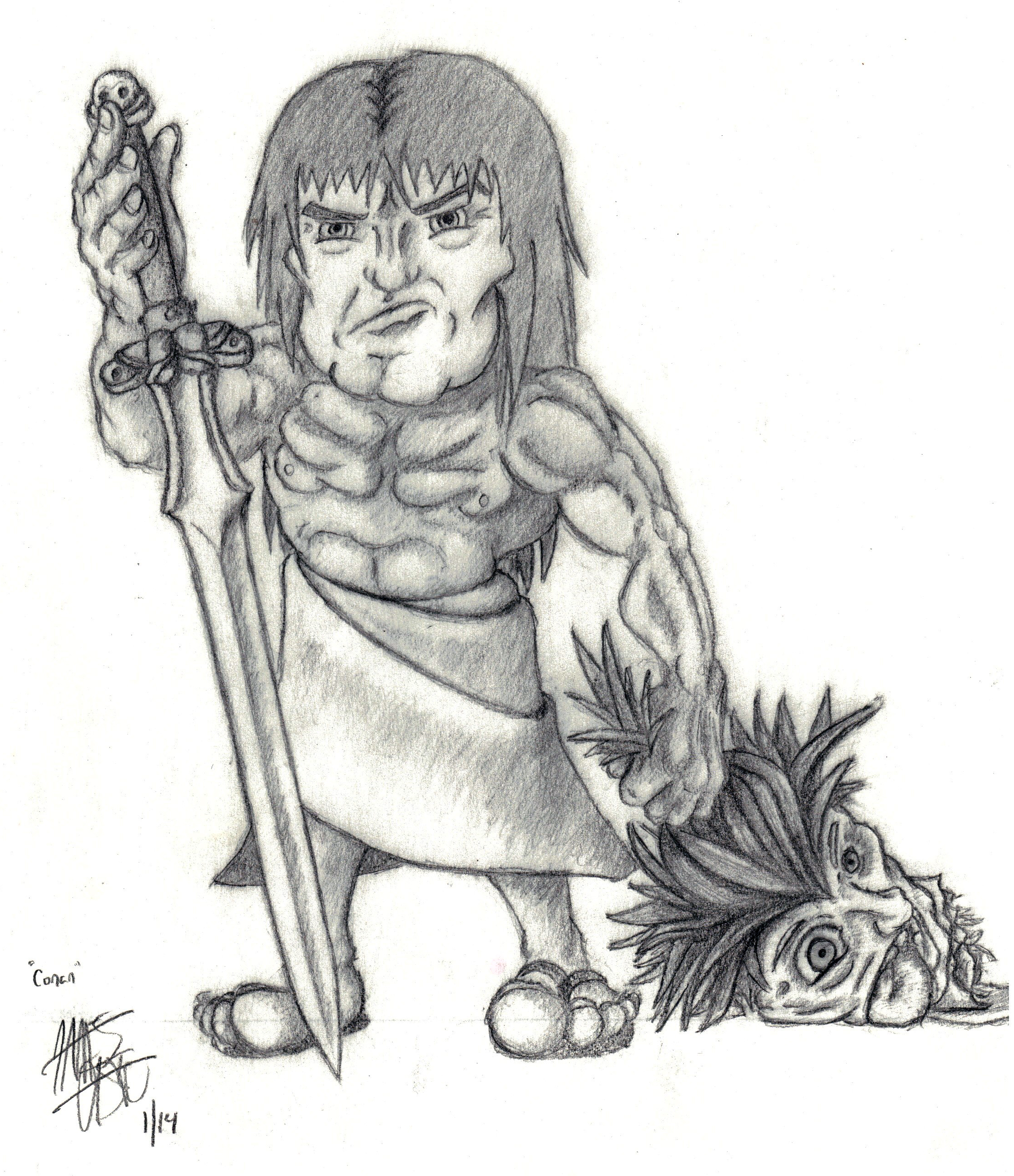
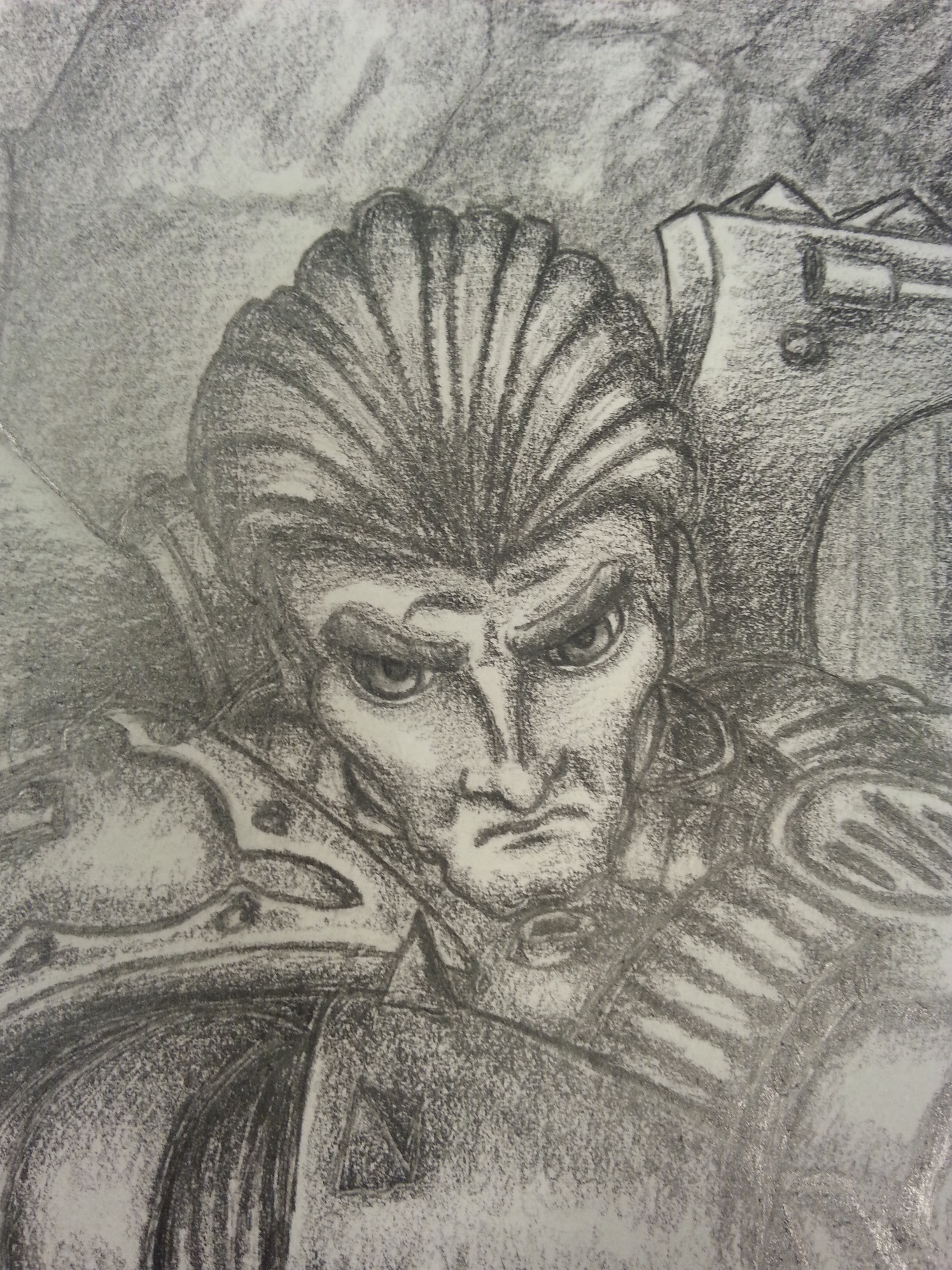
My Original Illustration inspired by a scene from Chosen of Khorne.

Kharn from Chosen of Khorne
Click for a detailed view!

I have to admit that Games Workshop, though they get a lot of stick from forums, has made a great game and created a terrific universe with some wonderful characters.  When I first got into the Warhammer world I purchased a lot of used books, old codexes, whatever I could get my hands on to learn more about it and immerse myself completely in the grim darkness of the far future.

During my hunts for anything narrative 40k I could find I came across Gav Thorpe’s Raven’s Flight and regular readers of RevPub might guess why I decided to get that one!  That one audio drama, read wonderfully by Toby Longworth, got me hooked on the Black Library audio drama/audio novel series.  I’ve got almost all the ones I could find and have a few favorites.  Raven’s Flight remains on my top list because of its terrific narrative and the rousing action sequence when Corax charges the Iron Warriors.  The Garro series is also a superlative series and Mission Purge was a nice surprise and a great Deathwatch story.  Recently there have been some terrific Horus Heresy dramas (Censure is excellent, as was the short Warmaster) as well as some good additions to the Space Marine Battles series (Veil of Darkness’ first person narration is wonderful).

My favorite and the one I’ve listened to the most, however, is Anthony Reynolds’ Chosen of Khorne. In the 40k universe I am a staunch, staunch loyalist (For the Emperor!), which is why it speaks volumes to both the writing and performance this drama, one that is centered wholly on traitor Chaos Space Marine characters, that this one is my favorite.  Of all the dramas I’ve heard I don’t think I’ve heard any of them with as vivid imagery and as clear a narrative as this Chosen of Khorne.  Not only is the story very tightly written and the settings so clear, but the action set-pieces wonderfully well-described and easy to picture.  Not only that but the story arc of the narrative’s star, Kharn the Betrayer, is remarkably well done and, despite my pro-imperium stance I found myself cheering for him as the story went on.

The hands-down star of Chosen of Khorne, after the writing, is Chris Fairbanks as Kharn the Betrayer.  Fairbanks’ performance is ferocious and subtle.  His Kharn isn’t a wild, bloody brute but a smoldering killer slowly building to a burning crescendo.  I first heard Fairbanks’ Kharn in The Butcher’s Nails before I knew anything about the character, but Chosen of Khorne had me running to the game store to pick up a Kharn model that day.  Fairbanks’ performance is so good I was even cheering for him over my own chapter master, Azrael, in The Trials of Azrael.

One image in this audio drama has always stood out for me, so much so that, despite years of not drawing large, finished pieces I had to get the image of it down in graphite.

When Malvin Bitterspear first enters Kharn’s lair beneath the arena the setting is described as a gladiatorial dungeon.  Kharn is said to be “slouched on the dais like an arrogant warrior king upon his throne” with Gorechild nearby and his collection of skulls laid out before him.  I couldn’t get the image out of my head, and so interpreted it as best as I could.
20140220_141036

My Kharn differs from the official Games Workshop/Forge World Kharn in that I gave him hair.  I’m actually a little tired of bald Space Marines and Fairbanks’ accent for Kharn reminds me of a more-intense, brutal Bela Lugosi so I gave him a bit of a 1930s Dracula-style cut.  Not only that but it went well with the description in the drama as his face being long and noble.

I relied heavily on the Warlords of the Dark Millennium to do Kharn’s wargear, taking my favorite aspects from previous interpretations and including them in the design.

One of the most fascinating parts of Reynold’s writing of Chosen of Khorne was Kharn’s outward demeanor compared to the raging inferno within.  He gives the character amazing depth and provides clear motivation for his actions, something very few narratives do well.  Because of his description and his actions, I tried to give Kharn a look of impassive malevolence, outwardly calm but promising rage.

Anthony Reynolds’ story mixed with the magnificent performance by Chris Fairbank really provided me with great inspiration.  This illustration was amazing to work on, and I hope it lives up to what the writer and performer had in mind when they made Chosen of Khorne!

Here’s where you can buy Anthony Reynolds’ Chosen of Khorne.

And Reynolds’ Kharn short The Eightfold Path which is another very personal look at the scion of the Blood God.

Where to get yourself a Kharn model.  Some say it’s a little out of date, I think it is terrifically expressive.

And Reynolds’ WordPress site!

Trends in Modern Storytelling in Film: Conan – Conclusion and The Riddle of Steel

OffTheCharts

What is the riddle of steel?  The 1982 film asked this question in some of its first spoken dialogue, in 2011 it is asked in the forge, in both films it is posed by Conan’s father.

In 2011 the answer is given in the same scene “fire and ice” provides the strength of steel.  Meaning of course that as heated/quenched steel is best tempered, a spirit that consists of equal parts furious passion and level-headed temperance is indomitable.  A fine lesson for the young Conan, but one he has trouble mastering throughout the film.

Ron Perlman as Conan’s father in the 2011 film teaching his son about steel.

In the 1982 film the answer is provided but never written down on a piece of paper, tied to a rock, and thrown at the audience’s collective forehead so the audience must interpret the answer, and not everyone’s is guaranteed to be the exactly same.

Conan’s original solution is to rely on the strength of steel.  He blunders from place to place, hacking and slashing, until he comes face-to-face with Doom, whose legion of followers catches him easily and Thulsa Doom provides him another answer: flesh is stronger.  Steel is fine, but with his horde of fervent acolytes succumbing to his false prophet-eering, some willing to turn on and murder their own parents, Doom can overcome steel.  Was that the answer then?  If so Conan and the world were doomed.  But that wasn’t the answer either.  During the last battle with Doom’s lieutenants Valeria keeps her promise, that not even death could stop her from fighting by his side, and aids Conan when he most needs it.  Then, renewed with strength, Conan rises to his feet, shatters his opponent’s sword, his father’s sword, and destroys the High Priest of Set, a man bigger, stronger, filled with faith in a false prophet, and with steel forged by the very man who provided Conan the riddle.  Then looking at the shattered sword, he crosses his weapons in his battle-pit salute and bows his head to the Valeria’s funerary altar.  This battle was for her, and she gave him the answer at last: steel is weak, flesh is weak, but the strength of true belief and true purpose can overcome greater steel, greater strength, and any false beliefs no matter how powerful in the brutal world of Hyboria.

Conan then takes his father’s broken sword and kills Thulsa Doom and burns his temple to ash; neither taking his place as a new demagogue nor slaughtering his followers.  It is at this point that James Earl Jones suggests Conan becomes a hero.  By destroying the cult of Set and Doom he does something “for the whole world” not just himself.  For the betterment of everyone, not just for his own revenge.  Meaning there is a progression of the character, from wrathful to heroic.  And doing it all not as a “chosen one” but just driven by his own will.  Not a god nor a giant.  Just a man.  Finding the answer to his riddle.

Where does this leave forging a narrative in modern filmmaking?  Without sounding as old-mannish as shouting “things were better when…” I would like to at least silently mouth it.  Mostly because this trend has exploded into all forms of media; popular books, movies, music, video games; a trend where the narrative is so simple and closed it leaves no room to grow and has been dropped to the lowest common denominator.  Plots now have to be obvious, spelled out, and blatant.  Scenes have to be short, colorful, and loud.  Characters have to be broad and exaggerated.  Nothing can be implied in a character’s personality or purpose; it must be shown in excruciating detail (lengthy sequences of flashbacks, voice-overs, and “childhood” scenes instead of effective montaging done in older films) or spoken in needless expositionary dialogue.  To quote the Robot Devil from Futurama, “Your lyrics lack subtlety! You can’t just have your characters announce how they feel! That makes me feel angry!”  So why do the various industries want to remove all nuance and just have their characters simply announce how they feel?  The answer is simple: it’s easier and they have very low opinions of us…

This is definitely not an indictment to say “all new movies bad, all older movies good” but there is something to the reduction in intricacy of a lot of newer media.  I for one would like to see less hand-holding and provide room to let the audience divine its own answers or at least take the narrative training wheels off.

I never again want to have a roadmap explaining all the stops during a tale of high adventure!

The author's take on mini-Conan
The author’s take on mini-Conan

Trends in Modern Storytelling in Film: Conan – Actors and Characters ’82 & ’11 Comparison

OffTheCharts

So in comparison, what do the films and their characters tell us of how narratives were forged in 1982 compared to 2011?

In 1982, they relied on persona for casting first.  Arnold was a name then, not much more, but one known and larger than life.  Conan was more than a grunting thug and would take some ability to perform, but it wasn’t Hamlet so it was well within his purview of early skills.  The filmmakers wisely chose similarly talented actors to act beside him most of the time (Bergman and Lopez are very good, but they aren’t master thespians) so as not to outshine him, and added veteran screen virtuosos von Sydow, Jones, and Mako to be solid feet on the acting floor to make sure there was some balance.

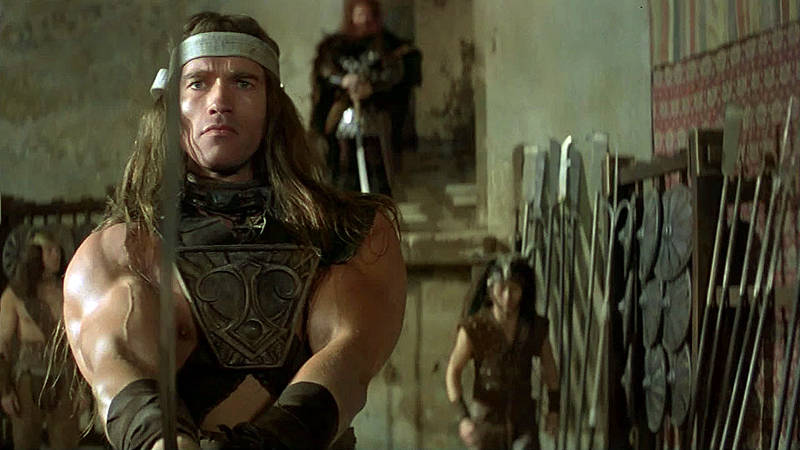
Conan 1982 learning his swordsmanship.

In 2011, they seemed to rely on the look more than the persona.  Momoa played a good-looking barbarian in Game of Thrones, a character very Conan-like, so since he’s the kind of guy that would bring young women to a hack and slash movie usually audience’d by young men he was a win for them.  The other “good guy” characters seem to appear more out of convenience than necessity, the possible exception being Artus, Conan’s friend.  Tamara is the pretty damsel in distress and El-Shan is a sneaky thief who comes in handy because they need a sneaky thief.

Conan 2011 wielding his own sword.

Zym as a villain is far more in-your-face than Doom; bashing, smashing, and slashing his way through the film seeking revenge…much like Conan really, except he is basically wearing a t-shirt that reads “I’m evil and I know it.”  Doom’s perspective is far more gray, as proven by a speech he gives:

Purging is at last at hand. Day of Doom is here. All that is evil, all their allies; your parents, your leaders, those who would call themselves your judges; those who have lied and corrupted the Earth, they shall all be cleansed.

Like any kooky cult leader Doom sees himself as righteous, not wicked.  Not for some personal wrong (“You killed my evil wife!”) but because as the last Atlantean he is clinging to a time when his people were the power of the world and he longs to go back to those halcyon days.  But the movie doesn’t need to spoon you that – it’s just part of the back story, insinuated by dialogue, mood, and Jones’ performance.

Overall, it gives the newer film less complexity, but not really in a good way, just in a “this-is-just-a-sword-swinging-hack-n-slash-adventure-for-fun-so-let’s-not-do-any-more-than-that” kind of way, which really is the trend of narratives now.  If something can be simpler it is made simpler.  Or often “darker” because much of the audience automatically feels “darker” is “better” or “more real” (See Star Wars I-III).  “Real” has come to mean everything has to be shown or explained directly.  Nothing has nuance or subtlety.  Many narratives’ most powerful points are either spelled out and/or done so blatantly as to provide little interpretation or analysis, thereby robbing the audience of some of the intensity of personal realization.

Next time will be the  summation, one best provided by a riddle…

Trends in Modern Storytelling in Film: Conan – Actors and Characters (2011)

As I mentioned previously, the 2011 version’s star Jason Momoa actually looks the part of Conan far more than Arnold.  He really does resemble a Vallejo painting quite well.  His choices for his portrayal of the conqueror aren’t bad at all.  He laughs heartily, drinks, brags, threatens all with believability, so why is it that when people say “Conan” the vast majority will say something in an Austrian accent?  Charisma.  Momoa certainly has the attitude and the look but he doesn’t have that “special quality” that Arnold possesses.  It’s no shame, few do, but it’s one of the strongest reasons I think Arnold made a superior Conan.  His presence and persona in the part are just overwhelming.  Add to that the voice, and yes, range Arnie gives his Conan (his exclamation of “you killed my people!” in rage and despair is far more effective than the many anger-filled tirades in the new film voiced in a grumbling hiss through clenched teeth) and this it becomes relatively clear why 1982’s portrayal will endure while 2011’s is classified as more a popcorn film.

Momoa looked very Conan-esque as Drogo in Game of Thrones.

Furthermore since we see so much of Conan’s childhood (a trend I think the film industry needs to start doing without…we see how Michael Meyers, Hannibal Lector, Darth Vader, and Conan become who they are rather than providing glimpses of a backstory and letting either good dialogue flesh them out or leaving it to the audience’s imagination) we see he has changed little from when he was a warrior boy to when he was a warrior adult.  Leaving only modest room for the character to grow and removing the mystique provided so well through montage in the first film.

Momoa’s performance is quite good, but not as larger-than-life as a guy who’s entire life is “larger-than-life” but what of his cast mates? Nonso Anonzie is great as Artus and wins the prize for the secondary character I’d most like to see in a spinoff.  Said Taghmaoui is good as a stereotypical thief but his character is in it with such unusual irregularity you don’t get nearly as attached to him as you do Subotai.  The main female character, Tamara, played by Rachel Nichols is done well, but she falls back into the “chosen one” category that so many characters are in (though “chosen for sacrifice” is less appealing) and has none of the bad-assery of Valeria.  Which only leaves our villains.

Of course Khalar Zym is our bad guy, played well with manic ferocity by Stephen Lang, however when comparing villains we see how much simpler he is as a character to Thulsa Doom.  Not only did his back story require a long pre-title narration, but he IS a skull-smashing, sword wielding, wildman.  He’s the Sonny Corleone of Conan villains to Thulsa Doom’s Michael and it makes you wonder how a cell-block boss like him could maintain power in the intervening decades between Conan’s village being burned and adult Conan’s revenge.

Zym looks more like a crazy villain than did Jones’ Thulsa Doom

This film’s scene is clearly stolen, as was mentioned previously, by Rose McGowan as Marique, who is a far more fascinating villain than Zym.  Not only is she a wicked sorceress with serious Elektra issues, but she is played somehow both as a incredibly creepy and still somewhat sultry by McGowan, who really has to try not to be full-on sultry just standing there in most of her roles.

Rose McGowan is great as Marique, possibly the best character in the film as her background and motivations aren’t always 100% obvious.

2011’s actors all did well with what they were given and made a fun adventure film, but it’s almost as though the bar they were provided was set far lower than in 1982’s outing.  Next post we’ll compare the two methods and see what they both accomplish.

Trends in Modern Storytelling in Film: Conan – Actors and Characters (1982)

OffTheCharts

According to the weirdo, but shamefully funny Pauly Shore comedy Son-in-Law,­ “charisma” is “… a special quality of leadership that captures the popular imagination and inspires allegiance and devotion.”  It’s a rare thing, even amongst the popular, talented, or famous.  If Pop Idol and American Idol have proved anything beyond the desire for mass audiences to watch public humiliation, it’s that just being great at something isn’t often sufficient.  But being good enough and having a lot of charisma can often be the difference between the singer who makes the records people buy and the singer who simply rings up the records people buy.

No one would ever claim Arnie is a great thespian.  I don’t feel he’s given the credit he deserves for being a decent actor most of the time though.  Arnold is good at playing Arnold, and these are often the roles he takes.  Most people couldn’t name off the top of their heads the characters Arnold plays in Predator, Commando, and  The Running Man (Alan “Dutch” Schaefer, John Matrix, and Ben Richards, by the way) as most people just say, “I like it when Arnold did this or that.”  But he does emote sadness, humor, goofiness, and rage all effectively, even if it’s essentially the same in most of his movies.

Arnold in 1977s “Pumping Iron” looking a lot like Conan as King of Aquilonia

His portrayal of Conan is no different.  He very successfully expresses emotion and his Conan is vengeful, inquisitive, ferocious, and gloomy, all believably during the film.  When he prays to Crom, you believe it.  When he asks “does it always smell this bad? How does the wind ever get in here?” you find yourself asking it along with him.  When he glares humorously and knowingly at Subotai for having a better god than him we glare with him.

And why is that?  Arnold has charisma.  His persona is even bigger than his Mr Olympia biceps.  In fact, it’s what got him the part as Conan.  Going by Boris Vallejo’s art and Robert E. Howards dark-fringed, sullen-eyed, bronze-skinned Cimmerian, the only aspect Arnie had was his massive physique and his larger-than-life personality, so readily on display in Pumping Iron where he was just being himself.  A part he played effectively for the next 30 years.  In fact, when you ask a lot of people what they know about Conan they more often than not say some lines, sometimes made up…in Arnold’s voice.  He left his stamp on the character as indelibly as he left it on the Terminator.  Yeah so-called “better” actors have been in other Terminator movies, but when asked “did you see The Terminator?” no one would respond, “Is that the Christian Bale movie?” despite many people out there jumping on the Bale wagon recently.  Many mistakenly believe if Arnold wasn’t a world-class muscleman he wouldn’t ever have been a star.  That’s certainly part of what he built his mountain of money on, but if you look at just this film it also stars Ben Davidson and Sven-Ole Thorsen who are arguably bigger and muscley-er than Arnold, but 9 out of 10 people wouldn’t know them.  So there is definitely something he has that they don’t.  And that something is “a special quality of leadership…yadda yadda yadda.”

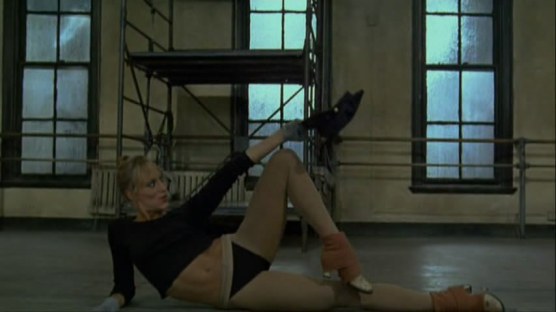
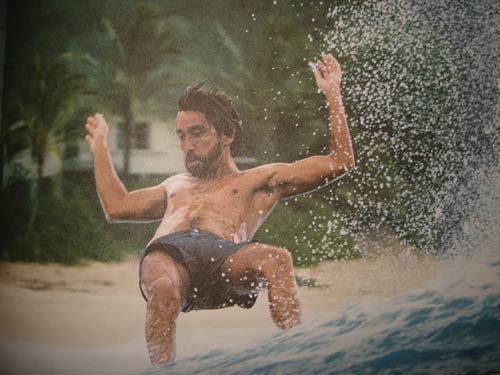
The other characters in the 1982 film received their parts for similar reasons.  Sandahl Bergman was cast as Valeria after director John Milius saw her in, believe it or not, All That Jazz, and exclaimed “she’s a valkyrie!”  Gerry Lopez, Subotai, a surfing buddy of Milius’, received his part based largely on his disarming personality rather than his acting ability, and it is his demeanor more than his dialogue that brings the character out.  Yet put together, they created some great characters, and despite my desire to propose marriage to Valeria at any given moment, Subotai comes close to stealing the show.

Sandahl Bergman in the “Air-Rotica” sequence in “All that Jazz”
Gerry Lopez was a surfer before he was an actor.  It was his swagger, slouch, and persona that makes the character of Subotai what he is.

The guy who really might steal the show is no surprise.  Despite a power-house cameo by Max von Sydow and some great over-work by Mako, James Earl Jones is without a doubt one of the most effective villains in fantasy films as Thulsa Doom.  The first question I would pose is: how many evil things do you see Thulsa Doom do?  Really the only thing you see him do personally is behead Conan’s mother in the beginning of the film; though given the world that’s established you’d think that kind of thing happens all the time.  So what makes Doom effective as a villain?  Sure he’s a 1,000-year-old sorcerer leader of a cannibal cult, but it’s what he doesn’t do that makes him powerfully scary; not because he can’t just because he couldn’t be bothered.  Jones plays him with so much subtle power you’re only moments away from falling to your knees in the worship of Set yourself.  Jones actually says he doesn’t want to play his villains in the typical, manic, Batman-villain type crazy evil.  Think Darth Vader, and, I think more powerfully, Thulsa Doom.  He never gratingly shouts orders or smashes skulls.  You know he can but he has “guys” for that.  He’s far too powerful to mix it up.  So when he says, “Now they will know why they are afraid of the dark. Now they learn why they fear the night” you shake in your boots far more than if he drew an axe and roared.

As Doom James Earl Jones radiated silent, subtle power. He wasn’t needlessly cruel or wildly vicious. It made him seem all the more powerful because of his confidence and calm.  In that scene it is his utter LACK of emotion that makes him seem so frightening.   The scene itself is terrifically done, shot in silence with only the score and Jones to focus emotions.

The characters are all believable for their world and included in an organic, if sometimes convenient ways for the story.  Again, this film isn’t perfect (what film is) but for the most part you overlook anything that isn’t 100% pristine because its intentions are so pure and its narrative so excellent.  Next time, we’ll look and see how the 2011 characters and actors compare.

Trends in Modern Storytelling in Film: Conan – A Case Study Part 2

OffTheCharts

What makes a good protagonist character?  I was once given advice by a good friend about one of my characters who I created to be a warrior savant.  During one scene the character meets his match, but refuses to give up.  My friend told me he felt this was the most relatable the character ever was.  Not his brilliance as a combatant, but when he refused to give up despite the long odds.  With that advice in mind I completely changed the character to embody those traits rather than his previous traits of being a natural genius.  I still believe a character that has to face hardship to gain ability makes for a better hero and we return to the two Conan films to see how this trend has changed over the years.

Conan the Barbarian (1982) – The Wheel of Pain: Becoming Great

Wheel of pain

As I said in my previous post, the Schwarzenegger Conan is sold into slavery after his village is burned and his people killed.  In a dramatic montage we see him and dozens of other boys herded into a desert where they push a monstrous device the filmmakers dubbed “the wheel of pain.”  During the scene we see young Conan with many other slaves pushing the wheel.  Then adolescent Conan with fewer slaves pushing it.  Then adult Conan, now as Arnold, pushing it alone.  Conan is insinuated to have pushed the device for perhaps a decade and a half, some of that time alone; only the strength of his will keeping him alive and making him stronger.  Because of the strength he has gained, his rather benevolent slave master takes him to a fighting pit where he is instantly in over his head as a more experienced fighter rushes him, wounds him, and nearly kills him.  Again, Conan’s strength of will, along with the physical strength he gained pushing that wheel, overcomes the opposition and he defeats his opponent.  We then see another montage as Conan improves in the fighting arena.  Mako’s narration provides his impetus:

He did not care anymore. Life and death – the same.  Only that the crowd would be there to greet him with howls of lust and fury. He began to realize his sense of worth. He mattered. In time, his victories could not easily be counted. He was taken to the east, a great prize, where the war masters would teach him the deepest secrets. Language and writing were also made available, the poetry of Kitai, the philosophy of Sung…

Here we see him improving himself, fighting endlessly.  We see him training with masters, studying, practicing endlessly into the night.  We see Conan getting better so that when the time comes for him to fight for real, we know why he can and feel he has earned the victories over his enemies.  This is what makes him a great protagonist.

Conan the Barbarian (2011) – Born of Battle – The Chosen One

Recently there has been a strange trend in making our heroes the “natural genius” or “chosen one” that I find unusual; almost as though we want our heroes to be naturally better than us rather than to have them work for their abilities.  This “chosen one” trend can be seen in a lot of recent films.  The Matrix, Star Wars I-III, Eragon, and most disturbing to me (no joke) Kung Fu Panda, where the guy who worked his tail off to be great is the villain, and the “gifted” character who doesn’t have to work to be great is the hero.

In the 2011 Conan film Conan, in an interesting scene, is born when his pregnant mother is stabbed and his father performs an impromptu sword-cesarean.  We then see young boy Conan who wants to partake in a trial for the older boys to race through the mountain with a small egg in their mouths, those who return without breaking the egg can participate in battle.  The boys are ambushed by vicious, adult, tribal warriors during the race.  The other boys retreat but Conan stays to fight.  The young boy killing them all, beheading them, and returning to town without breaking the egg.  It makes for a rousing scene…however something is missing from the character.  We just accept our hero is naturally better than the older boys.  He is our hero and he’s gifted, even as a young boy he’s better than his peers, enemies, everyone but his father.  There is no progression from boy, to warrior.  He’s always mighty, and therefore many of his fights are less fulfilling because we know he’s gifted, and furthermore we don’t feel he has earned his strength.  He was “born of battle,” he just is great he didn’t have to work, train, and struggle to become great.

Many great, classic characters embody when I think of when I consider what makes a great hero.  Rocky immediately springs to mind; he knows he can’t beat the champ, saying:

Who am I kiddin’? I ain’t even in the guy’s league.  It don’t matter ’cause I was nobody before… That don’t matter either.  It really don’t matter if I lose this fight…  ‘Cause all I wanna do is go the distance…if…that bell rings and I’m still standin’ I’m gonna know for the first time in my life that I weren’t just another bum from the neighborhood.

It’s this we can all relate to.  Few of us are as slick and talented as Apollo Creed, but many of us feel like just another bum from the neighborhood and look for a way to disprove it.  It makes me wonder why so many of our recent heroes have been written to simply be great rather than earn greatness.  Is it an aspect of lazier writing (writers would rather just have characters be than explain why) or is it endemic of our culture?  No one wants to earn their greatness, we all just want to be granted greatness and declare ourselves great.

It might seem like a little heavy thinking for a discussion about a couple of fun fantasy-action-adventure films, but it is worth consideration.

The next post will be about the actors’ in both films; analyzing heroes, villains and how they are portrayed.