When I tell people I have a dog and a bird, I get raised eyebrows and strange looks. Sure, most people understand the dog, but a bird? They ask, “Why do you have a bird?” “Does it talk?” and “What do you do with a bird?”
A lot of people think a pet should just be a dog or a cat. Dogs and cats are “real” pets because you can play with them and/or cuddle with them. If you have a bird, reptile, amphibian, or any other animal that doesn’t fall into the traditional pet category, it’s weird.
These people should open their eyes (and minds) a little.
Friday afternoon as I sat in traffic, I received the call about my bird, Snowflake, passing away. She sat comfortably in her cage, where she used to lay eggs, and fell asleep for the last time. She did not suffer and simply died from old age.
She loved to explore our bedroom.
I won’t lie, it hurt. A lot. I cried the whole way home. I thought, if she wasn’t a real pet, this wouldn’t hurt so much…
We adopted Snowflake 15 years ago when she landed on someone’s head, and they brought her to us. Growing up, I only had dogs and maybe a cat, but there was no way I would let her just fly out a window. She needed a home, and I was happy to care for her.
Snowflake was more than just a pied cockatiel. She was sweet and affectionate. She was moody and hostile. She hated men of her kind and mine. She loved heavy metal, hated the answering machine, protected the women in the house, and only wanted to socialize on her terms. She loved popcorn and Doritos. Snowflake had personality.
Snowflake rubbing her head on my cheek.
When I got married and moved into my current house, she was the only thing – other than clothes and a few posters – that was mine. Sure, she was the family pet, but we shared a special bond. I talked to her like she was a person, I let her fly around my room, and she loved to walk on my bed. And she’d fly back and forth, from one window to another, when she didn’t want to go back into her cage. Sometimes I’d cuss at her for that, too, as I balanced on chairs and my bed while offering my hand as a perch.
No matter the animal, we grow attached to them. Sometimes we talk to them when we can’t talk to anyone else – animals can’t gossip or argue. In fact, they may be the only ones in the world we can completely trust. There’s no judgment or criticism.
So, to those who don’t understand why someone has a nontraditional pet: Think about having a confidant who is understanding, loyal, and can offer peace and normalcy during the toughest times. We depend on them, whether we realize it or not, just as they depend on us for food, shelter, and water. We need them as much as they need us.
A special thanks to Snowflake, one of the best pets I’ve ever owned. The house won’t be the same without her…
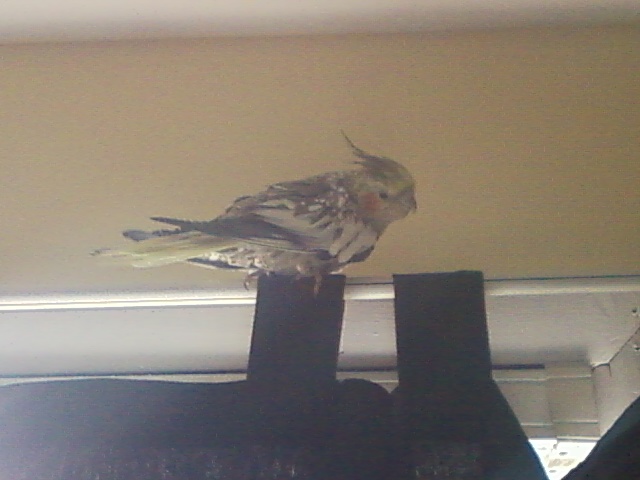
Perched on top of my curtain rods where she’d spend hours in my room…
Imagine you work at an advertising company, and you have a client you want to impress. The client is some ritzy hotel in some heavily traveled city. So in their ad you type, “the premiere destination for fun and entertainment.”
Guess what? You just made a BIG mistake.
I mark up premier vs. premiere all the time. Most times, the error is in ads in this exact usage. They are the premiere hotel, destination, B&B, etc. Unless they are a movie or play, they’re not the premiere anything.
Common Terms Used in This Post:
Noun: a person, place, thing, or idea
Verb: an action that is performed
Adjective: a word that describes a noun
I’ve noticed people use an e on the end because they think it looks better, or maybe they are misinformed and think it’s the British or French spelling. The e on the end does not make something look more important – in fact, it may make you look dumb. It’s not a style thing or preference; they are two different words with two different meanings.
Premier (no e on the end): This is an adjective that describes something first in rank or importance, or first in time.
a. Some say the Music City Center is the premier place for meetings and events.
b. The premier hot spa draws in more than a million people annually.
Premiere (with an e on the end): This can be a noun or a verb, and is the first public viewing of something. Think of a debut of a movie or play.
a. The movie premieres next weekend.
b. We’re going to the after party once the premiere is done.
One way you can remember this is: movie ends in e, and its premiere ends in e, so there’s your correct usage. Otherwise, you probably need to use premier.
Welcome to the film industry! Where Christian Bale is offered $50M to play Batman. Another sequel bombed. And a few premieres failed to make money on opening weekend.
I’ve wanted to write this post for a long time, and I love movies. I really do. Watching movies is one of my favorite pastimes, and in another life I’d work as a costume designer or makeup artist. But some things just need saying.
As I scrolled through Facebook this week, I read about Bale and rolled my eyes. Hollywood is so desperate to make another Batman-type movie, they’re willing to spend 1/8 of what the movie makes domestically on one person. They are even more desperate to make good movies. So desperate they think Batman himself can save a Superman sequel that doesn’t need to be made anyway.
I’ve read numerous articles about the film industry losing money. Dozens of reports say ticket prices will soar, possibly in upwards of $50 a ticket. They blame Netflix, Amazon and Redbox for stealing audiences away from the big-screen. It’s crap. The industry has no one to blame but itself.
If Hollywood wants to save (and make) some money, there are five things it needs to do:
1) Stop making movies no one cares about. Think: Pacific Rim, The Lone Ranger, The To Do List, Jack and the Giant Slayer, John Carter, After Earth, and the list goes on and on …
Sure, someone went to these movies, but these movies bombed in the states and some worldwide. Why is that? Because the masses don’t care about any of the stories. It doesn’t matter who you put into a movie and how much CGI there is, audiences today want a good story. They want a story that entertains them, makes them bust a gut from laughing, or scares the snot out of them.
2) Stop making senseless sequels. At first, I thought this was just a trend, but as I read about 106 new movies coming out this year, I counted eight sequels – five of which didn’t need to be made – like Machete Kills and Cloudy with a Chance of Meatballs 2. Will Catching Fire do well? Of course. Those movies have a huge following for good reason: they are based on a good book series. Movies like Catching Fire and The Hobbit already have an audience and fan base.
3) Stop rebooting movies that don’t need it. We needed a remake of Total Recall? Clash of the Titans? And coming soon, Romeo and Juliet, Great Expectations, and Carrie? Out of those three, guess which one will do well. Without a doubt it’s Carrie, and the original is nearly 40 years old. That fact and the popular Chloë Grace Moretz will ensure the success of the remake.
4) Reduce the number of premieres. There are 28 movies premiering in September 2013 alone. That’s almost a movie a day! No one has the time or money to see that many movies, nor do they want to. It’s insane to think Hollywood has to release that many movies to keep up with demand. I’d like to see Hollywood cut the number of premieres before jacking ticket prices up to $50. People do have jobs, families, friends, hobbies, and lives.
5) Stop spending so much money to make the movie. Sure Marvel’s The Avengers cost $220M to make, and it’s made $1.5B (that’s billion) worldwide. Anyone who hasn’t lived under a rock for the last five years knew it would do that well. However, Jack and the Giant Slayer cost $195M to make and grossed a whopping $65M domestically and $197.6M worldwide. It barely broke even. The lesson here is: if you’re going to make a movie no one will see, don’t spend a fortune producing it. Less expensive movies can do well when the audience actually cares about the story and wants to see it (eg: Paranormal Activity, Insidious, Warm Bodies, This Is The End).
I went through my EW a couple of weeks ago and made a mental list of the movies that will flop this year. It’s sad that a regular person with no film experience can draw that conclusion. And you know if I can make that list – and to tell you how confident I am, I’d bet my car on it – big-time Hollywood executives can do the same. All it takes is paying attention and having a little common sense.
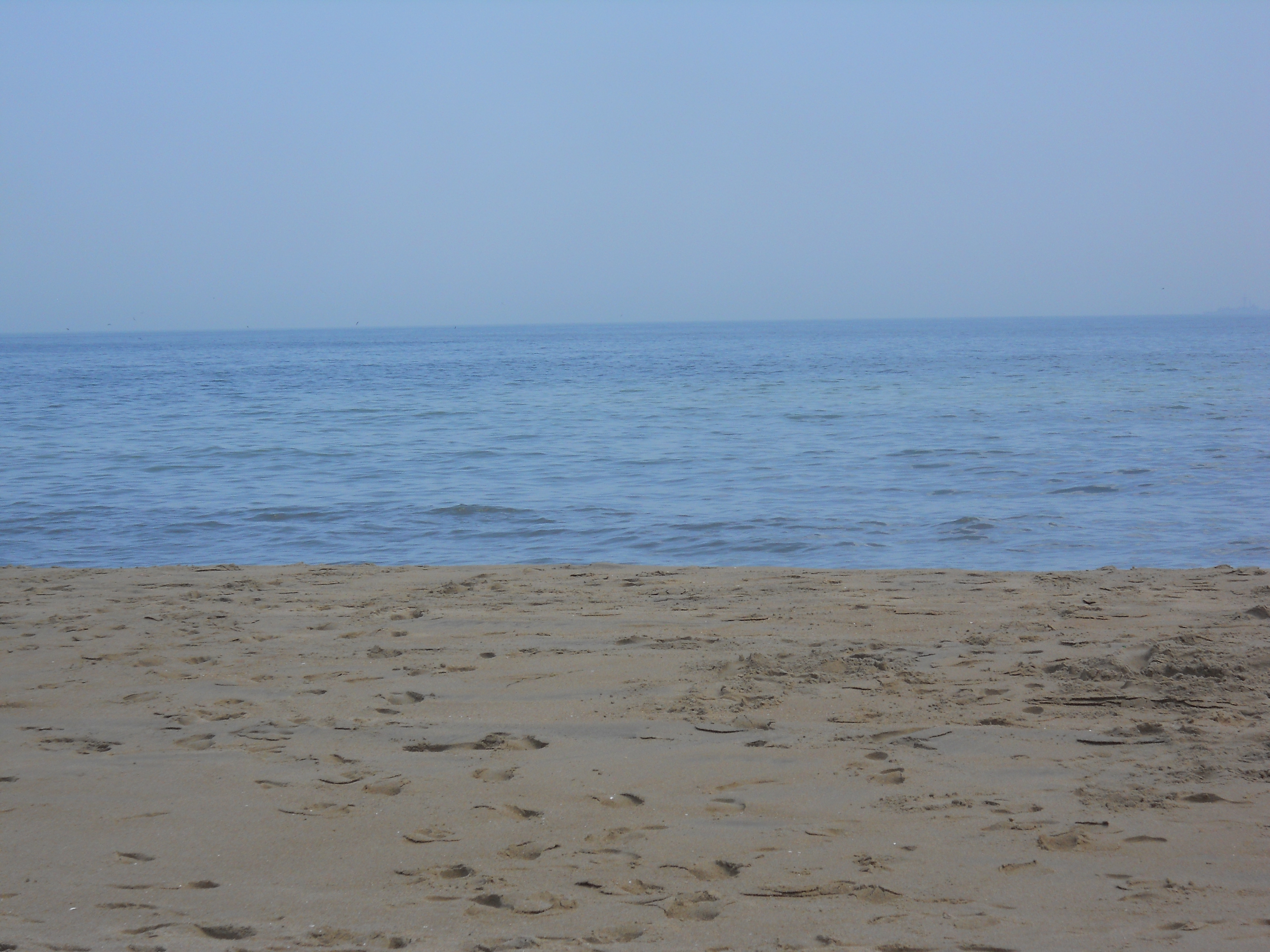
When you write, think of painting a picture. It can be any picture you want, but think of the images that must be in the painting. For example, a beach scene.
If you wanted to duplicate this picture, you would need to include the sand, ocean, and sky. You wouldn’t add clouds, the sun, an umbrella, etc. If you added those things, you may lose the tranquil setting this picture represents and change the meaning. Adding unnecessary items may distract your audience or lose them entirely.
The same is true in writing.
Adding unnecessary words, phrases, and punctuation can distract your readers or cause them to stop reading. Once that happens, conveying your message is almost impossible. Most studies agree that the average adult attention span is 8 seconds or 140 characters. Not words, characters. If that’s true, you would only read the first two sentences of this post before moving onto something else.
So, what does that mean to writers? It means we need to cut the crap.
In the chapter Art is Inspiration, Ueland discusses writing from our hearts and saying it like it is. She credits Russian writers, like Chekhov, who focus more on the truth rather than how they sound. Personally, I enjoy Russian writers for the same reason and believe that it is more effective to teach readers than sound like you have read the dictionary.
Here are a few tips to help while you write:
1. Don’t use words/phrases no one knows or ever says. Big words do not make you sound smarter or tell your reader anything about you – except maybe you’re over compensating for something. As you write ask yourself, “Would anyone ever actually say that?”
2. Only use adjectives and adverbs when needed and know how to use them. They do not improve your writing or ideas, and sometimes readers will think they are fluff.
3. Show don’t tell. Future post coming, but Ueland says, “… quietly describe what you are feeling. Don’t say your boredom was excruciating or agonizing, unless your own was, which is doubtful.”
4. Focus. Remember to only include what is necessary to convey your message. This tip applies to characters, setting, plot, words, objects, etc. You probably wouldn’t paint a mountain with a fruit bowl, so why would you add unnecessary words, details, or characters to your story? Everything should have a purpose.
Do you have any tips on editing? For more info, check out:
This was a real first for me. For the first time in 20 years, I picked up a paint brush that wasn’t for trim or a wall. I painted a little in my youth but never anything more than your typical ten-year-old.
In my post about Red Bubble, I mentioned the important of thoughtful gifts. And this month, one of my dearest and best friends had a birthday. He is incredibly difficult to shop for though, so I have to get creative. Really creative.
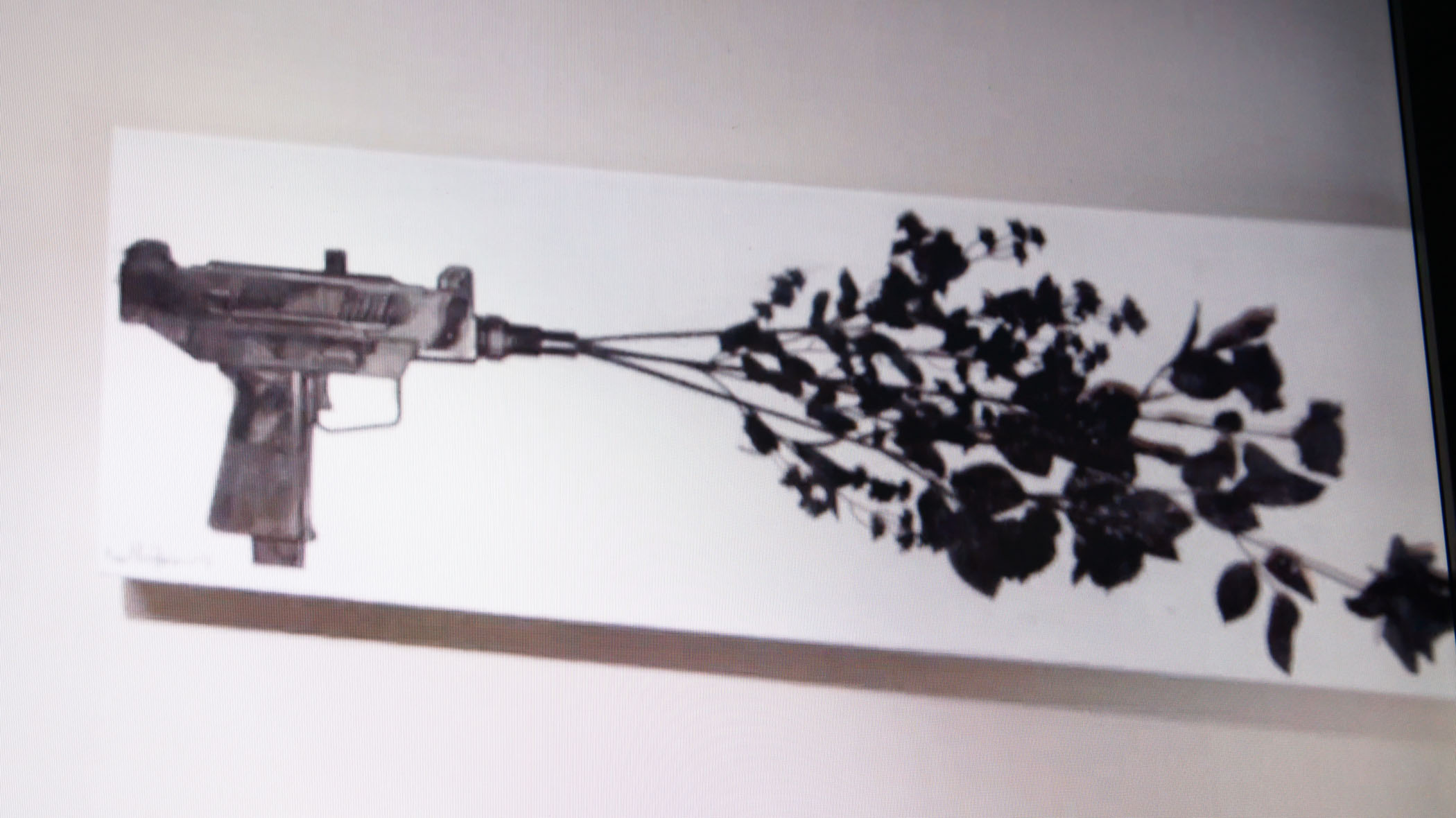
This painting first premiered in Psych’s This Episode Sucks, and my pal immediately texted me about it immediately. In fact, a couple of people did, and you have to admit, it’s pretty friggin’ cool.
The problem is you can’t buy the painting. I’ve read through dozens of forums and posts searching for the artist and/or painting, but turned up empty handed. The problem-solver in me thought, “Psh. If I can’t find it, I’ll just paint it.” And that’s exactly what I did.
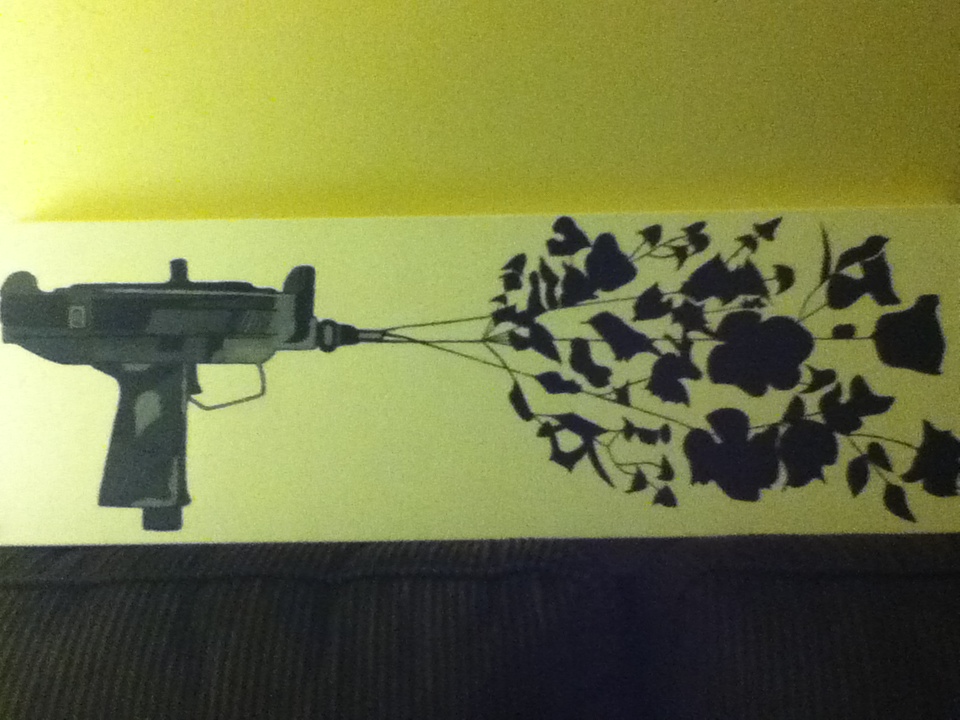
The flowers were not a problem for me, but I knew the Uzi would be, so my amazing RevPub partner penciled the Uzi on the canvas. From there, I printed a picture of the original and used it to paint my version. It’s not an exact match, which is a good thing, but I think it came out well. This project also inspired me to paint regularly because it was fun, relaxing, and something different. I can’t draw or visualize things, but I look forward to painting more penciled drawings!
It just proves that you should never be afraid to try something new. You never know what talents lit inside you or what new hobbies you’ll find!
*If anyone knows the original artist’s name, feel free to leave it in the comments section.
The start of painting the sketch. I did the shading in pencil and the basic outline first.Uzi painted in full color scheme. I lost all the lines but having a print out and pics helped a lot.Full painting after flowers were painted. I sketched them in pencil.Completed Uzi flower painting. I had no idea how to shade, so I made my own version!
In her Nashville Driving Tips for Out-of-Towners, Raven suggests that the average Nashville driver should cruise at a steady five miles over the posted speed limit. Although she gives stellar advice nearly always, this is one guideline I choose not to follow.
I’m a speeder. Like my father before me, I drive like I’m hurrying to stop a terrorist attack or there’s a pregnant woman in the backseat crowning. That being said, I don’t get many tickets and haven’t been issued one in probably seven years (though I definitely will have earned my next one). And I’ve never been directly involved in a traffic accident. However, I have been in an accident where someone else was driving – a pretty serious one – that involved a fully loaded school bus. Hard to believe it was almost 25 years ago, but the memory is extremely vivid, and as I reflect on it now, the experience has had its lingering effects.
And We All Fall Down
In the summer of 1991, my younger brother and I spent six weeks at a boys sleep-away camp in Asheville, N.C. If you’ve never been to Asheville, it’s a beautiful place and remains one of my favorite spots to visit with its spectacular mountainous scenery and somehow untouched feel. Now it’s basically full of hippies and artists, but that’s not so bad I guess.
It was a summer of firsts for both of us in many ways. Our first flight without a parent. Our first time away from home for an appreciable amount of time. Our first time being responsible for our own schedules. I remember riding from the airport in the camp’s 15-passenger van with all those strange faces, everyone dead quiet, like we were on our way to a mass execution instead of a summer filled with swimming and camping. I remember the terrible food and the life-saving care packages from Mom. I remember slow dancing with a heart-breakingly beautiful blonde from the girl’s camp and sneaking out to kiss her behind the stables after. Good times.
I took to camp life immediately, without a hint of homesickness, partially because the program I was enrolled in was so exciting. Whereas my brother (who was just 9 at the time) did the typical camp activities you see in movies, like woodcraft and archery and tying crazy knots. My group – “the old kids” – went whitewater rafting and mountain biking and spelunking. Every day was a new adventure, and it was exhilarating.
Towards the end of our term, my group just finished a three-day hike down part of the Appalachian trail in almost constant rain. Several of the kids became sick, and I remember fighting a cold, but unlike some who checked themselves into the infirmary, I fought through it – mostly because I did not want to miss the next trip. The next day we were repelling down a sheer mountain face, and I had looked forward to it ever since I saw it in the brochure.
The following morning reveille sounded over the loudspeakers at 7 a.m., bringing collective groans and creative curses that only 12 year-olds can muster. After another horrifying breakfast barely touched by most, my group gathered at the gravel entrance, loading up the battered old short bus with climbing gear and coolers full of sandwiches and drinks for the day trip.
It was a longer drive than most of our outings, and after the usual round of rousing camp songs – most involving vomit and/or boogers – I remember we settled into a comfortable silence as the bus wound up into the foothills. It was cool and bright and gorgeous, with a strong breeze and the deep earthy smell of the mountains. I sat towards the rear of the bus on the right side, so I could look out over the valleys as we climbed up and up. All that summer I had been reading Tolkien and daydreams of the Misty Mountains came easily with no sign of man’s hand visible, except for the back country road and, of course, the bus.
Looking back, I estimate there were 15 kids and four counselors that day, basically four people per row with the walkway splitting us into twos. The oldest of the counselors, whose job it was to keep us from killing ourselves and each other, was a very large man who always sat in the half seat at the front of the bus, opposite the driver near the main door. In my memory, he’s somehow turned into the late and great Chris Farley, which seems to fit perfectly – he was all shoulders with floppy light brown hair. The other three are faceless to me now, but he stands out easily.
Long, lazy spirals took us closer to the upper end of this sub-range, and my view through the thick rectangular window was bright and clear and very steep. Without warning, the bus took a sudden lurch to the right and I felt the brakes lock, which caused the back-end to fishtail a bit outward towards the drop. I looked up in time to see an old pickup zip past us going the opposite direction and slide into the little ditch scraping against the face of the mountain. Curses came from the counselor driving as he tried to guide the bus back towards the center. The boys gasped, and suddenly we were tilting in very much the wrong direction. Grinding and crunching as the rear wheel fought for purchase. It seems like a very long moment looking back, but it couldn’t have been more than five or ten seconds.
Farley gave a shout and threw his considerable weight against the opposite side of the bus, slamming his shoulder against the frame of the wall, but it made no difference. Those three or four tons of bus and children tilted almost casually and down we went.
The only way I can express how the fall felt is to imagine a giant hamster wheel in which children and backpacks and sandwiches are all thrown together to spin around and around helplessly (no seat belts in those days). It was basically ceiling, window, floor, and repeat. And screaming, lots of that.
We came to a sudden crunching halt, my face pressed against the window I had been looking out of peacefully just seconds before. Except now that window was pressed into the dirt with a single fat earthworm squished on the other side, no doubt shocked by this turn of events.
Cautiously, we made our way out of the now horizontal rear exit lowering ourselves one by one down to the ground several feet below. The first thing I remember is how steep the fall was; I want to say at least a 40 degree angle. The bus had cut a swath of earth the way you would imagine a jet crash-landing in a field without landing gear. Flattened trees were strewn in its wake. I looked back to the bus, its progress down the mountain had been halted by a single tree. There was a noticeable bend as the roof bent in a slight V around the tree, which was leafless, and by all rights, seemed to be dead or dying. Farther below was more mountainside and an even more steep drop.
Our eventual extraction by firemen and police is pretty dim at this late age, but I do remember us being taken to the hospital for exams. Amazingly outside of some minor cuts and bruises, the only major injury was a dislocated shoulder by our heavyset counselor who charged the wall.
I remember getting back to the camp and sleeping the sleep of the dead, both through the exhaustion of climbing back up the mountainside and the emotional strain of nearly dying. The next day we were given an amazing dinner attended by the head of the camp and several older folks who must have been the owners. Afterward, the oldest of the oldies gave a speech, which even to our unsophisticated minds amounted to, “Please don’t tell your parents to sue us.” No one did to my knowledge.
Despite the accident, I did return the next year; though it was unremarkable for the most part. I did get a ridiculous case of athlete’s foot from the community shower. I also saw a boy cut off most of his thumb with a hatchet. Nothing matched the bus accident though.
Was I scarred for life? No, not really. I was a little more afraid of heights after the accident, but not in a debilitating way. Really the only after-effect was I have trouble driving in the mountains still, and I tend to drive close to the center line regardless of where I am, which is disconcerting to my passengers but comfortable for me. And, of course, I drive like my hair is on fire, but that’s purely genetic.
Have any crazy camp stories? Feel free to share them below!







 Revenant Publications