Life Lessons from Video Games Versus Mode: Street Fighter 2

LifeLessonsHeader

Street Fighter II…  Capcom’s sequel to the now-obscure Street Fighter changed the face of fighting games.  Multiple, selectable characters, specific special moves, bright graphics; it took everything that could be learned from beat em ups like Double Dragon and simplified it into a one-on-one tournament fighting game.

I won’t go into the game’s colorful history.  That’s not the focus of this review, this will just be my history of Street Fighter.

My first introduction to this legend of the arcade occurred in 6th grade.  Our middle school typically took students with decent grades and no suspensions on an “incentive” trip to a skating rink or a bowling alley.  That six weeks we all went to an local bowling alley for a couple of hours.  I wasn’t interested in bowling really, but the alley had two arcade machines.  I don’t remember what the other one was, but one was Street Fighter II.  There was a queue of kids lined up at one stick, and a kid named Ralph dominating the other.  I got into the queue, not knowing what this game was or why there was a line and one-by-one kids fell as Ralph took them out.  When it was my turn I put in my two quarters, selected the character I thought looked the most interesting (I chose Blanka…all I thought was “wow big green monster!”) and preceded to lose two rounds.  I didn’t do too badly.  In fact after the fight I remember saying, “I didn’t know what I was doing!” with a laugh and Ralph telling me, “Actually you didn’t do so badly…”

I only went to the arcade on rare instances or when the school went to a place that had some machines so I had to wait for a home version in order to really play games.  Despite having only played the game one time, I got swept up into the craze when Street Fighter II: Champion Edition came out on the Sega Genesis.

It was here that I really learned the game.  The Genesis standard controller wasn’t great for these games, but buying a six button controller made it PERFECT for Street Fighter (in fact the licensed “Street Fighter” controllers that came out with the release of SFIV look suspiciously like Sega 6-Button controllers…) and I played the game religiously.  So much so that on trips to the Rivergate Skate Center during 7th and 8th Grade incentive trips I started to run the Street Fighter II machine.  I originally played as Sagat, having recently seen Jean Claude van Damme’s Kickboxer but eventually moved to Ken, and solidified using Ken once super moves were introduced in Super Street Fighter II.

So what makes Street Fighter II a legend?

1.)    Design: Starting with the first thing a gamer would see when they first laid eyes on the cabinet or picked up the cartridge box.  The characters were all unique (except of course the Ryu-Ken similarities) and colorful.  Similarly the backgrounds were all character-specific and had great animations.

2.)    Graphics: Tied to design, the graphics of the game were amazing at the time.  The characters moved fluidly and smoothly, their jumps and attacks all looked better than anything I’d seen before, and the special moves truly looked special

3.)    Diversity: All the 14 of the 16 characters in Street Fighter II Champion Edition were unique.  Though similar commands were used for special moves, they didn’t execute the exact same moves (though they may be similar) and ALL the basic attacks were individual to each character.  Also each character (except essentially the four “boss” characters) had unique story-based endings that gave the game massive replayability.  Beating the game with Ryu was an entirely different prospect to beating it with Vega.  Similarly, fighting each enemy took thought.  You couldn’t always use the same strategy to beat Zangief as you did to beat Chun Li.  Until you mastered it…your brain had to be awake for this game.

4.)    Ease of Play: the most important aspect of a fighting game to me…and something I feel they’ve lost, even the Street Fighter series, over the years.  Fighting games are GREAT because they are “pick-up-and-play” games.  Like I said, I never played before losing terrifically to Ralph in that first game.  But I did ok.  It’s not button mashing, you don’t get far in Street Fighter doing that, but the attacks, moves, and special moves are all so easy to figure out and execute a player can easily learn how to play one or two characters after playing the game only a handful of times.  This pre-dates the over-complexity that I feel has been added into fighting games.  Long-strings of combos, idiotic “air-juggles,” and multiple counter moves are just more than I want in a fighting game.  Keep it simple and fun for me…

5.)    CONTROL: Tied to the last one but by far the most important aspect of the game.  Street Fighter II‘s control was a revolution to me.  It was intuitive to the player and even made sense for the actions being executed.  Pressing “back” to block was a stroke of genius.  Six attacks varying in strength, 3 punches and 3 kicks, all useful (thought admittedly I played for YEARS with just a jab-fierce and short-roundhouse button setup on PS1) “Down-Down+Forward-Forward” is actually the motion you’d expect a character to do when throwing a fireball.  The same goes for the Shoryuken and the Hundred-Hand Slap.   I don’t think I’ve ever played a game with more perfect control (but woe be unto the second player who’s used to playing first player…and has to reverse all those commands!)

Street Fighter II revolutionized arcade gaming.  Through various iterations of II, eventually Alpha (Alpha 3 is my favorite of the series by far…the most balanced and best character roster I feel), a 3D game (EX…ugh), and now back to 2D with Street Fighter IV (and its iterations), it retained basically the same controls.  It’s heaped on many new complex concepts, and crazy characters, but at it’s based on the same framework.

Next time will be another arcade fighting game that revolutionized the genre, Mortal Kombat!

Life Lessons from Video Games: Versus Mode!

LifeLessonsHeader

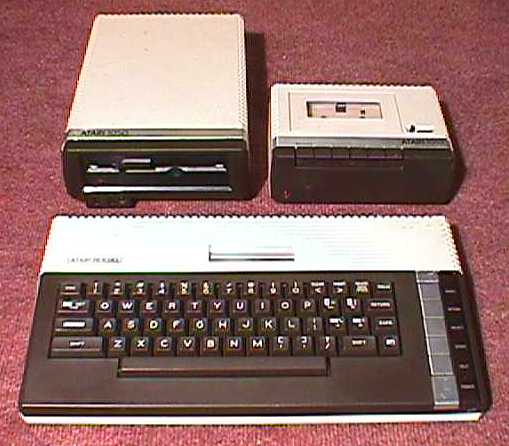
I’ve been playing video games since I 4 years old.  My first “gaming” system was an Atari 400 and was replaced (actually it was added to by) an Atari 800XL in the mid-80s.  I was a military kid who lived in secluded base-housing and, essentially, only knew my family.  I just assumed that everyone was playing Centipede, Missile Command, Frogger, and  Pac-Man.  In addition I had loads of games that almost no one has heard of but remain my all-time favorites; Sea Horse Hide n Seek, Ducks Ahoy, and Movie Musical Madness.  It wasn’t until my father retired from the USAF and we moved into “civilian” life that I first learned of what kinds of systems were popular.

I had an Atari…but never heard of an Atari 2600.  My memories of Pac-Man are slightly different from most others…the 400 and 800XL computers I had played different versions that actually (to me) looked superior to the 2600 version.  I only ever saw Commodore 64s and Apple IIs in school.  I never heard of Colecovision until I saw it on VH1’s I Love the 80s and never heard of Intellevision until James Rolfe did a video about it.  I DID hear of NES almost immediately after my we left the military lifestyle.

Atari400

Atari400

Atari800

I can remember being in my elementary school cafeteria in my private school blue shirt and slacks and a vicious little rich kid snarling at me, “What?  You don’t have Nintendo?! What’s ‘Atari’?”  I remember telling my mom that and she said, “I bet our Atari has better graphics than their ‘Nintendo…'”  And I immediately agreed.  And the game was on.

Over my lifetime I’ve seen numerous competitions in video games, systems, and gaming culture in general that are all just as frivolous and subjective as this one.  Sega vs. Nintendo.  Street Fighter vs. Mortal Kombat.  Sony vs. Microsoft.  It’s been fascinating to see them come and go, and each generation of hardware and software customers act like it’s the first time these things have ever been discussed.  I’ve been thinking a lot about all these various, senseless wars I’ve witnessed during my gaming life and thought I’d start sharing some of the most memorable.  Since this is just a little intro I thought I’d start with a brief look at the Atari vs NES.

Of course the Atari 400, which came out in 1979, and even the updated 800XL had nothing, hardware-wise, on the NES.  The NES came over from Japan with a library of games that would become classics (and some hardware strangeness that would fall into pop-culture obscurity).  Since the NES clearly has the edge in nearly every technical sense, I thought I’d look at just one thing that strikes me as amusing in terms of my old Ataris compared to the NES.

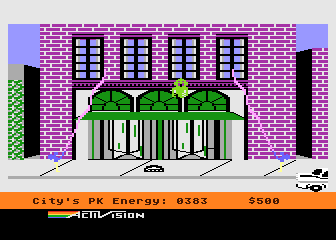
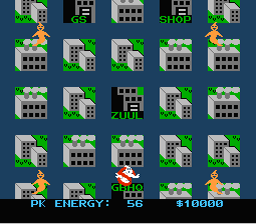
I started watching AVGN when the new Ghostbusters game was set to come out on current-gen consoles.  I heard a funny online reviewer had reviewed the NES Ghostbusters game and I was intrigued, I didn’t know there WAS one.  I turned on his review and was alarmed to see him reviewing a game I knew…only I knew it from my Atari 800XL…I knew it on floppy disk……and I knew a MUCH better version!  Smoother gameplay, more “ghostbuster-y” graphics, and less idiotic additions (like the gas station…)  Granted it was still a monotonous “wtf is going on?” kind of game, but the NES version looks like a butchered port…of an Atari game.  The Atari version was no masterpiece…but it’s definitely competitive with the later NES version!

That little fact did indeed help remind me that, although the most popular system might dominate the market, the reviews, and rewrite the history, for the minority of us who lived with other brands…we might have found a nice classic gem.

In two weeks I’ll start versus mode in earnest, and will try to do one every two weeks.  The first one will be the most appropriate way to start such a contest and has been a heated debate for almost 20 years…ladies and gentlemen…it will be: Street Fighter vs. Mortal Kombat!

Atari GB

NES GB

Life Lessons Learned from Video Games #4: A Love Letter to Old School Sega

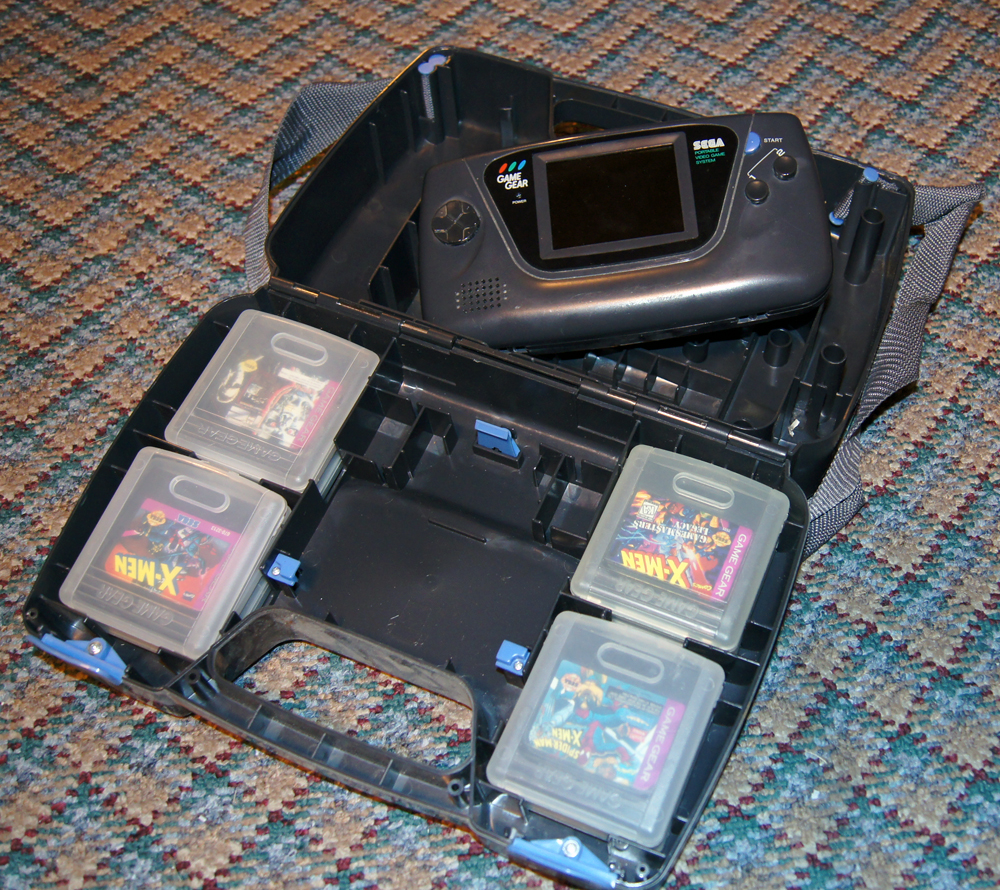
Though I have very little time to just kick back and play games like when I was a kid, I still follow the culture and play when I can.  I do have a current-gen PS3 but I find the most joy playing the games from my youth.  As I said in previous posts, I started with an Atari PC (and was roundly mocked by all the Nintendo kids), but eventually got an NES for Christmas.  I loved the system and played its games religiously.  Nintendo was so dominant, I didn’t even know what the “Sega Master System” was until I got a Sega Game Gear and it came with an attachment that let me play Master System games.

Game Gear
This IS my original Game Gear. I fell in love with Sega after playing it.

Shortly after acquiring my Game Gear in the early-mid 90s I discovered the Sega Genesis.  Unlike many, I don’t recall ever seeing the “Nintendon’t” or “Blast Processing” commercials.  I do remember seeing Sonic the Hedgehog and Streets of Rage 2 on the demo unit at Target.  The Genesis looked cool and the games were a lot of fun in the store.  I was sold.  I pawned my NES, all my games, and used some birthday money to buy a Sega Genesis (with Streets of Rage 2 included!!)  I loved the system, and began a rabid support of Sega.

Genesis Games
NES fans…I have nearly every great, classic NES game…and I think this collection is every bit as classic and no where near as complete…

In the early-to-mid-90s gamers were divided into Sega people and Nintendo people…I was a Sega person.  I played the fighting games, the Mutant League games, I LOVED the Genesis Shadowrun, and fought viciously with those who compared SNES franchises and graphics.  I so supported Sega I got a Sega CD one Christmas, and a 32X the next.  And I even enjoyed those systems.  I played and beat Sewer Shark; I was obsessed with Sonic CD and it remains the best Sonic game EVER in my opinion.  I had Doom on the 32X and a great little unknown game called Kolibri, a horizontal 2-d shooter where you and a friend can play as hummingbirds.  Don’t laugh…it was terrific…  I eventually bought the Saturn, which for its time was by FAR the best system out there.  It was well-supported and had great tech-specs, but lost out eventually to the N64, and eventually was crushed utterly by the new Playstation.  I even bought a Dreamcast…and only ever played Resident Evil: Code Veronica on it…before the PS2 did it in.

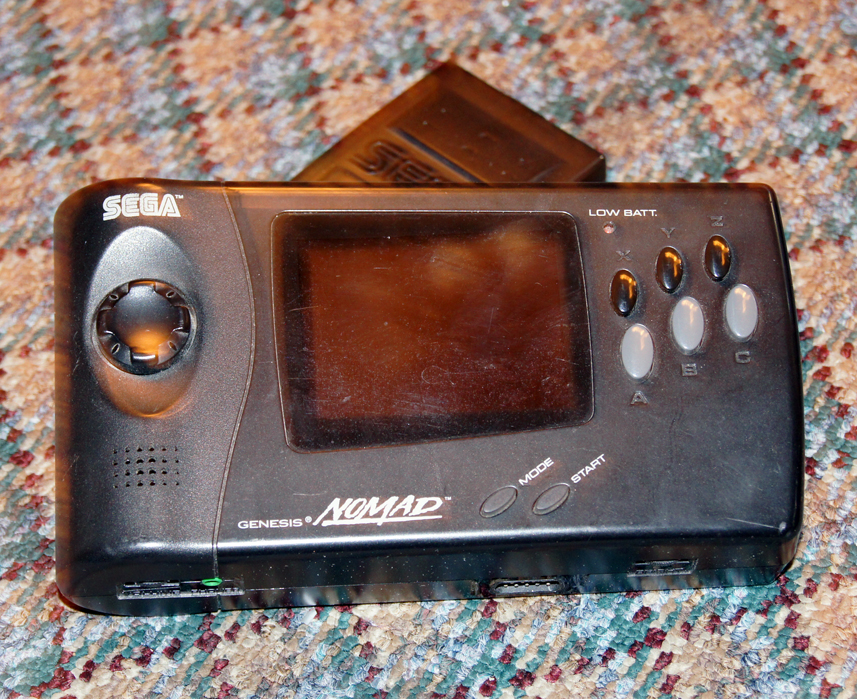
Sega Nomad
My handheld Nomad Genesis system.
Sega CDX
How I currently play my Genesis and Sega CD games on my TV. And a Slime PS2 controller. Because that’s where he lives and he’s photogenic.

Despite all their mistakes in business (Sega was obsessed with hardware and put games and software support secondary, blinded by competing with other companies they forever sought the “best tech” and rushed it out before the market was ready…barely supported it…then rushed out the next one and barely supported it) I have a lot of love for Sega.  After I set up my PS3, I played some Oblivion then, while filing the game away I found my Sega Nomad and spent the rest of the evening playing…you guessed it…Streets of Rage 2.  Still beat it too.  Sega lives in my gaming consciousness.  I still remember the Mortal Kombat blood code (Down-Up-Left-Left-A-Right-Down…memorizing codes from magazines in the grocery store…those were the days…), and playing as a raptor in Jurassic Park.  The GREAT X-Men Genesis games are still loads of fun to play and I still plan to invest time into eventually beating Shadowrun…if it’s possible.

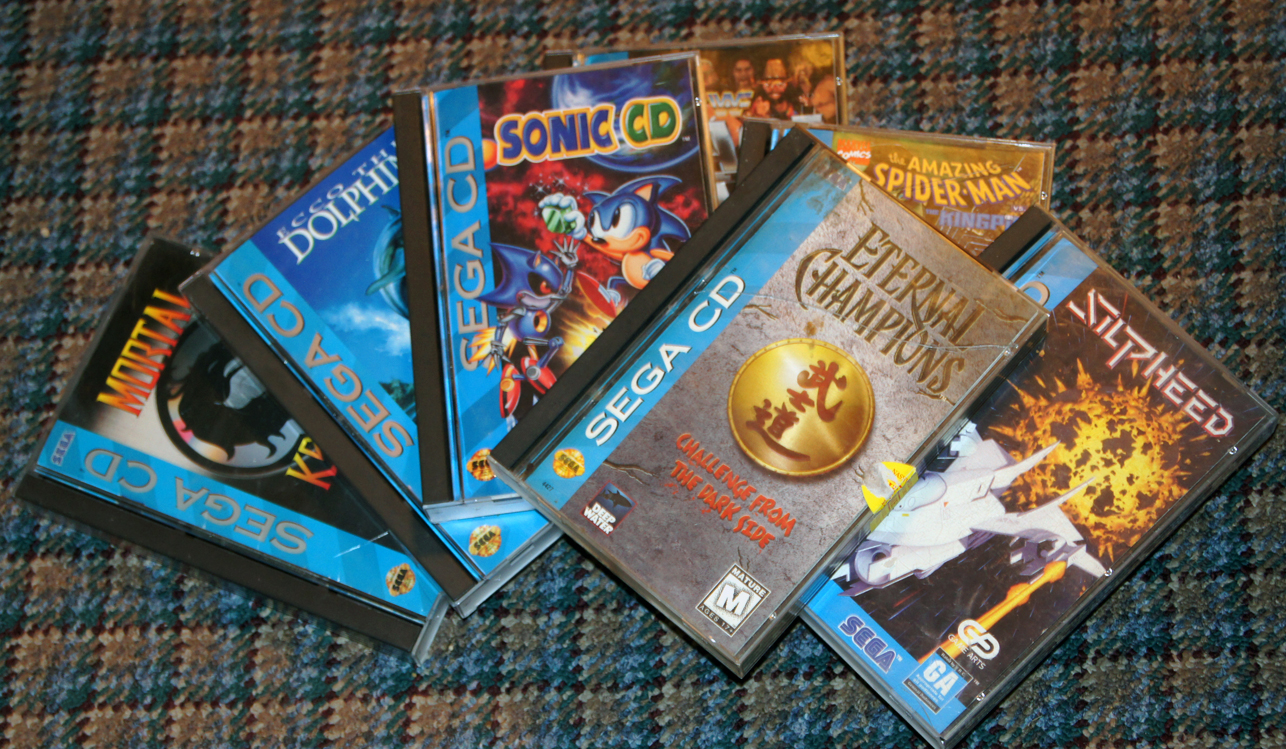
Sega CD Games
To all those who criticize the Sega CD I thought I’d produce a STACK of some great Sega CD games. This pile doesn’t even include the great Terminator game…
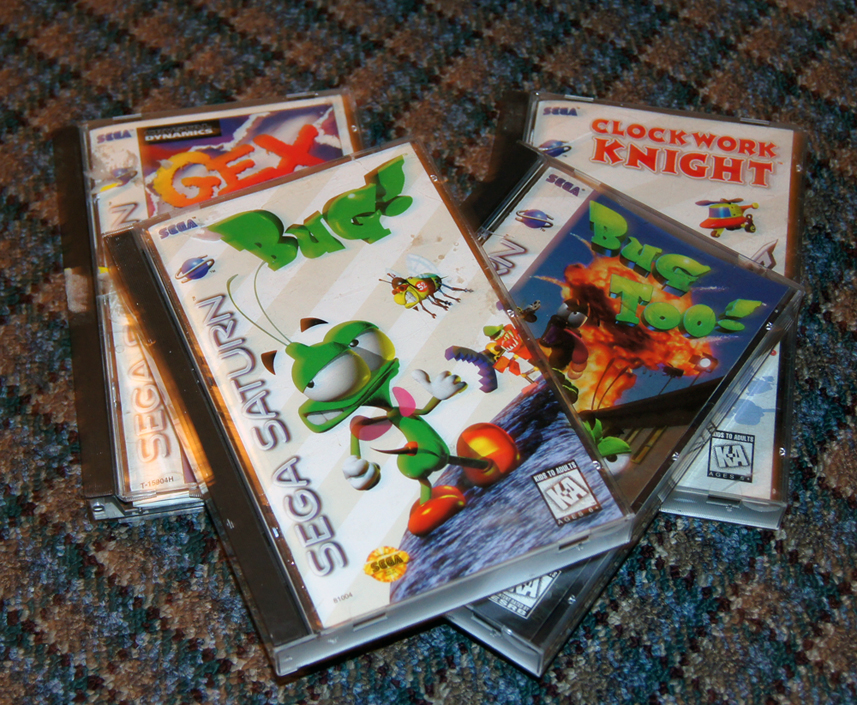
Saturn Games
Some of my Saturn games. I don’t have the Panzer Dragoons (though I beat the first one in high school) nor do I have the fantastic “Children of the Atom” X-Men fighting game. I put plenty of time in on that in the 90s too.

Sega is now in software only and is a shadow of its former self.  With the Sony vs Microsoft competition dominating the market now it seems like history is repeating itself.  Sides are being chosen, graphics comparisons are appearing in articles, libraries are being compared, and tech specs have appeared in countless posts and forums.  What seems to be lost is competition is actually good for the market.  I see posts on game sites where rabid fanboys declare their hope that their side puts the other out of business.  Does anyone think that would be good?  A monopoly on game technology would only reduce quality and innovation.  The Wii’s motion control and rapid sales incited Sony and Microsoft into motion controls as well.  The handheld war continues with new innovations like 3d, HD graphics, and wi-fi capability.  Social gaming has gone from a second controller and split screens to worldwide gaming.  I for one am hoping the “big three” continue to produce successful systems and franchises for several “next-gens” to come.  And here’s hoping that none of them, like Sega, become lost relics, sacrifices to the gods of greed and commerce.

But for now I say, long live the memory of Sega.  Plug in some 16-bit fun some time.  The Genesis is every single bit the great, classic console the NES is.  And I’ll GRAND UPPER anyone who says otherwise!

Grand Upper!
GRAND UPPER!  Forward-Forward+B. You can beat the whole game with this one…
Mutant League Hockey
And I don’t care who you are…this is AWESOME…

Life Lessons Learned from Video Games #3: The Dragon Warrior Skill Set

During my early NES days I considered platformers and action games to be my favorites.  I bought nearly all of my games used from a local hobby store and only ever got new games for Christmas or my birthday.  Contrary to popular belief, the price of games has always been high.  It’s only gone up with current generation games and then only $10 up from the glory days of NES and Sega Genesis.  Because there was no internet and I didn’t have any magazine subscriptions the only way I could find out about games was from other kids talking about them or renting them from the local video store, The Video Place, which is long defunct and had a limited quantity.  Because of this I never owned some of the most popular games of the time.  Despite my love of platforming games and action games I never owned Super Mario Brothers 2, Double Dragon, Ninja Gaiden, or Contra.  I did own Mario 1 and 3, Double Dragon 2, and Mega Man 2, but I also had some weird/bad stuff like Narc, the Predator game (based on the movie) and some from the now infamous LJN movie series, Nightmare on Elm Street and even worse…Jaws.  Since I didn’t know what was out, good, or popular, I went with what was familiar.  I liked Freddy so I bought the game.  Narc was cheap and available.  I loved (and still love) the Predator movie so I bought that one too (though it sadly didn’t work…talk about one disappointed kid…).  Not only did I go with what I knew, but I was also usually restricted by what the local comic book/used media store had in stock.  Often this meant buying obscure titles but sometimes I lucked out; like when I wanted a Game Boy for my birthday but they only had Game Gear which was both in color and awesome to the 12 year old me.  Another lucky find was Dragon Warrior.

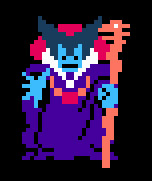
I bought Dragon Warrior (or Dragon Quest to Japanese fans) because I thought it was a Legend of Zelda-style adventure game, or hoped it might even be a Double Dragon 2 style beat ‘em up.  I played the hell out of Double Dragon 2 and hoped for something similar in a fantasy environment.  Shockingly, when I put the game in I saw the most rudimentary graphics I’d ever seen on the NES.  My character was a barely animated sprite.  Most of the game was text.  And then there was the game play…  Why am I talking to guards?  Who are these people?  Is that mass of blocks with the brown square a shop?  Is that smiling blue thing really a bad guy?  Is the ghost making a face at me?  Why don’t they move?  What am I doing?  Why doesn’t this damn bamboo pole do anything?!  Why is it in the game if it doesn’t do ANYTHING?!  These were my first thoughts on Dragon Warrior.  And I hated it.  Or at least I said I did.  But for some reason I kept playing it.  And kept playing it.  I had no idea what I was doing so I wandered randomly, kept fighting creatures, leveling up, and collecting money.  I died.  A LOT.  I wiped every couple of hours and was magically transported back to Tantegel Castle where I was robbed of my gold and forced to walk back to where I died where, if I was still too low in level, I would wipe again rinse and repeat.

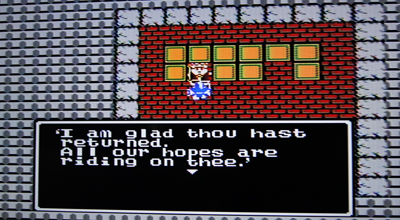
Dragon Warrior Castle
When I first played this game ye olde timey dialogue was easily mockable. It eventually grew on me to become some of my favorite video game text. Which is good…since most of the game is text…
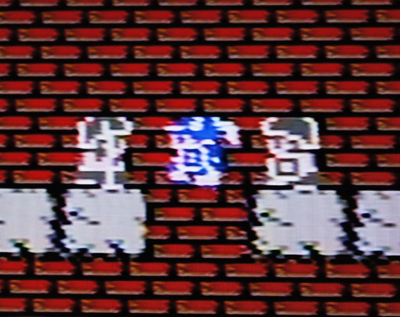
Guards in the Castle
“Who are you people?! Why do you keep repeating the same unhelpful advice ad infinitum?!” That accurately expresses my initial feelings on NPCs in Dragon Warrior.

Because I didn’t play any of the table-top RPGs I had no concept of RPG conventions.  Character traits, character status effects, enemy levels, listening to NPCs, attack-misses, and running away…it was all a mystery.  So I wandered aimlessly for hours and hours.  I had no idea I was actually power-leveling and grinding.  Every now and then I’d come across a new town, village, or environment texture and was thrilled to see something new.  As I progressed further into the game I started to figure out the methodology.  I listened to all those guys who said the same thing over and over (and over and over) again.  I started following their advice, and found Erdrick’s Sword and armor and figured out how to defeat the Golem.  It was immensely rewarding to easily best the Green Dragon and save Princess Gwaelin and get my status updates by using her “love.”  There was nothing more satisfying to a young gamer than to eventually grind your way (on purpose!) to the Dragonlord’s Castle.

The fight with the Dragonlord was harrowing.  I remember my heart pounding in my chest as the music came up and he changed from a warlock into the massive dragon.  Beating Dragon Warrior was by far the most memorable video game victory of my youth.  In most games of this era, once you figure them out you can beat them quickly and easily again and again.  This was the first game I ever played that required as much toil to beat again as it did to beat it the first time.

It is still the best RPG I’ve ever played.  Its simplicity and design taught me patience in gaming, strategy in tactics, how to listen to characters, to pay attention to the surroundings, to remember details, and even how to “trick” the game to make things easier.

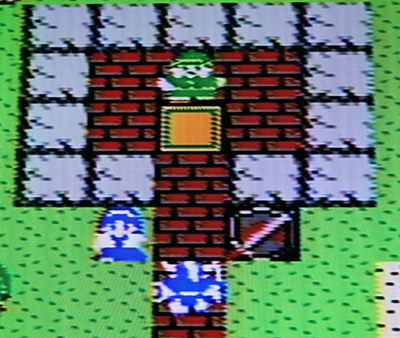
Shop
Yeah that’s a shop-pe. More specifically a weapons shop-pe. You can tell from the little sign. Simple and clear!

Modern RPGs have abandoned many of Dragon Warrior’s “slower” tendencies.  Most of them now play more like action games to compete with flashier titles and more instantly gratifying games.  Everything happens quickly, fighting is rarely turn-based, and few necessary story elements require serious problem-solving.  To me (and yes I’ll show my age here) there is something far more entertaining and rewarding about going through a game line-by-line to dissect the correct course of action.

As was stated in my “Value of Life” post, success and failure meant something in this era.  Often it meant starting over from the beginning (or in this case the beginning place which was punishment enough based on how slowly you moved…)  This required you to get good at the game.  It rewarded you for your progress with little short cuts, power ups, and story elements.  Even in the many Dragon Warrior remakes they’ve removed many of these elements to make it a “faster” more “friendly” game.  Give me standard NES Dragon Warrior any day.  There’s a reason I still have my original poster (with map on back!) framed on my wall.

It’s still my favorite game of all time and perhaps the one that taught me some of the best traits to add to a gaming/personality skill set; patience, attentiveness, strategy, problem-solving, plus text swordsmanship/”HURTMORE” spell mastery.  If you get the chance, break out the cart and play it.  Even today it might teach you a little something.

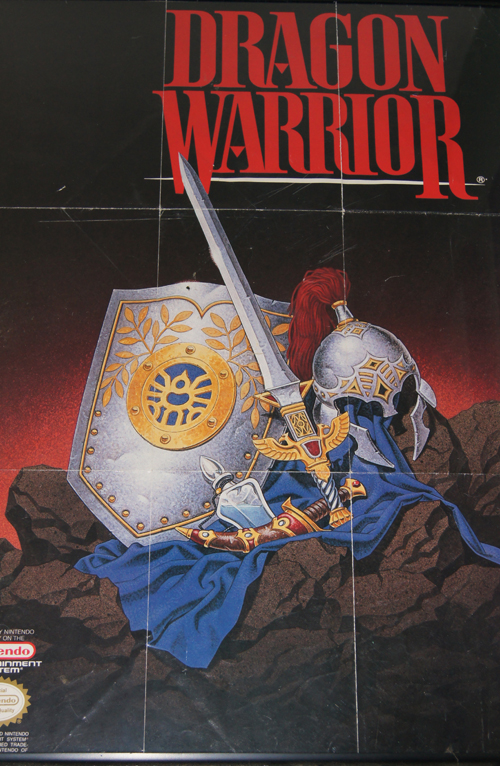
Dragon Warrior Poster
My original Dragon Warrior poster. I thought it was lost forever and found it folded in a book. It’s hanging in a place of honor next to my High School Diploma and College Degree In many ways it represents my entertainment media education!

Just don’t join the Dragonlord…seriously…don’t do it…

Dragonlord
“Join me for instant game over…”

Life Lessons Learned from Video Games #2: The Value of Life in Snake Eater

The first post in this series was a fun one, so this one will be an actual lesson I learned from game-master Hideo Kojima.  Also telling this story to the other half of the RevPub team provided inspiration for the Life Lessons series.

Most of us play games without giving thought to life or death.  Even when we die in games it’s never terribly critical.  I’ll show my age when I say this but…there was a time when dying in a game could bring up a dreaded GAME OVER screen that actually meant something.  It usually meant starting over from the beginning.  Of course this was after expending a number of lives, so even then your own character’s death meant little, let alone the countless enemies that were stomped, shot, burned, or blown up during your gaming rampage.

This has changed in the last few years with games like Demon’s Souls and its sequel, Dark Souls, where death is more than just a minor inconvenience and can change the alignment of the world and the style of gameplay.  But even in these games slaughtering countless monsters and faceless knights was a positive and absolutely necessary as it provided you with currency.

And that’s the classic relationship of games.  They reward you for offing enemies; the tougher the enemy, the greater the reward, and this trend is true across genres; mindless shooters, over-rated RPGs, basic platformers, and even the earliest arcades.  I won’t go into a preachy lecture about what this teaches gamers.  Games are entertainment, they aren’t meant to teach players how to behave and anyone who thinks stomping on someone’s head is a viable method of problem-solving needs help anyway (though I could be persuaded it is likely the best technique when dealing with giant belligerent mushrooms…)  This doesn’t mean games can’t occasionally teach you something about the value of life and one such game for me was Metal Gear Solid 3: Snake Eater.

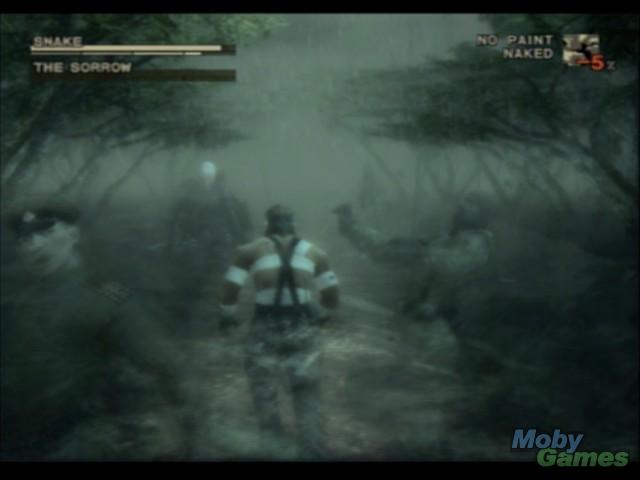
The Sorrow
Get ready…if you played through the first time like I did…this is going to be a long walk….

Hideo Kojima turned the gaming world on its head with Metal Gear, a game series that rewards players for not killing, not being seen, and not interacting with enemies except when deemed necessary by the narrative.  MGS3 brought this to an entirely new level, however.  I played MGS3 the first time through like most of players.  I tried to sneak, got busted a lot and had to shoot my way out of danger until the alarms ceased, usually after I killed nearly every guard in the hemisphere and dove under a convenient truck.  Even when not getting caught sneaking around, I would camo myself up and use my trusty knife to off hapless guards unfortunate enough ventured by my position.  I went through that game like John Rambo on a Red Bull binge until…The Sorrow.  After a thrilling chase through the sewers and a Fugitive-style dive into a stream you enter a near-death, dream-like state where you walk down a  river.  Walking for what seemed like eternity I kept passing shadowy figures of faceless guards all screaming and showing wounds.  It took so long to walk though the river I thought I’d hit a glitch.  Until I saw The Pain, an unmistakable early boss, crawl by.  Then dozens more soldiers…and The Fear.  It finally dawned on me: the countless soldiers I walked through…were all the people I’d killed in the game…  I walked through the river for no less than 15 minutes.  It’s a long time just to press forward on the analog stick and an even longer one when hundreds of men I’d killed screamed in agony around me.  By the time I got to The Sorrow, the boss of the stage, I  barely wanted to play any more.  Before the battle commenced I reset the game…and started over.  The second play through I killed no one, was never spotted, and (yes it lowered my ranking) used only the tranq gun and CQC.  Never had a game so brutally shown the consequences of my actions and blatantly shoved my easy-way-out choice of gameplay right in my face.  Only Kojima could think of something like that.

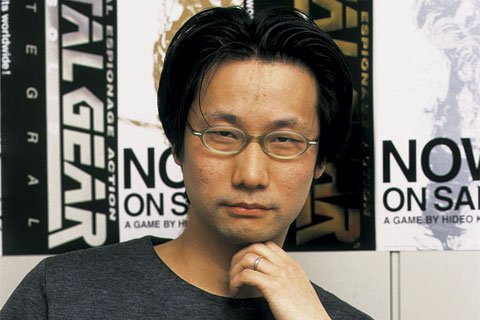
Hideo Kojima
Hideo Kojima, the dude that made me question my morals…

Since then games like Heavy Rain have offered similar experiences to face the consequences of your actions but MGS3 still stands out, not by punishing you through points, fewer power-ups, altered story-telling, or reduced game play time, but by making you literally face your victims.  In the end it is just a video game but it gives me some hope in humanity…because if a machine, a video game, can learn the value of human life … maybe we can too ; )

Electronic media: saving humanity from itself since 1991…