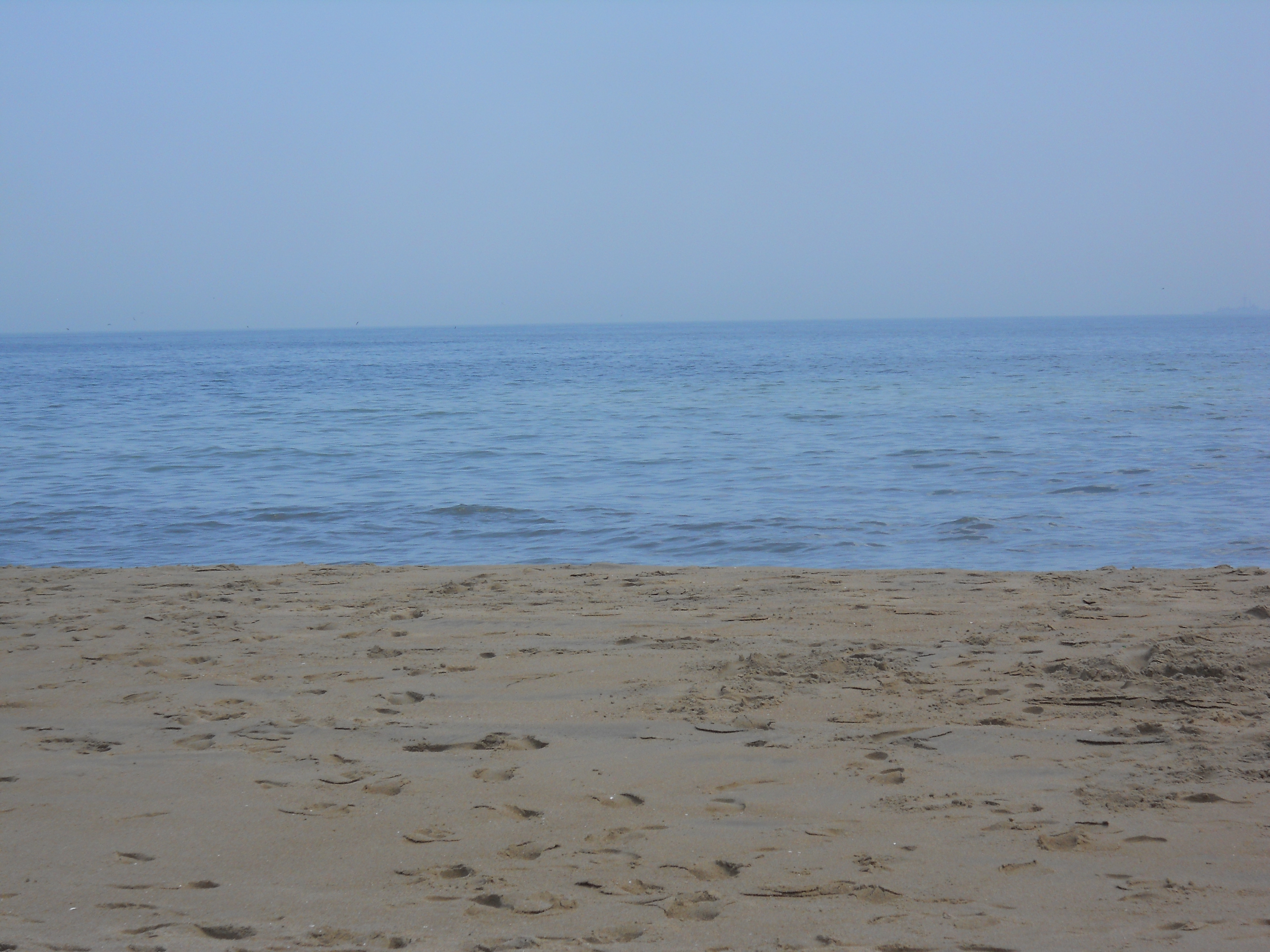
When you write, think of painting a picture. It can be any picture you want, but think of the images that must be in the painting. For example, a beach scene.
If you wanted to duplicate this picture, you would need to include the sand, ocean, and sky. You wouldn’t add clouds, the sun, an umbrella, etc. If you added those things, you may lose the tranquil setting this picture represents and change the meaning. Adding unnecessary items may distract your audience or lose them entirely.
The same is true in writing.
Adding unnecessary words, phrases, and punctuation can distract your readers or cause them to stop reading. Once that happens, conveying your message is almost impossible. Most studies agree that the average adult attention span is 8 seconds or 140 characters. Not words, characters. If that’s true, you would only read the first two sentences of this post before moving onto something else.
So, what does that mean to writers? It means we need to cut the crap.
In the chapter Art is Inspiration, Ueland discusses writing from our hearts and saying it like it is. She credits Russian writers, like Chekhov, who focus more on the truth rather than how they sound. Personally, I enjoy Russian writers for the same reason and believe that it is more effective to teach readers than sound like you have read the dictionary.
Here are a few tips to help while you write:
1. Don’t use words/phrases no one knows or ever says. Big words do not make you sound smarter or tell your reader anything about you – except maybe you’re over compensating for something. As you write ask yourself, “Would anyone ever actually say that?”
2. Only use adjectives and adverbs when needed and know how to use them. They do not improve your writing or ideas, and sometimes readers will think they are fluff.
3. Show don’t tell. Future post coming, but Ueland says, “… quietly describe what you are feeling. Don’t say your boredom was excruciating or agonizing, unless your own was, which is doubtful.”
4. Focus. Remember to only include what is necessary to convey your message. This tip applies to characters, setting, plot, words, objects, etc. You probably wouldn’t paint a mountain with a fruit bowl, so why would you add unnecessary words, details, or characters to your story? Everything should have a purpose.
Do you have any tips on editing? For more info, check out:
We’re all fans of something. It doesn’t matter what; we can be fans of sports, food, TV shows, video games, books, characters, just about anything. I personally have been a fan of numerous things including history, comic books, art, bands, and games. I still am a big fan of too many things to count, though admittedly I only throw myself completely into a few. After all, there are only so many hours a day to spend on one’s obsessions.
There has been a move recently away from being a “fan” and being a “good fan.” Too many people nowadays are what I think of as “bad fans.” These are the people who are belligerent and haughty with their fandom, and not only obsess about certain things, but belittle, attack, or denounce those who don’t share the interest or, even worse, dislike the interest.
These kinds of fans I mostly run into with the “geek” subculture. Though I have seen them in the limited experience I’ve had in the sports subculture as well.
Commodus was a “Bad Fan”
I feel it necessary to mention something about the “new geek” subculture. All my life I’ve been considered a “nerd” for whatever that’s worth. I’ve never been into sports or popular culture much. I grew up in the Save by the Bell, Real World, and Beverly Hills 90210, and never enjoyed a full episode of any of them. Except for Tai Kwon Do and recently boxing, I never played sports and spent most of my time reading, drawing, or playing with action figures into my teens (I admit that happily. It’s fun and ya know what? Still is!) Thus, during school, several of my friends (who shared similar interests) and I were labeled by the @55holes of the world as “dorks” and “nerds.” I distinctly remember a kid in middle school asking me and my buddy Mike where our “neon-colored pocket protectors” were. I’m not sure the insult there, since I never wore neon and never owned a pocket protector, but it speaks to how we were viewed.
Nowadays due to internet and tech culture, “geek” has become cool. While “back in the day” geeks banded together because of distinct lack of “cool” perception from the popular culture, they have become a section of the popular culture and, much to my dismay, have adopted many of the negative features popular culture has always had; negativity, exclusionism, derision, and segregation. People “aren’t enough” of a geek or “aren’t real” geeks. People are “geek posers” or “faux geeks.” While I was growing up, the geek groups tended to be more accepting to people — we were outcasts, how on earth could we exclude other outcasts? So you had comic dorks, video game dorks, and school dorks all crowded together. Today, these groups have broken up and even actively dislike other “geek factions,” a lot like various denominations of a church that don’t get along. We’ve all interpreted the nerd scripture differently, and not only are those who disagree with us WRONG, they aren’t welcome in our presence.
This brings me back to fandom. It feels like geek fans have completely lost control recently, and many have gone from being “good fans” to being the worst of “bad fans.” I think of the difference as being the difference between “patriotism” and “nationalism.” Patriotism I have always seen as a positive. It’s a feeling of pride and stating, “Despite all its flaws, I love my country.” Nationalism is pejorative, a negative and superlative view of, “Not only do I love my country, but my country has no flaws, and is not only BETTER than yours but the BEST there can be.” This breeds nothing but hostility.
In this series (I’m not sure how long it will be, but it’ll run and run…) I plan to lay out what I think the best ways are of being a “good fan” in the hopes of maybe getting it across that you can love, obsess, and immerse yourself into something without being a toxic individual to those who don’t share the interest or disagree with it.
The first topic will start next week with Accepting All Paths to Fandom.
This was a real first for me. For the first time in 20 years, I picked up a paint brush that wasn’t for trim or a wall. I painted a little in my youth but never anything more than your typical ten-year-old.
In my post about Red Bubble, I mentioned the important of thoughtful gifts. And this month, one of my dearest and best friends had a birthday. He is incredibly difficult to shop for though, so I have to get creative. Really creative.
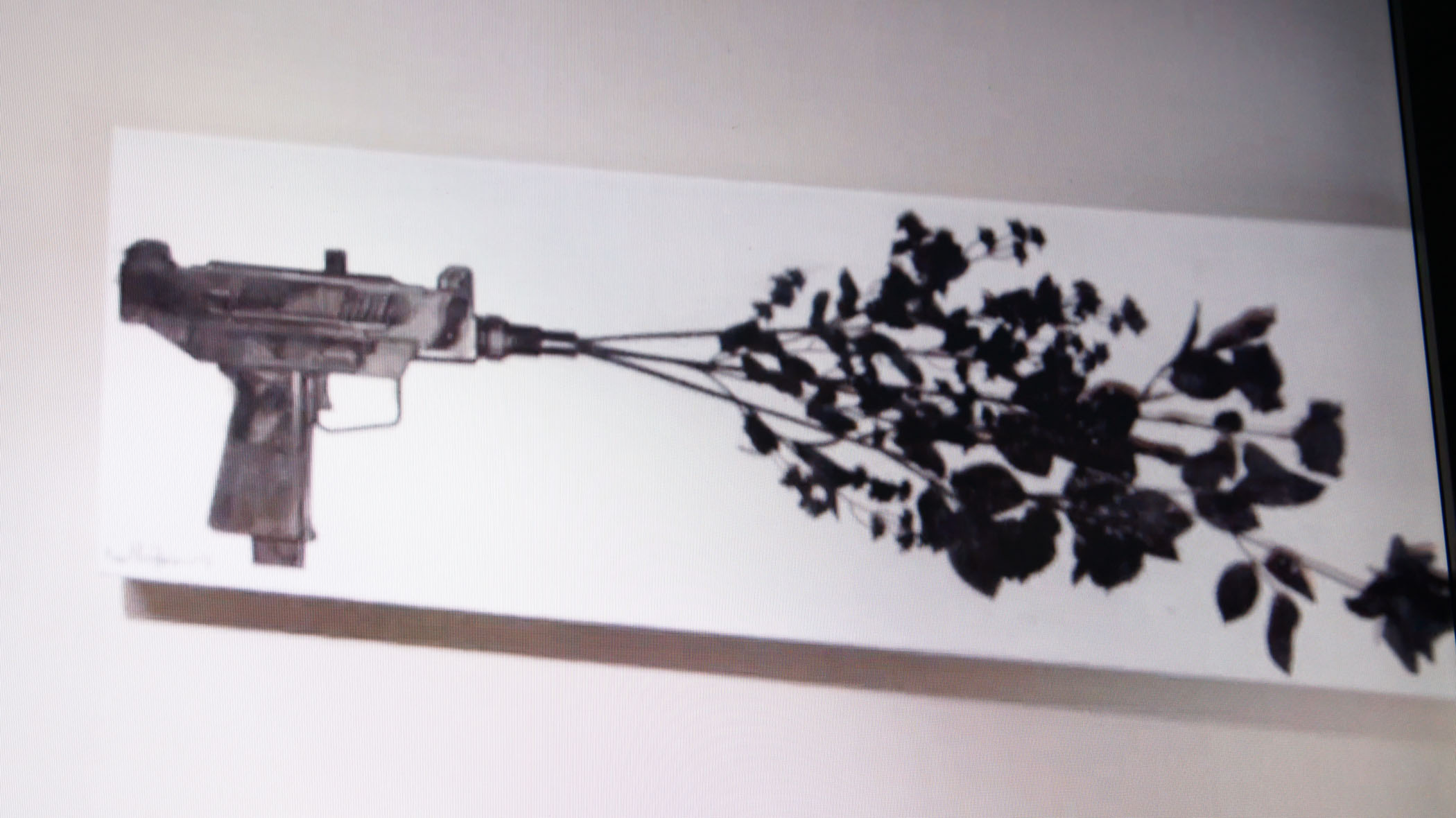
This painting first premiered in Psych’s This Episode Sucks, and my pal immediately texted me about it immediately. In fact, a couple of people did, and you have to admit, it’s pretty friggin’ cool.
The problem is you can’t buy the painting. I’ve read through dozens of forums and posts searching for the artist and/or painting, but turned up empty handed. The problem-solver in me thought, “Psh. If I can’t find it, I’ll just paint it.” And that’s exactly what I did.
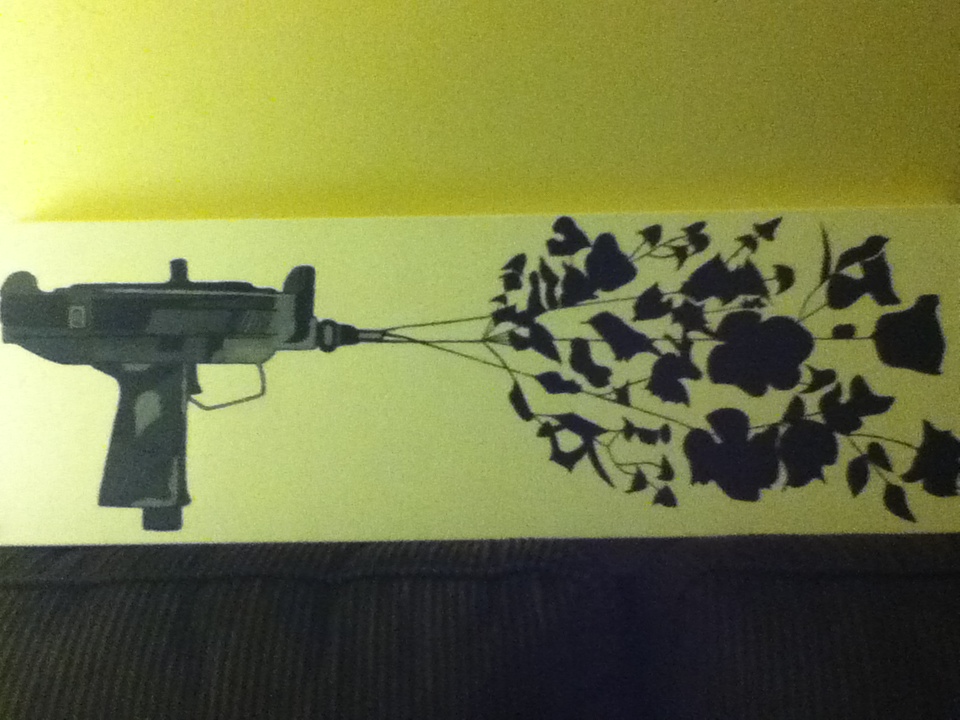
The flowers were not a problem for me, but I knew the Uzi would be, so my amazing RevPub partner penciled the Uzi on the canvas. From there, I printed a picture of the original and used it to paint my version. It’s not an exact match, which is a good thing, but I think it came out well. This project also inspired me to paint regularly because it was fun, relaxing, and something different. I can’t draw or visualize things, but I look forward to painting more penciled drawings!
It just proves that you should never be afraid to try something new. You never know what talents lit inside you or what new hobbies you’ll find!
*If anyone knows the original artist’s name, feel free to leave it in the comments section.
The start of painting the sketch. I did the shading in pencil and the basic outline first.Uzi painted in full color scheme. I lost all the lines but having a print out and pics helped a lot.Full painting after flowers were painted. I sketched them in pencil.Completed Uzi flower painting. I had no idea how to shade, so I made my own version!
As a wrap up to my Karl Pilkington posts I thought I’d do a list of Karl Superlative Awards, a range of favorite moments from throughout the Karl library I’ve had the good fortune to experience so far:
Best XFM Feature: This was a tough one. Though Monkey News seems to be popular for me it was a toss-up between Rockbusters and White Van Karl but I think I have to go with the latter. While Rockbusters had several moments of genius and the reactions of Ricky and Stephen to the competition can be as hilarious as the “cryptic clues” and their answers, White Van Karl was consistently hilarious and didn’t have any of the antagonism Rockbusters picked up later. White Van also brought about some of the funniest moments in the history of the show.
Best XFM Karl Moment: Without a doubt…the horse in the house. Brought about by a White Van question about genetically enhanced babies, the horse in the house story became so legendary it was referred to without any explanation years later. While other stories Karl told are forgotten or require re-telling over the years of Ricky-Stephen-Karl broadcasting, the horse in the house is without a doubt the most memorable! (Though a VERY close runner-up is the “man-moth.”)
Best XFM Ricky Gervais Moment: During a series of links where Ricky and Stephen swap stories about past run-ins with police and firefighters Ricky tells a story of being out on a Saturday in the early 80s (dressed in period-typical new-wave clothing, gelled hair, etc) when a police car cruised by and one cop yelled out the window “You look like a couple of prats!” To which Ricky’s friends asked Ricky, “Is that an offense?” Hearing Ricky tell this one is a great moment in XFM story-telling.
Best XFM Stephen Merchant Moment: Almost the funniest overall moment in the whole XFM run is Stephen’s story of him, a girl he fancied, a guy she liked, a Volvo Estate, and a pig named Vera. If THAT doesn’t get your attention I don’t know what will. I won’t go into the details. No one can do this story justice like Stephen can.
Most Moving XFM Karl Moment: Karl’s stories of “bad gift giving” are remarkable, but one of the saddest stories from the XFM series is the story of him buying his mother a Victoria Plum figure, excited he found his gnome-figure loving mother the prefect present. When she saw it in the shops before Christmas she responded, “that’s bloody awful” dashing young Karl’s hopes that he found the perfect gift!
Best Ricky Gervais Show (HBO) Feature: Again Monkey News loses out. Karl’s diary is by far my favorite feature. Karl’s words, read by Stephen, animated in that style, with Ricky’s commentary/reactions was the perfect storm of humor.
Best Ricky Gervais Show (HBO) Moment: What Karl would do if it was the last day before the end of the world. Just thinking about that sends me into hysterics. The first time I laughed uncontrollably at the show.
Best Ricky Gervais Show (HBO) Ricky Gervais Moment: I’ve got to go with Ricky’s story of having a construction worker tell him “Oi Rick, not as fat as on telly!” because of Ricky’s analysis of the statement, “He was saying, ‘you’re still FAT but you look ever FATTER on telly.’” To which Ricky could only say, “Cheers mate!”
Best Ricky Gervais Show (HBO) Stephen Merchant Moment: Another tough one. It was a toss-up between Stephen’s night out at a club and his experiences in Rio. I’m going to have to go with Rio. Not only is the story hilarious (it involves Stephen going into the sea to “have a wee,” a wave taking him out to sea, pulling his trunks off, and washing him down shore away from his friends and in front of a beach full of lovely women) but Ricky’s response to Stephen’s question whether he would’ve saved him is also priceless, “I couldn’t have helped you. Not with your knob out and your glasses off.”
Most Moving Ricky Gervais Show (HBO) Moment: Fittingly the last moment of the last episode, which imagines the three of them still together in an old-age home, still laughing and re-telling their favorite stories.
Best Ricky Gervais Show Episode: It was a tough one. Too tough to choose. I’m going to have to declare a tie between Insects and Karl’s Day though there were many others that came in REALLY close second…
Funniest Idiot Abroad Moment: I’ve said it before, ANYTHING to do with the bungee jump. From his “daring” land dive, to his lie about jumping in Africa, to Ricky’s discovery of and reaction to Karl’s lie. It couldn’t have been any funnier if it had been written!
Best Idiot Abroad “Wonder” Episode: This is another tie for me. Either Mexico, which features wrestling, the search for the jumping bean, and dancing to Depeche Mode outside Chichen Itza; or Peru, which has the stay with former cannibals, the news of the title of the show (NOT Karl Pilkington’s Seven Wonders like Karl thought it would be…) and Karl slyly getting out of going any further up Machu Picchu by declaring the view to be “magnificent,” a word Stephen had never before heard Karl use, raising his suspicions that Karl might be trying something sneaky.
Best Idiot Abroad “Bucket List” Episode: My favorite is Meet a Gorilla. It has the end of the bungee-jump runner, Karl’s shopping in the market, and his meeting a hippo-in-the-house.
Most moving Idiot Abroad Moment: By far Karl’s self-reflection during his climb up Mt. Fuji.
Best Book: Definitely Karlology. The most pure collection of Karl’s thoughts and experiences.
That’s my wrap up of all things Karl I’ve experienced thus far. I’m looking forward to The Moaning Life and highly recommend the above media for anyone who needs a good laugh!
In her Nashville Driving Tips for Out-of-Towners, Raven suggests that the average Nashville driver should cruise at a steady five miles over the posted speed limit. Although she gives stellar advice nearly always, this is one guideline I choose not to follow.
I’m a speeder. Like my father before me, I drive like I’m hurrying to stop a terrorist attack or there’s a pregnant woman in the backseat crowning. That being said, I don’t get many tickets and haven’t been issued one in probably seven years (though I definitely will have earned my next one). And I’ve never been directly involved in a traffic accident. However, I have been in an accident where someone else was driving – a pretty serious one – that involved a fully loaded school bus. Hard to believe it was almost 25 years ago, but the memory is extremely vivid, and as I reflect on it now, the experience has had its lingering effects.
And We All Fall Down
In the summer of 1991, my younger brother and I spent six weeks at a boys sleep-away camp in Asheville, N.C. If you’ve never been to Asheville, it’s a beautiful place and remains one of my favorite spots to visit with its spectacular mountainous scenery and somehow untouched feel. Now it’s basically full of hippies and artists, but that’s not so bad I guess.
It was a summer of firsts for both of us in many ways. Our first flight without a parent. Our first time away from home for an appreciable amount of time. Our first time being responsible for our own schedules. I remember riding from the airport in the camp’s 15-passenger van with all those strange faces, everyone dead quiet, like we were on our way to a mass execution instead of a summer filled with swimming and camping. I remember the terrible food and the life-saving care packages from Mom. I remember slow dancing with a heart-breakingly beautiful blonde from the girl’s camp and sneaking out to kiss her behind the stables after. Good times.
I took to camp life immediately, without a hint of homesickness, partially because the program I was enrolled in was so exciting. Whereas my brother (who was just 9 at the time) did the typical camp activities you see in movies, like woodcraft and archery and tying crazy knots. My group – “the old kids” – went whitewater rafting and mountain biking and spelunking. Every day was a new adventure, and it was exhilarating.
Towards the end of our term, my group just finished a three-day hike down part of the Appalachian trail in almost constant rain. Several of the kids became sick, and I remember fighting a cold, but unlike some who checked themselves into the infirmary, I fought through it – mostly because I did not want to miss the next trip. The next day we were repelling down a sheer mountain face, and I had looked forward to it ever since I saw it in the brochure.
The following morning reveille sounded over the loudspeakers at 7 a.m., bringing collective groans and creative curses that only 12 year-olds can muster. After another horrifying breakfast barely touched by most, my group gathered at the gravel entrance, loading up the battered old short bus with climbing gear and coolers full of sandwiches and drinks for the day trip.
It was a longer drive than most of our outings, and after the usual round of rousing camp songs – most involving vomit and/or boogers – I remember we settled into a comfortable silence as the bus wound up into the foothills. It was cool and bright and gorgeous, with a strong breeze and the deep earthy smell of the mountains. I sat towards the rear of the bus on the right side, so I could look out over the valleys as we climbed up and up. All that summer I had been reading Tolkien and daydreams of the Misty Mountains came easily with no sign of man’s hand visible, except for the back country road and, of course, the bus.
Looking back, I estimate there were 15 kids and four counselors that day, basically four people per row with the walkway splitting us into twos. The oldest of the counselors, whose job it was to keep us from killing ourselves and each other, was a very large man who always sat in the half seat at the front of the bus, opposite the driver near the main door. In my memory, he’s somehow turned into the late and great Chris Farley, which seems to fit perfectly – he was all shoulders with floppy light brown hair. The other three are faceless to me now, but he stands out easily.
Long, lazy spirals took us closer to the upper end of this sub-range, and my view through the thick rectangular window was bright and clear and very steep. Without warning, the bus took a sudden lurch to the right and I felt the brakes lock, which caused the back-end to fishtail a bit outward towards the drop. I looked up in time to see an old pickup zip past us going the opposite direction and slide into the little ditch scraping against the face of the mountain. Curses came from the counselor driving as he tried to guide the bus back towards the center. The boys gasped, and suddenly we were tilting in very much the wrong direction. Grinding and crunching as the rear wheel fought for purchase. It seems like a very long moment looking back, but it couldn’t have been more than five or ten seconds.
Farley gave a shout and threw his considerable weight against the opposite side of the bus, slamming his shoulder against the frame of the wall, but it made no difference. Those three or four tons of bus and children tilted almost casually and down we went.
The only way I can express how the fall felt is to imagine a giant hamster wheel in which children and backpacks and sandwiches are all thrown together to spin around and around helplessly (no seat belts in those days). It was basically ceiling, window, floor, and repeat. And screaming, lots of that.
We came to a sudden crunching halt, my face pressed against the window I had been looking out of peacefully just seconds before. Except now that window was pressed into the dirt with a single fat earthworm squished on the other side, no doubt shocked by this turn of events.
Cautiously, we made our way out of the now horizontal rear exit lowering ourselves one by one down to the ground several feet below. The first thing I remember is how steep the fall was; I want to say at least a 40 degree angle. The bus had cut a swath of earth the way you would imagine a jet crash-landing in a field without landing gear. Flattened trees were strewn in its wake. I looked back to the bus, its progress down the mountain had been halted by a single tree. There was a noticeable bend as the roof bent in a slight V around the tree, which was leafless, and by all rights, seemed to be dead or dying. Farther below was more mountainside and an even more steep drop.
Our eventual extraction by firemen and police is pretty dim at this late age, but I do remember us being taken to the hospital for exams. Amazingly outside of some minor cuts and bruises, the only major injury was a dislocated shoulder by our heavyset counselor who charged the wall.
I remember getting back to the camp and sleeping the sleep of the dead, both through the exhaustion of climbing back up the mountainside and the emotional strain of nearly dying. The next day we were given an amazing dinner attended by the head of the camp and several older folks who must have been the owners. Afterward, the oldest of the oldies gave a speech, which even to our unsophisticated minds amounted to, “Please don’t tell your parents to sue us.” No one did to my knowledge.
Despite the accident, I did return the next year; though it was unremarkable for the most part. I did get a ridiculous case of athlete’s foot from the community shower. I also saw a boy cut off most of his thumb with a hatchet. Nothing matched the bus accident though.
Was I scarred for life? No, not really. I was a little more afraid of heights after the accident, but not in a debilitating way. Really the only after-effect was I have trouble driving in the mountains still, and I tend to drive close to the center line regardless of where I am, which is disconcerting to my passengers but comfortable for me. And, of course, I drive like my hair is on fire, but that’s purely genetic.
Have any crazy camp stories? Feel free to share them below!
This is the book where Karl really comes into his own as an author. Though some of the material is repeated in some of the podcasts, unlike the previous books Karl sat down to specifically write a complete book of his thoughts on various topics. In Karlology we are treated to his musings on The Natural History Museum, the London Zoo, and the Tower of London.
Each chapter consists of Karl’s visit to a place of “culture,” usually a museum or gallery of some kind, and he then comments on what he’s seen. In the Tate modern he comments on street performers outside the location, what he thinks art is (“stuff to fill a space that would otherwise be empty” according to Karl), and his opinions on the art he sees in the gallery (such as dwarf sculptures and creepy videos).
Included in karl’s random thoughts are:
Medical words are too complex, that’s why doctors have bad handwriting.
Maybe humans and dinosaurs did live together but there weren’t many people so we haven’t found traces yet. “A bit like pug dogs – they’ve been around for years but I only saw one for the first time about nine years ago.”
Chinese surgeons are apparently the best because “they’re always dealing with kids with four legs or two heads in China.”
Extensive thoughts on stick insects, including, “If reincarnation does exist, I wouldn’t want to come back as a stick insect. I’d rather come back as a real twig: a least I wouldn’t have any enemies, and I’d be the real thing as opposed to an imitator.”
And of course, in relation to the astronauts’ short duration of time spent on the Moon “I suppose once you’ve seen one bit of the Moon, you’ve seen it all.”
In addition to the main text there are lists of facts concerning the topics covered each chapter, brief quotes from other individuals describing things they’ve learned, and occasional random incidents such as Karl’s Brain scan, his attempts at a Mensa test and “what can I learn from the news?” where Karl keeps a log of what’s reported on the news for a whole week. Though I’m sure more news was reported than he records, it really gives a good log of all the nonsense the “news” talks about, such as it being “talk like a pirate day” and fish born with two heads. He also mentions the Middle East war (surprisingly!) and comments “I don’t know how the can keep the anger up.” A great point I think…
Several of the thoughts in Karlology are heard in conversation during the “Ricky Gervais Guide to…” podcasts, but unlike previous efforts this book doesn’t have the feeling of a tie in. Though natural history, medicine, and art are topics in the “guides to” Karlology isn’t a collection of the podcasts in written form or Karl’s thoughts on the previous discussions, they are, instead, Karl’s pure thoughts on what he sees in the places he visits. In fact he covers stick insects again on Idiot Abroad giving the impression that he tends to stick with what he believes! Karlology may be Karl’s best book. Because it is Karl in his purest form, viewing familiar subjects (though Gunther van Hagens’ Bodies exhibit might not be exactly “familiar” it was something that many people visited) through his own unique lens. It’s highly recommended for Karl fans, and it would be interesting to see what people who don’t know Karl think of his commentary!
Here’s a nice clip of Ricky and Stephen talking to Karl about his book.

 If you wanted to duplicate this picture, you would need to include the sand, ocean, and sky. You wouldn’t add clouds, the sun, an umbrella, etc. If you added those things, you may lose the tranquil setting this picture represents and change the meaning. Adding unnecessary items may distract your audience or lose them entirely.






 Revenant Publications