If You Want to Write: Journals

Doctors will tell you to keep a journal in order to release stress and sort out emotions. Jotting down all your feelings and thoughts can help you resolve conflict, make decisions, and force you to learn about yourself. But why should writers keep a journal?

In this chapter, Ueland explains the benefits of journal writing and how it makes you a better writer. Not better in the sense of correct grammar and what the world expects of you – better in the way of more honest, real, and true to who you are.

But why is it important to be real?

Readers want to devour a good book. A good book deprives you from sleep, takes you away from your family and friends, and sucks you deep into the world it creates. As an author, you can’t do that without being real. Your reader will move onto something better, and frankly, honest is more interesting and fun.

Any writer can fill pages with words. It takes true talent to show a reader what you see rather than telling them. Ueland uses this example:

  • His muscles rippled through his shoulders. (Did they really? No.) So she asks, what do you see it your mind?
  • His muscles looked as if they would burst through the seams of his shirt. (Believable and descriptive)

The novel Gone Girl is a great example of this. And ironically, it’s set in a journal format. That’s no accident. Journals are people being who they are and who they don’t want to be. The best-seller captivated readers worldwide, and it remains one of the most talked about novels in my office. It was the nitty-gritty details of a relationship, and it felt real. You were smack in the middle of the story and couldn’t put it down.

What you can gain from your journal:

  • A greater love for writing – Sometimes it’s hard to write and get into the habit, but once it becomes a routine, you have to do it. It’s like an addiction, and if it’s not done, your day may feel incomplete.
  • It jump starts other projects – We all have a book or story idea that we haven’t made time for. We sit down at the computer and freak out because we don’t know where to begin. After journal writing, you’ll realize that you can just start, and edit and fill in gaps later. You can even trade the time you’d spend on your journal on that new project, or switch back and forth as needed.
  • Immerse yourself in your own life – If you took one hour a day you play on social media or watch TV and wrote in your journal, you’d have insight into your own life, dreams, and self. As scary as it may be, good writers aren’t afraid to explore their most inner thoughts.

She recommends keeping a journal and writing in it every day, but not looking back on it until six months have passed. Doing so, you’ll see honest progression and skill as the journal continues. You learn more about the personality that comes out in your writing because no matter how hard you try, it will come through for the world to see.

Want more tips? Check out our If You Want to Write section!

Serial Comma: To Use or Not to Use

GrammarTips

Grammar geeks all over the world will battle this issue until the end of time. It’s almost as controversial as abortion, health care, and gay rights. The debate: the serial comma (aka the Oxford comma) and its relevancy.

What is the Oxford comma?

This is a comma usually used before the word ‘and’ in a series.

Ie: For dinner, we had mashed potatoes, fried chicken, green beans, and rolls.

In school, we were taught to always use that comma. No exceptions. However, when I worked on my college newspaper, I learned that Associate Press says to remove it. What?! It felt like my world turned upside down.

Should You Use the Oxford Comma?

It depends. If you’re writing a college paper, probably. Although, I’ve heard some professors don’t care. If you work for a magazine or newspaper, probably not. If you’re writing for your blog, decide and be consistent.

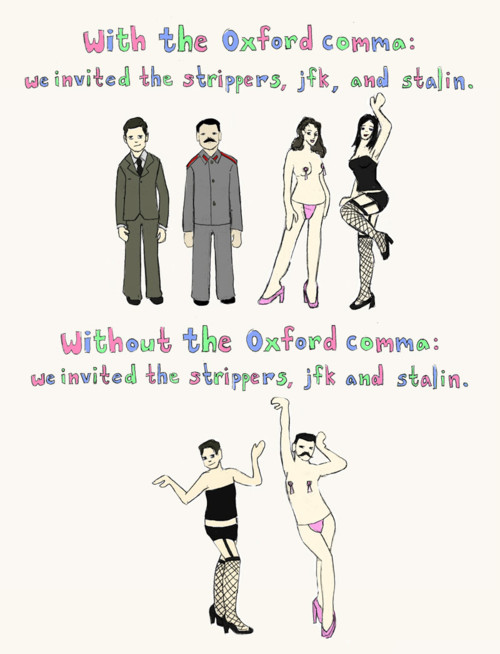
The comma was originally deleted to save space in newsprint, and with everything going digital, that’s no longer a concern, so it may make sense to use it. I’m a fan of using the comma because you can change the entire meaning of a sentence without it:

Not using the Oxford comma
Photo from: kickyandfun.tumblr.com

I don’t argue usage often because, much like religion, the decision to use the Oxford comma is a personal one. My rational is I can list more reasons to use it instead of not using it. It does clarify meaning, it does help the reader pause, and it separates items in a series. Saving space is not enough of a reason to not use it.

And even though my job requires me to remove it and follow AP style, I do use it if there is more than one ‘and’ in a sentence because AP doesn’t address that instance.

Ie: On our vacation, we hiked and biked though the mountains, ate seafood, and went to an amusement park.

Therefore, I recommend using it unless otherwise told. I don’t think the Oxford comma will ever disappear, especially with more than 30,000 Facebook fans and possibly millions of hard-core grammarians supporting its usage.

What are your thoughts? Are you pro or anti Oxford comma? Tell us why in the comments section!

If You Want to Write: Personality

“But since he has no true feelings about poverty, nothing to offer about it, neither do you, the reader, have any feelings about it. There is no infection.” – Brenda Ueland

Passion and personality: The difference between good writers and great writers. The difference between a good story and a story no one remembers.

In this chapter, Ueland discusses what she calls the “third dimension”. It is the personality behind the words and ideas.

Depending on the reader, seeing a writer’s personality can be the deal breaker. If there is no personality, why should your reader care what you have to say? Ueland also references Chekhov’s idea for fiction, “to pose a question but never answer it.” According to Chekhov, as soon as you answer it, the reader knows you are lying or trying to prove something. That’s the beauty of writing as art; it’s all about interpretation.

What does your writing say about you?

Honest writing exemplifies its author. If you look closely, you can see certain personality traits from the author(s). Here are a few examples from recent posts:

1. I think we CAN all get along. I think various kinds of fans CAN get along, and many kinds of fans can exist within one person – you can be a fan of games, electronic entertainment, sports, literature, history, natural science, etc. I know you can be, because I am a fan of aspects of all those things.

2. No matter the animal, we grow attached to them. Sometimes we talk to them when we can’t talk to anyone else – animals can’t gossip or argue. In fact, they may be the only ones in the world we can completely trust. There’s no judgment or criticism.

3. Despite the accident, I did return the next year; though it was unremarkable for the most part. I did get a ridiculous case of athlete’s foot from the community shower. I also saw a boy cut off most of his thumb with a hatchet. Nothing matched the bus accident though.

What do you notice about the writers?

  • I see writer one is accepting and open-minded, but he wants and possibly expects others to be as accepting and tolerant.
  • Writer two doesn’t trust easily, and she sometimes feels alone and judged – so much so, that animals fill a void people cannot.
  • In the third passage, the author shows fearlessness in a potentially traumatic situation. However, he also uses humor to make light of the situation that may still haunt him.

Fun, right?! This week, pick an article, post, or book, and look beyond the words and images. What do you learn about your author’s personality? Also, think about what your readers will say about you. Feel free to share your thoughts below!

Read more tips on writing and grammar.

Premier vs. Premiere

GrammarTips

Imagine you work at an advertising company, and you have a client you want to impress. The client is some ritzy hotel in some heavily traveled city. So in their ad you type, “the premiere destination for fun and entertainment.”

Guess what? You just made a BIG mistake.

I mark up premier vs. premiere all the time. Most times, the error is in ads in this exact usage. They are the premiere hotel, destination, B&B, etc. Unless they are a movie or play, they’re not the premiere anything.

Common Terms Used in This Post:

Noun: a person, place, thing, or idea

Verb: an action that is performed

Adjective: a word that describes a noun

I’ve noticed people use an e on the end because they think it looks better, or maybe they are misinformed and think it’s the British or French spelling. The e on the end does not make something look more important – in fact, it may make you look dumb. It’s not a style thing or preference; they are two different words with two different meanings.

Premier (no e on the end): This is an adjective that describes something first in rank or importance, or first in time.

a. Some say the Music City Center is the premier place for meetings and events.

b. The premier hot spa draws in more than a million people annually.

Premiere (with an e on the end): This can be a noun or a verb, and is the first public viewing of something. Think of a debut of a movie or play.

a. The movie premieres next weekend.

b. We’re going to the after party once the premiere is done.

One way you can remember this is: movie ends in e, and its premiere ends in e, so there’s your correct usage. Otherwise, you probably need to use premier.

For more tips, check out our Grammar and Punctuation tricks!

If You Want to Write: Writing as Art

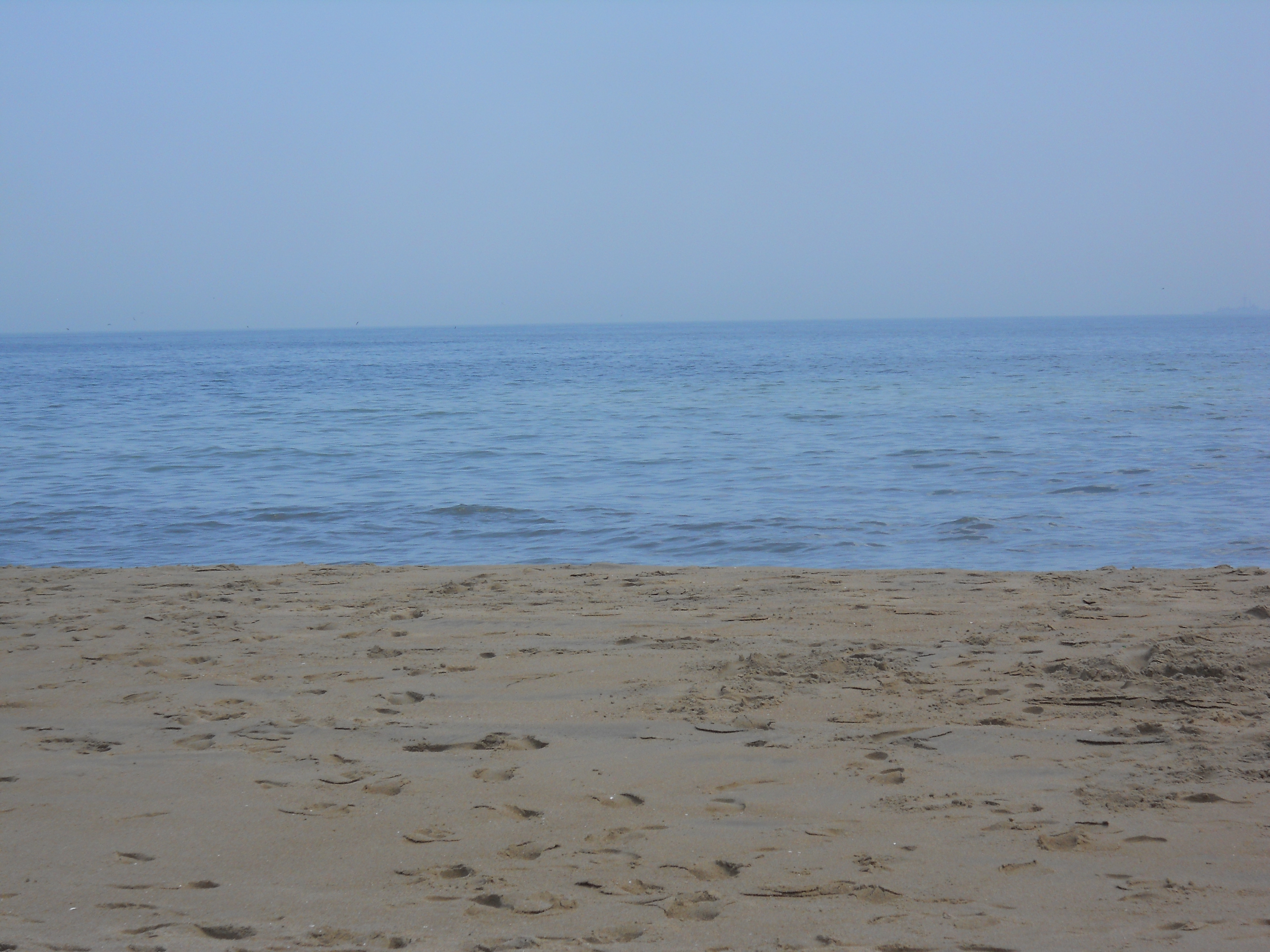
When you write, think of painting a picture. It can be any picture you want, but think of the images that must be in the painting. For example, a beach scene.

Virginia Beach, VAIf you wanted to duplicate this picture, you would need to include the sand, ocean, and sky. You wouldn’t add clouds, the sun, an umbrella, etc. If you added those things, you may lose the tranquil setting this picture represents and change the meaning. Adding unnecessary items may distract your audience or lose them entirely.

The same is true in writing.

Adding unnecessary words, phrases, and punctuation can distract your readers or cause them to stop reading. Once that happens, conveying your message is almost impossible. Most studies agree that the average adult attention span is 8 seconds or 140 characters. Not words, characters. If that’s true, you would only read the first two sentences of this post before moving onto something else.

So, what does that mean to writers? It means we need to cut the crap.

In the chapter Art is Inspiration, Ueland discusses writing from our hearts and saying it like it is. She credits Russian writers, like Chekhov, who focus more on the truth rather than how they sound. Personally, I enjoy Russian writers for the same reason and believe that it is more effective to teach readers than sound like you have read the dictionary.

Here are a few tips to help while you write:

1. Don’t use words/phrases no one knows or ever says. Big words do not make you sound smarter or tell your reader anything about you – except maybe you’re over compensating for something. As you write ask yourself, “Would anyone ever actually say that?”

2. Only use adjectives and adverbs when needed and know how to use them. They do not improve your writing or ideas, and sometimes readers will think they are fluff.

3. Show don’t tell. Future post coming, but Ueland says, “… quietly describe what you are feeling. Don’t say your boredom was excruciating or agonizing, unless your own was, which is doubtful.”

4. Focus. Remember to only include what is necessary to convey your message. This tip applies to characters, setting, plot, words, objects, etc. You probably wouldn’t paint a mountain with a fruit bowl, so why would you add unnecessary words, details, or characters to your story? Everything should have a purpose.

Do you have any tips on editing? For more info, check out:

5 Tips on Editing Your Own Writing

Writing Succinctly

When to Use Since and Because

GrammarTips

One night, a friend of mine called and asked me what the difference was between since and because. I hesitated for a second and reached for my laptop – I knew how to use them but not the hard rule. He asked after a professor marked up a paper I proofread earlier that week. Oops!

It never occurred to me there was a real difference, especially when we use them correctly without realizing it. Some hard-core grammarians would object, but because and since can almost be used interchangeably. Even Webster’s shows the word SINCE after the definition of because.

But don’t worry, there’s a rule to distinguish the two:

Since: Think of time. If you’re talking about the past, use since. T also comes after S in the alphabet, so think: since time.

a. They moved to Nashville since the hurricane hit Florida.

b. Since we were kids, we have gotten into trouble together.

c. I’ve wanted to talk to you since yesterday.

Because: Think of reason. Something happened because of something else (cause and effect).

a. We went to the store because we were out of milk.

b. I have to finish the project because I am going on vacation.

c. Because we were in love, we eloped. (yes, you can begin a sentence with because)

Sources: Grammar Bluebook, GrammarGirl

For more usage examples, enjoy a great song that uses both words correctly 🙂