Until this post, I had never created a Power Point presentation.
When I was in college, Power Point was just making its way to projector screens everywhere, and I preferred a more hands-on approach. I only gave a few presentations, and I liked to use music and handouts so people didn’t have to take notes. There were only a few students who used a Power Point, and I was amazed at their project.
Chapter 4 discusses adding motion to your posts in the forms of video, slideshows, animation, motion graphics and software simulation. This chapter was easy to understand and read through without being overly technical or making the reader have too many “Oh…” moments. There is a lot of important information in this chapter, and Felder recommends lots of tips for effectively adding motion to your writing.
Here are the important tips to remember about motion in your posts:
Know what you want to say. Write a script, make a story board, or simply brain storm ideas on post its or napkins.
Have a beginning, middle, and end.
Keep it short and simple.
Think of your audience. What do they want to see? How can you make it interesting? Is it fun?
Ask for feedback, and take constructive criticism while remembering you make the final decision.
With these items in mind, I created a quick Power Point slideshow of the people behind Revenant Publications. I hope you enjoy my first attempt at a Power Point, and feel free to leave comments in the reply section below!
Like most of the American generation born between 1975-1985, I grew up in the golden age of video games. Starting with an Atari 400, moving to an Atari 800XL, an NES, and finally settling with Sega consoles throughout much of the 90s, I became a “gamer” at an early age and remain one to this day. Recently elitists and exclusionists have hijacked that term, but to me a “gamer” is still just someone who enjoys playing games. Any games from the board variety, to the cellphone kind, to the newest console release. Whether they play once a month or 24/7, whether they’re hardcore MMORPGrs with hundreds of hours logged or they just play the Sims on their PC, it’s the pure enjoyment of playing a game that makes one a gamer. Not how high they’re ranked, how many accessories you own, or how many noobs you’ve pwned. At it’s heart, gaming is just entertainment; it’s not life or death. So to all my generation who live and breathe by their gear, their rankings, or their e-reputations … seriously … it’s just a game. Kick back and have some fun.
During my long gaming history I have learned a lot of lessons, lessons that apply to both the real world and the virtual world. Real world lessons aren’t always apparent, and the games that teach them can sometimes be surprising. Virtual lessons are more about the peculiarities of the gaming world, ways you learn to interact with a world of invisible walls and filled with store clerks who never leave their desks and repeat the same two lines over and over for all eternity.
Since this is the first post of this type, I thought I’d keep it light and start with a virtual world lesson:
If You Are Ever Injured, Seek Out Turkeys, Apples, Pizzas, Pork Chops, and Sodas Hidden in your Environment … and EAT Them Instantly!
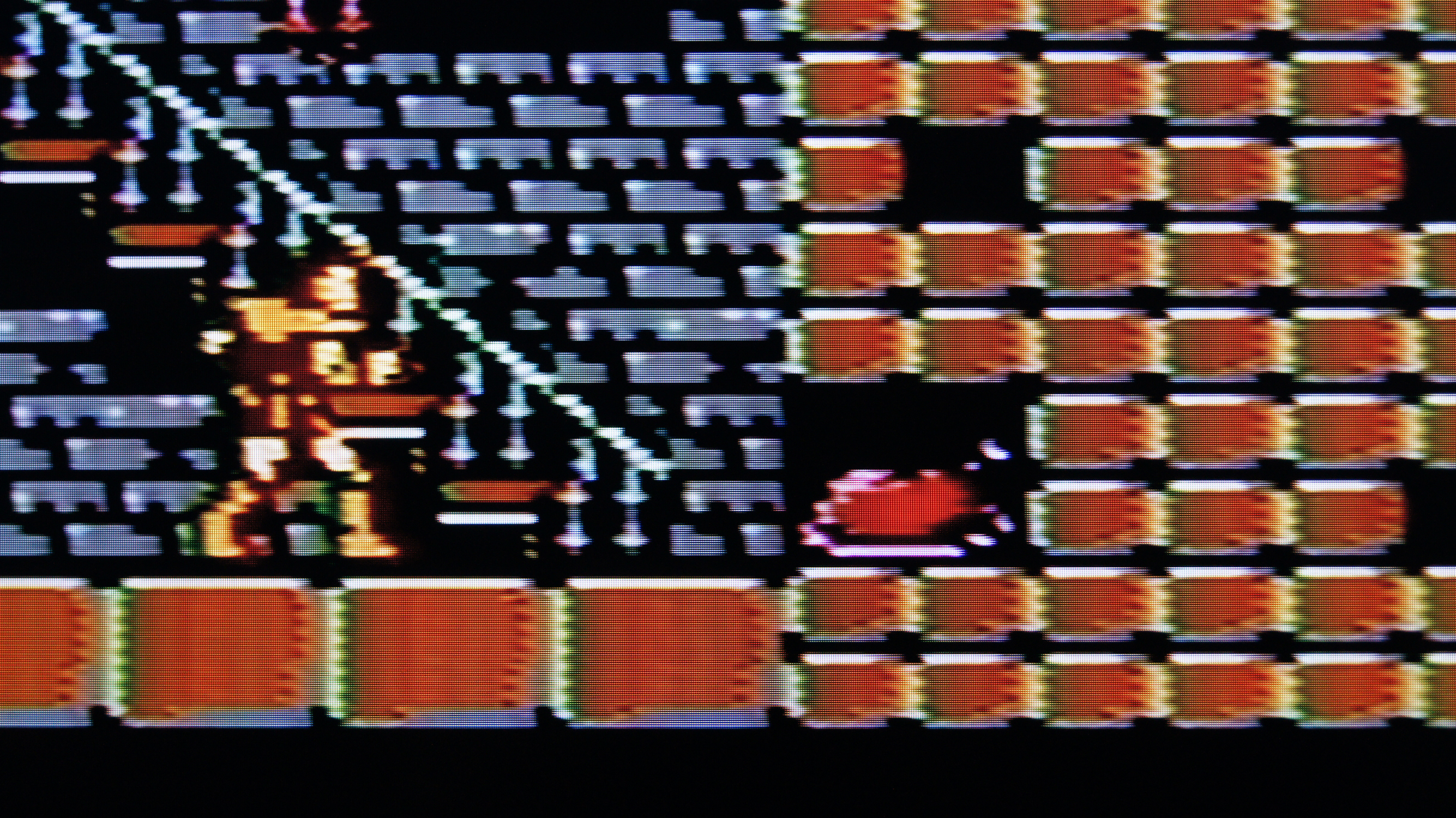
I know what everyone’s thinking … eating found food doesn’t sound like a good idea but, trust me, I spent a lot of time playing Castlevania, Teenage Mutant Ninja Turtles, Streets of Rage 2 & 3, and Final Fight. Found food will help you immeasurably. A turkey found in a garbage can you’ve just smashed into a fading, dented version of itself after breaking heads all over Metro City or a roast uncovered after you’ve whipped some brick walls of a Transylvania castle into rubble will save your life! This is one of those lessons I’ve always questioned as I’ve played games, but it shows up again and again. I can’t imagine grabbing food out of the trash or a crumbling castle being good for one’s constitution, but don’t take my word for it; ask Simon, Donatello, or Axel…it’ll bring you back from near death.
There’s the delicious, life-saving food item…found by smashing open the walls of a musty evil castle…Ever been near-death beating up weird spider-things and guys with chainsaws in a warehouse? Look around and see if there’s a pizza floating in the air on a blue square! A WHOLE pizza too. Those are the best ones….Taken some hits pummeling street trash through blue back alleys and baseball fields? Luckily there’s an apple hidden in a roadside sign. That’ll give you the boost you need! Eat the apple, Axel…EAT IT!And if you’re in REAL trouble knock over the random trashcan and you may discover a fully-cooked turkey dinner complete with platter!
Now, obviously, game programmers and designers probably got a little sick of using medical kits and vague red crosses as health power ups. It still seems strange that food as a medical restorative was and still is so popular. In the amazing fantasy world of video games it’s one of those things we just take for granted. But who says it can’t be applied to real life? I say we all give it a try.
So lesson learned. Next time you feel life slipping away and the world (or a gang of thugs) is beating you down, break open a nearby sign, rock, garbage can, or potted plant and eat the tasty contents revealed. Instantly. And watch the profound impact on your health!
I love pictures. You can capture some of the most beautiful moments and powerful feelings through a camera lens. In Chapter 4, Felder explains the dos and don’ts of using images in your Web writing and applies the same rules as writing. Images need clarity, meaning, and spark.
Before adding images to your writing ask yourself these questions to ensure you are making the right choice:
What does the image to your reader?
Is the message clear, or does it have mixed meaning?
What is the tone and and mood of the image? How does it make you feel?
Is the image simple, or are there too many things happening or in the background?
Will this image alienate anyone in your audience?
Running through this checklist will help you pick the best images for your writing, whether they are pictures, graphs, clip art, illustrations, etc. The most interesting tip I learned was images with embedded text (text on the image) do not translate into ALT text. The ALT text is actually disabled, which means people with poor Internet connections or blind Internet users will not be able to hear or receive the image in any way.
This week’s assignment is to tell a story using one image and words. Once you read mine, try writing your own using just one image and see how creative you can be. It’s a good warm up if you’re into creative writing.
True Independence
I sat down in the seat and melted into the warm black leather. The salesman started the engine, and my heart raced at the rev and slight vibration of the engine. We backed out of the parking lot and headed down the street.
He told me how well it drove, how nicely it handled, and how tight the steering was. All I thought was I cannot wait to learn to drive this car. This perfect, black two-seater that I promised myself after I graduated from college. There was one problem: it was a six-speed manual and I didn’t know how to drive one.
Later that night, I tossed and turned in bed. I barely made enough to pay my regular bills, but I wanted that sports car. I wanted something that was mine, something I could pay for and show off. It wasn’t practical, but the desire to own it was an itch I could not scratch.
The next day, a friend went with me to sign the papers. I decided I could afford it and would find a way to make it work even though I had a family. When the papers were signed, I hopped in my Cavalier while my friend drove my new car, and I followed behind it to my house.
The 350Z one year after signing the papers. I love the way the sun glistened on the paint that day.
After two long weeks, and a lot of frustration, I learned to drive the car. Over the next year, I became more confident and made slight modifications to it. It was the most expensive thing I had ever bought myself, and it was the first thing that was truly mine. I was the only one on the title, and I was the only one who paid the note.
Now, five years later, it’s mine. It is my baby batmobile, my Z baby, and still a symbol of my independence as a hard working, strong woman. I am judged because it isn’t a family car, and I still do not care. I will drive this 350Z, revving and launching whenever I can, until it cannot go anymore.
This is not just a car. It’s a promise to myself that I can do anything I set my mind to; I have and will continue to succeed.
We took a break last week, so thanks to everyone who commented and read my first movie review. Sometimes inspiration just hits you, and you have to run with it.
This week, let’s wrap up Chapter 2. The rest of this chapter is about organizing information for your audience. Many of us are aware that our attention spans are shorter, and the world moves much faster than it used to. We want information in chunklets, and we want to be able to scan without reading. Although, I’m a little sad that every precious word isn’t read, I get it. I do the same thing.
To practice what I’ve read, here are the most effective ways to write content for your audience:
Keep thoughts and sentences short for reader’s attention span.
Avoid semicolons and multiple commas because they are hard to see on screen.
Use bullets and lists to organize info.
Felder focuses this week’s exercises on attention to detail and brevity. These assignments were especially challenging because it’s difficult to be detailed and brief. The one below was my favorite, and I used one of my favorite books – Harry Potter and the Half-Blood Prince – instead of an author. I admit, it’s pretty cool to work with Harry Potter.
The assignment:
Find a sentence by your favorite author. Every writer can improve. Take that sentence and revise it so it follows the best practices from the Web.
125 words – J.K. Rowling, Harry Potter and the Half-Blood Prince
This was pure imagination, however, as he had had no opportunity to tell Hermione what he had overheard. She had disappeared from Slughorn’s party before he returned to it, or so he had been informed be an irate McLaggen, and she had already gone to bed by the time he returned to the common room. As he and Ron had left for the Burrow early the next day, he had barely had time to wish her a happy Christmas and to tell her that he had some very important news when they got back from the holidays. He was not entirely sure that she had heard him though; Ron and Lavender had been saying a thoroughly nonverbal goodbye just behind him at the same time.
98 words – R. Petty, Writing for Web
Harry couldn’t find Hermoine to tell her what he had overheard. An irate McLaggen explained she left the party early, and she was in bed by the time Harry returned to the common room. The next day as he and Ron left for the Burrow, she rushed out so quickly he barely had time to wish her a Happy Christmas. He tried to explain that he needed to see her after the holidays, but he was not sure she heard him. Ron and Lavender had been saying a thoroughly nonverbal goodbye just behind him at the same time.
There are several differences in the above examples. I think Rowling’s is written well, however I learned she uses the word ‘had’ too much. I left the last sentence as is because I liked the way she words it. It could be shorter and more direct for Web, but it wouldn’t be as subtle or fun. I did get rid of the semicolon, so I followed one rule. As you can see, by writing for Web I managed to cut 27 words from the paragraph. I’m curious if it made a difference.
So, here’s my question for you: Did you read each word, or have you skimmed this entire post? What keeps your attention? Leave replies below!
This week I caught one of my favorite movies, As Good As It Gets. For those who haven’t seen it, Melvin Udall (Jack Nicholson) is an obsessive-compulsive romance novelist. Melvin falls in love with the blunt, struggling single mother Carol Connelly (Helen Hunt) and befriends his homosexual artist neighbor Simon Bishop (Greg Kinnear).
This movie came out when I was 15 years old. I remember seeing it for the first time when I was 17, and I watched it on TV and later bought a copy on VHS. For some reason, this movie captured my heart when I was a teenager.
After rewatching it, I see why. This movie is packed with well-written one liners, an interesting (and believable) plot about acceptance and coping, and above all, it shows you can find happiness in the darkest times. For a moment, let’s to look beyond the basics of traditional romantic dramadies and see why this is a timeless must see.
The characters: Melvin is as obsessive compulsive as a guy can get. He separates his Skittles, doesn’t like animals, brings his own silverware to restaurants, won’t walk on cracks, etc. When he speaks, there is no filter. He frequently pisses people off and can make almost any social situation awkward. His character is refreshing, and everyone has a little Melvin in him/her. We are who we are, and the rest of the world either accepts us or they don’t. It’s not always easy, but it’s that simple.
It makes you think: The movie focuses on looking past ourselves and our problems to focus on someone else. All three major characters are significantly different and are forced to mesh together and coexist. It’s a great example of tolerance and acceptance, which we can all practice more. We can all care a little more and do something do help someone we know – even if it’s just to make them smile.
Realism:As Good As It Gets is exactly what the title states. It doesn’t play games or try to sugarcoat how awful things can be, and it shows how having the power of optimism can make things better. You can improve your life by either changing what you don’t like or accepting and letting go what you cannot change. Sometimes things are as good as they get.
Clever writing: This movie is full of one liners and great dialogue, which I admittedly appreciate more with age. When it comes to sappy romantic movies, Jerry Maguire‘s, “You complete me,” line is often thought of. Well, here are two for you: “You make me want to be a better man,” and “You’re the reason cavemen painted on walls.” Tom Cruise, eat your heart out.
If you haven’t seen it or haven’t seen it in awhile, you should. It’s a great flick and a reminder that we can be better people.
Assignment: Pick three words to describe your generation. Then write two paragraphs on why you chose those words.
My words: tech-savvy, impatient, opinionated
I am in Generation Y, and although I’m not entirely sure what that means, I didn’t hesitate when I scribbled down the three words above. Afterward, I thought of myself and the dozens of people I know around my age, and those three words applied. You may have noticed I cheated by using tech-savvy. I can do this because I used it properly (adjectives describe nouns, even hyphenated ones) and because I like it way more than techie. Generation Y is a group that is not afraid to try new technology. We are fearless when it comes to computers and devices and often view them as toys. We hear of a new iPhone or iPad coming out, and it is a competition about who can get it first. Others channel their excitement into programming; whether it’s building a new site or developing new software. I don’t know much about coding, but I’m happy to take instructions and work my way through it. If you had told me five years I would know how to work a WordPress site or a Central Content System, I would’ve laughed in your face. That is a common trait in my generation; when it comes to computers and mobile devices, bring it on. The more it can do, the more popular it is, and the harder we work to get it.
The last two adjectives tie together well. We are impatient and opinionated because of the technology used above. I used to get so frustrated in traffic and cussed my way through Tool’s Anemia on repeat, until one day I made myself stop. Generation Y hates to wait. It’s that simple. We whine about being in line too long, a drive thru too long, or sitting in traffic or at a light. We fidget, complain, honk, and yell because we have somewhere to be. We need to get over it and learn to breathe. That leads me to my final word: opinionated. Generation Y loves to tell you what it thinks. I’m definitely guilty of it (as you can see from this very site), and I want to be heard. All of us want to be heard and agreed with all the time. Maybe we’re used to controlling the technology, the machines and devices we own, or we are uncomfortable with real confrontation. With pushing a button, the device does exactly what we want. People do not work this way, and we don’t like it. What happens when we disagree with something? Watch out! Thanks to the world of websites and social media platforms, we can tell you how much or little we agree or disagree, and we expect you to care enough to read about it or watch us talk about it. YouTube, comment sections, “like” abilities, and forums make it possible for people to ramble endlessly about what they think. Not only is it possible, it’s encouraged. Generation Y loves to read its own thoughts.
Notes:
I learned some pretty interesting things in this chapter that focused on me, the writer, and you, the audience. I read about clarity, spark, and meaning – all of which are essential to effective Web writing. The assignments, all 10-minute nonstop exercises, included writing a letter to grandma, texting a friend, and the one above, which was my favorite. This assignment was significant because I had to write about a large group of people I hope to reach with our content.
Felder stresses being lively but straightforward, so I’m eager to learn how to be direct and purposeful without being dry. If the writing becomes dry or boring, she recommends stepping back and looking at it from another viewpoint. I struggle with this the most, and I wonder from what angle should I look?
What are your stepping-back strategies? Do you literally walk away for a few hours, or do you take skyline view approach? How do you change your vantage point?





 Revenant Publications