Off the Artboard #2: And They Shall Know No Fear…

2D or otherwise!

Anyone who has read my section in “About Us” knows I have of late gained a massive interest in Warhammer 40k.  Thereby giving me +100 to my “King Dork” abilities.

Honestly, I didn’t even know much about it until “Space Marine,” which was my favorite game from last year.  Purists might scoff at my console-game entry into this vast universe, but, to quote James Rolfe: “To be a fan of anything, you have to be exposed to it first.”  Since discovering the incredibly deep and detailed world of the far future, I have read several novels, collected many art books, played through the Dawn of War series, watched the fun Ultramarines movie, and even started my own army (pics of my first painting attempts coming soon!).

Though I began my knowledge with the Ultramarines and read books about both Space Wolves and Grey Knights, it’s the Librarian-Knowledge-Centric Blood Ravens from Dawn of War that appealed the most to me.

I utilized this overwhelming interest to exercise more of my recently acquired, albeit limited, Illustrator skills.  While I’m still in the “look what I can do with polygons” phase using only the limited tools that come with Illustrator (the preloaded color options, shapes, etc), and creating objects and/or figures that just stand there, I was impressed with how much could be done using just what was learned in a few Google-found tutorials.  This has been a fun exercise in making something I’m interested in to try and learn to operate Illustrator and make using all the tools and functions second nature.  It was also an exercise in mass-production as I started with the basic marine and used parts from that piece to create the others.  I also created two artboards of “stuff,” weapons, insignia, and symbology that could be used over and over in various places to prevent having to re-create anything.

How impressed I’ll be with these early efforts next year only time will tell, but for now I give you my 2D squad of cartoon-style Blood Ravens!

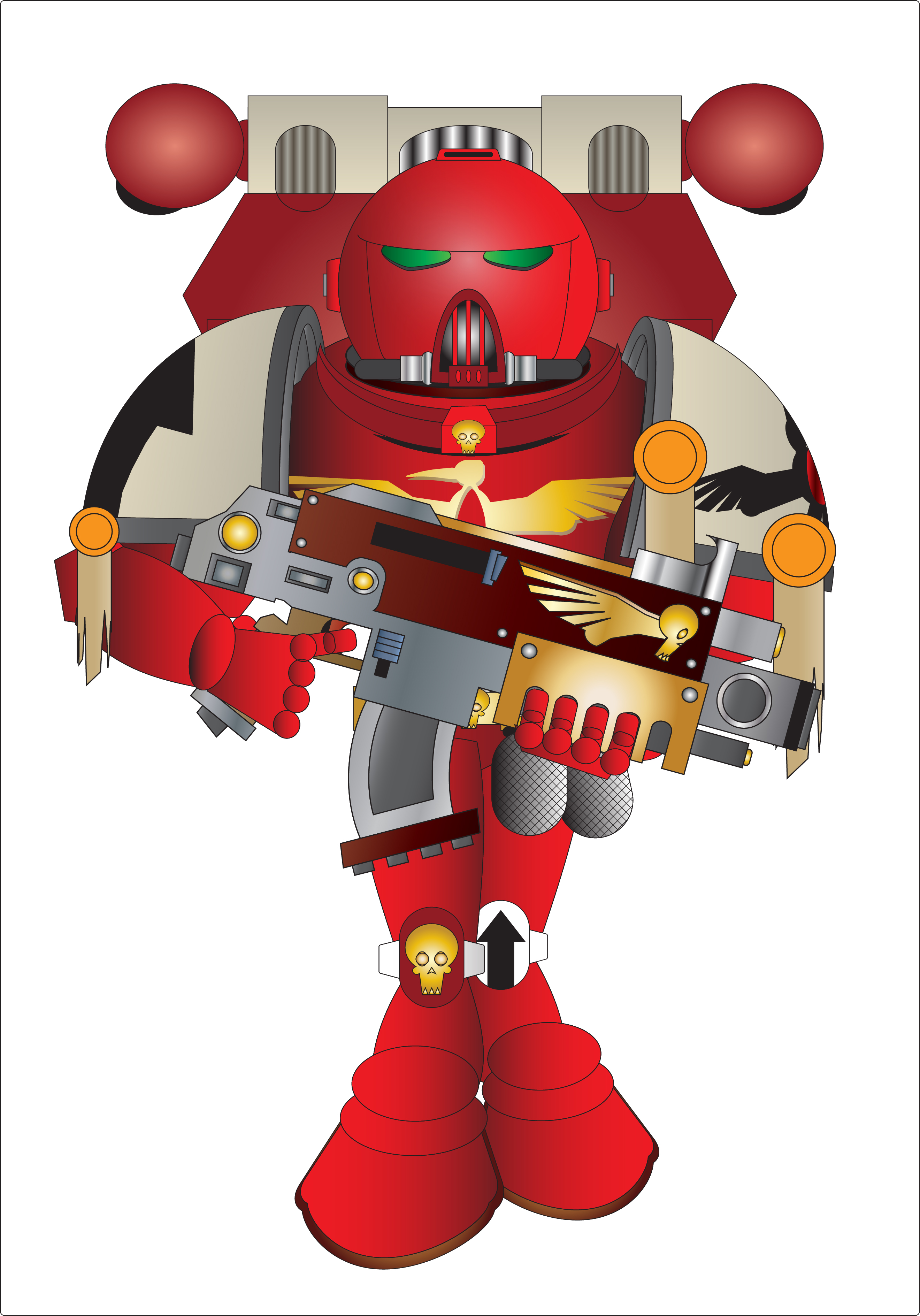
Tactical Marine
My first effort. Basic tactical marine all cartoon’d out.  I gave him a standard bolter and a couple of grenades.
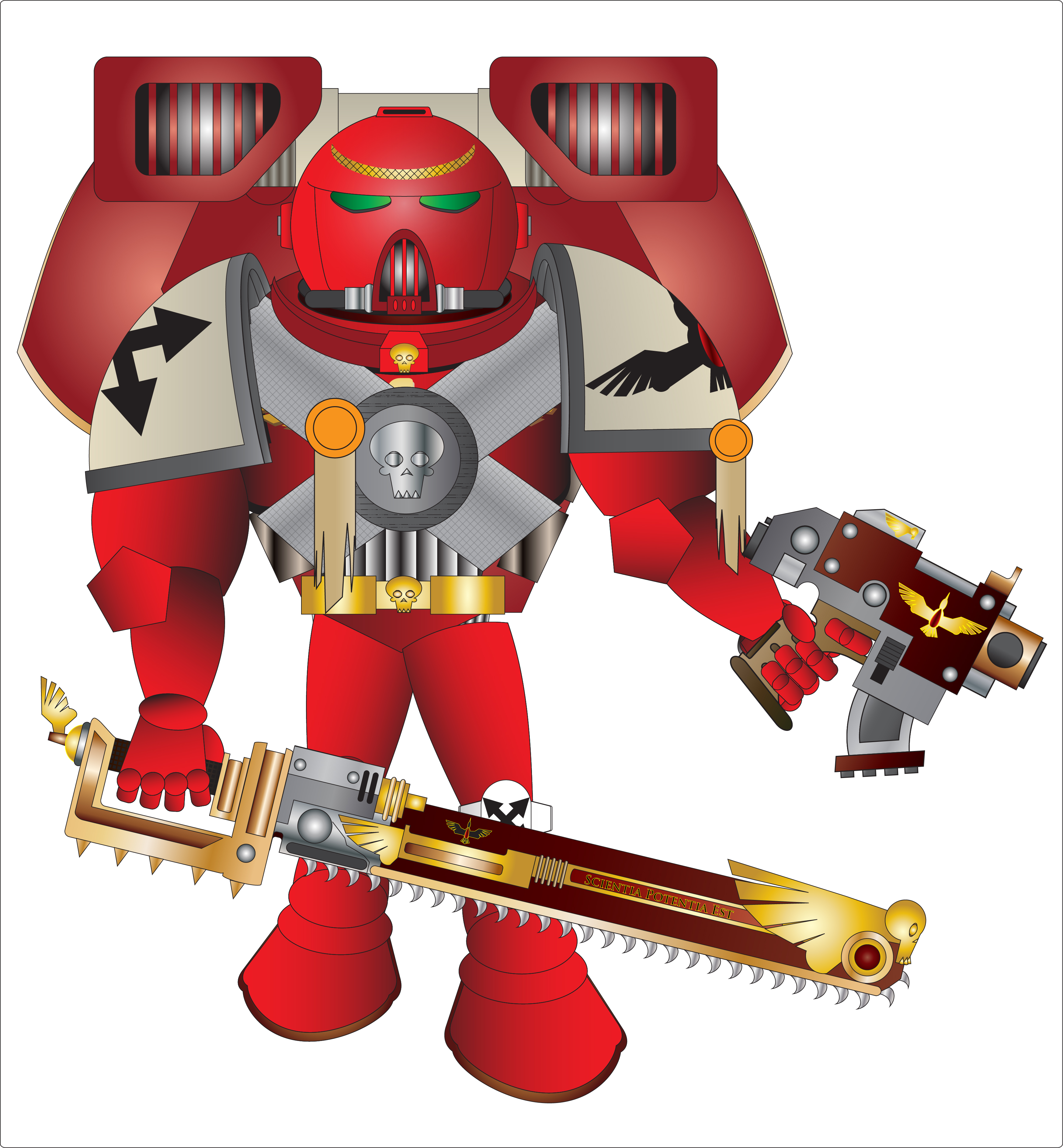
Assault Marine
This one was a nice exercise in different equipment. Making that chainsword was a blast and the first part of the Blood Ravens’ motto can be seen on its blade.
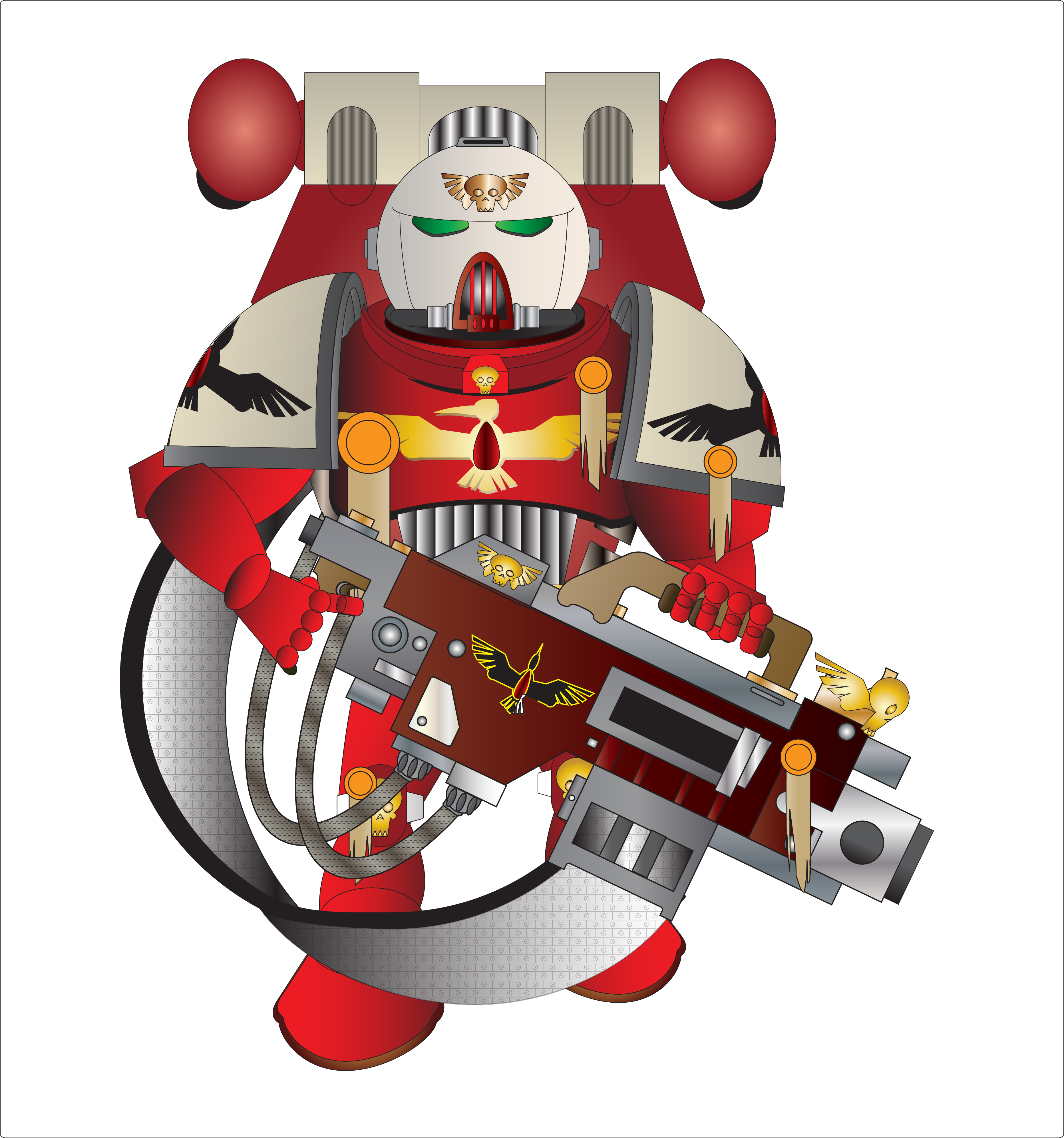
Devastator marine
A heavy-support devastator marine with heavy bolter. This one proved tricky and needs the most correcting. I made him a veteran just to mix up the colors a bit.
Captain/Chapter Master Gabriel Angelos
Captain Angelos with the Godsplitter. Making the artificer parts of his armor were an immensely fun challenge. Also he’s the only one with a human face. He’s still a cartoon but mostly recognizable!
Davian Thule
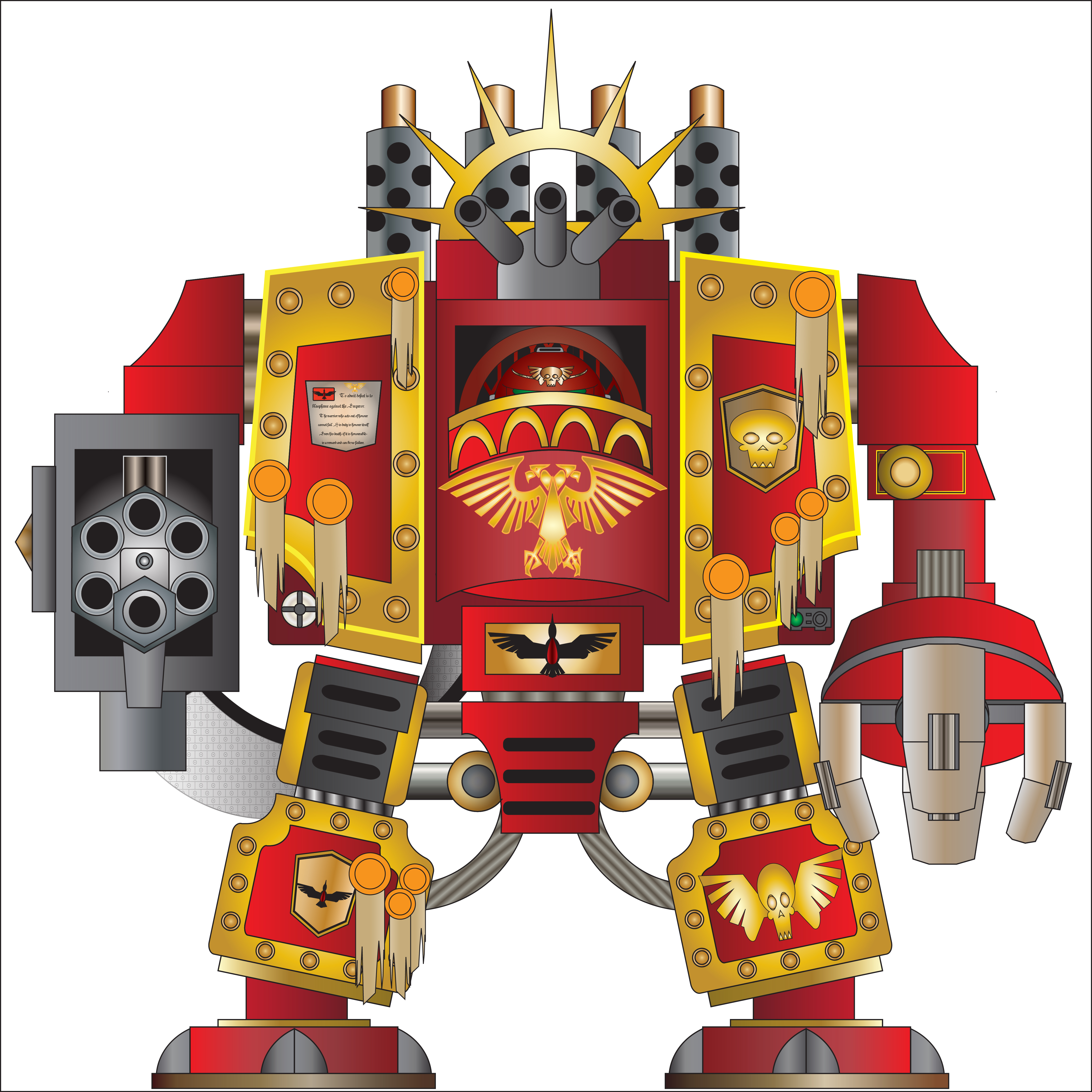
The final piece of the squad, Davian Thule as a Venerable Dreadnought. This one was obviously the most difficult, I could borrow very little from the others. It was also the most fun to build! There’s some canonical text on his armor.  Davian Thule was my favorite character in the Dawn of War series.  I wanted to ensure his venerable dreadnought state got the respect it deserved.

These were fun creations and made for nice self-taught Illustrator tutorials.  They’re still 2D flat objects, but are pretty far from my first “magnifying glass” creation, even though they were created essentially using the same concepts.  Next I’m going to try some expressive orks and maybe more dynamic character art.  These were fun though and hopefully they’ll be enjoyed!

As Good As It Gets – 15 years old, but not forgotten

This week I caught one of my favorite movies, As Good As It Gets. For those who haven’t seen it, Melvin Udall (Jack Nicholson) is an obsessive-compulsive romance novelist. Melvin falls in love with the blunt, struggling single mother Carol Connelly (Helen Hunt) and befriends his homosexual artist neighbor Simon Bishop (Greg Kinnear).

This movie came out when I was 15 years old. I remember seeing it for the first time when I was 17, and I watched it on TV and later bought a copy on VHS. For some reason, this movie captured my heart when I was a teenager.

After rewatching it, I see why. This movie is packed with well-written one liners, an interesting (and believable) plot about acceptance and coping, and above all, it shows you can find happiness in the darkest times. For a moment, let’s to look beyond the basics of traditional romantic dramadies and see why this is a timeless must see.

The characters: Melvin is as obsessive compulsive as a guy can get. He separates his Skittles, doesn’t like animals, brings his own silverware to restaurants, won’t walk on cracks, etc. When he speaks, there is no filter. He frequently pisses people off and can make almost any social situation awkward. His character is refreshing, and everyone has a little Melvin in him/her. We are who we are, and the rest of the world either accepts us or they don’t. It’s not always easy, but it’s that simple.

It makes you think: The movie focuses on looking past ourselves and our problems to focus on someone else. All three major characters are significantly different and are forced to mesh together and coexist. It’s a great example of tolerance and acceptance, which we can all practice more. We can all care a little more and do something do help someone we know – even if it’s just to make them smile.

Realism: As Good As It Gets is exactly what the title states. It doesn’t play games or try to sugarcoat how awful things can be, and it shows how having the power of optimism can make things better. You can improve your life by either changing what you don’t like or accepting and letting go what you cannot change. Sometimes things are as good as they get.

Clever writing: This movie is full of one liners and great dialogue, which I admittedly appreciate more with age. When it comes to sappy romantic movies, Jerry Maguire‘s, “You complete me,” line is often thought of. Well, here are two for you: “You make me want to be a better man,” and “You’re the reason cavemen painted on walls.” Tom Cruise, eat your heart out.

If you haven’t seen it or haven’t seen it in awhile, you should. It’s a great flick and a reminder that we can be better people.

Remakes and Reboots: Part 4

The Failed Remake

Of course not all remakes can achieve the heights of some of the previously mentioned films.  We have recently been inundated with remakes that have either fallen short or failed spectacularly.  Famously, there is the disastrous remake of Psycho, which was copied short-for-shot with a new cast in color.  As if a new director could possibly have made the film better than Alfred Hitchcock?  The argument could be made that it is the same method used for the Night of the Living Dead update, but there are subtle differences… most importantly Savini participated in Romero movies and made his film to honor Romero and help audiences remember the original.  Psycho… I’m not entirely certain what the purpose of it was.  Everyone, even people who have never seen it, KNOW the original.  It was shot by a cinematic virtuoso whose work could not be replicated or improved upon.  The same could be said for Kurosawa (if Hitchcock has an equal, his name is Akira Kurosawa), but remakes of Kurosawa often honor the original and try to place the basics of his story in a new place (as we have seen, with mixed results).  There has been word that Kurosawa’s magnum opus, The Seven Samurai, is getting yet another American remake, this one starring George Clooney.  Not only would it be the second western remake of this terrific film, this is overall a TERRIBLE idea, however still will not insult the original as much as reshooting the source film in color, shot-for-shot, with new actors as though he didn’t get it right the first time a la Psycho.  Please people… just bite the bullet, enjoy the black and white and watch the originals… there’s a reason these films are considered some of, if not THE, greatest movies in film history…

Cult Classic Case Study: Clash of the Titans (1981)

Leaving classics aside (as the general reception of the Psycho reaction proved) cult classics have become the focus of the remake machine.  While they are more understandable fodder for a remake, the reason behind the popularity of the original is still lost on most remakers.  One easy example is Planet of the Apes, which also achieved the same level of negative response as Psycho despite Tim Burton at the helm.  I saw the remake only once, and I remember enough to know I wouldn’t want to see it again.  We’ll jump to a more recent remake disaster: Clash of the Titans.

First, the nature of the cult classic.  The cult classic remains a cult because it succeeds in spite of its flaws.  It is greater than the sum of its parts.  Clash of the Titans (1981) was a delightfully cheesy feast.  Harry Hamlin’s Perseus is a feathered-haired relic of the late 70s and early 80s.  Monsters and creations by stop-motion animation wizard Ray Harryhausen show the art form at its precision best, from scorpions and vultures, to tiny clockwork owls, and Medusa with her dozens of snakes.  Acting legends like Laurence Olivier, and soon-to-be legends like Maggie Smith graced the screen with B-movie actors like Hamlin and Ursula Andress.  The story is right out of the basics of mythology, a hero is set upon by a vengeful god… he now has to set out on a journey, far too big for him, aided only by his guile (and some well-placed allies on Olympus) he goes to save his love, Andromeda, from the wrath of a sea goddess and her vicious creatures.  He gets an adorable clockwork owl, Bubo from Athena, a special sword and shield (of course), and rides the unridable Pegasus, one of Zeus’ winged horses.  Along the way, he fights with the twisted Calibos, fends off attacks from Calibos’ vulture and scorpions, duels Medusa, and finally saves the day by turning Poseidon’s mighty Kraken to stone with Medusa’s severed head.  The film is fun because it is so silly.  Stop motion isn’t as slick as CGI, but that’s what makes it special, something that took craft, patience, and years if not decades of training to get a physical something in front of the camera with actual lights reflecting off of it and casting actual shadows.  You wonder at how the little R2D2-esque owl flew, or how the menacing vulture, or the elegant Pegasus did the same.  You know it’s all just “the movies,” but you still leave it wondering how someone could take the time and effort to do all these things.  Perseus himself is a demi-god who acts like an everyman.  He doesn’t have the strength of Hercules, by far the most famous demi-god, but his cleverness makes up for it.  He succeeds by out-thinking enemies not out-muscling them.  He gets help when he needs it, and accepts it because he knows he needs it.  He travels the world to save his love while the gods literally play at dice high above him.

The film is not the masterpiece of Yojimbo, or Psycho, it’s not even a reflection of the times like The Karate Kid, instead it’s just a fun movie designed to entertain audiences and take them away to a fantasy world like movies are meant to do.  Then the remake…

Cult Classic Remake: Clash of the Titans (2010)

It’s hard to tell whether the 2010 version was supposed to be a remake or a reboot of a series.  In the end, it doesn’t matter.  It is one of the worst remakes, and one of the worst recent movies, in a number of years.

There has been a trend in movies, especially action movies and historical period movies, for revenge as a motivation for the protagonist.  Braveheart and Gladiator are two critically acclaimed movies that display this trend.  It’s strange to consider as revenge is, at its root, a very ugly thing; something not to be desired in a person, and certainly not a hero.  In the 1980s Clash (hereafter known as Clash) Perseus’ motivation was rescue.  He has offended the sea goddess, Thetis, and now she seeks her revenge by forcing Perseus’ betrothed Andromeda to be sacrificed.  Note that it is the villain of the piece after revenge… as traditionally a villain would be after something that petty.  In the 2010 remake, Crap of the Titans (hereafter known as Crap… for obvious reasons) Perseus’ family is killed by Hades at sea (Why Hades at SEA and not Poseidon?  I’d guess because the filmmakers thought, “Hey Hades is like the Devil he’s so much COOLER than Poseidon!”), and Perseus tries to defy the gods by tracking down Hades and defeating him.  That’s right, Perseus is seeking revenge for his family, which we’ve seen in every movie that features a guy with a sword since 1997… yawn.  Perseus in Clash looked every bit the classic Greek hero (save for the feathered hair).  Greeks always favored cunning over brute force.  Perseus uses his cunning constantly, he’s quick, clever, and fast thinking.  Things aren’t always spelled out for him (or the audience), and he has to decipher mysterious puzzles to defeat overpowering enemies.  And Perseus in Crap?  He’s a generic thug.  His shaved head, square jaw, and tiny-tight mouth make him look more like a second string UFC challenger than a Greek hero.  He’s capable of two emotions, rage and despair.  He shifts his feet, looks sad, shouts, and acts as though he has no common sense whatsoever.  He uses NO guile instead relying on just being mighty.  He is very mighty.  He cuts his way out of a big scorpion after all.  He refuses favors of gods trying to help him; instead he endangers his travelling companions because of his own pride and selfishness.  He is easily the most unlikable movie hero of the last 5 years.  His quest doesn’t even make sense.  Andromeda is no longer his love interest.  She’s just a princess who gave him water and will be sacrificed because the town her father rules has defied the gods.  It seems Perseus (especially the selfish brute they made him) could go on his quest to “kill” a deathless god without worrying about saving her since he has no plot-developed attachment to her.  Instead his love interest is Io, who is as unnecessary a character as has never existed in a movie.  She’s basically there to prod this mess of a plot along and explain things to Perseus (and the audience who are treated like imbeciles by the filmmakers).  They could’ve named her Expositiana and been more honest with everyone.  Then there is Perseus’ quest.  He wants to kill Hades?  What kind of sense does that make?  The gods can’t even kill each other…  Even Homeric hero Diomedes was only able send Ares back to Olympus after gutting him with a spear imbued with power by Athena herself.  Today’s Perseus’ quest can be described in real life as this: your family is killed in a drive by; so you collect the finest police officers in the city and your closest friends to go punch a Gambino in the face.  Well done, you’ve killed everyone with you and eventually yourself, even if you knock him out, break his nose, and put him in the hospital for a month.  Eventually, they will be coming for you, and they have the ability to take you out far better than you can take them out…  Even if you are friends with the Governor…

Breaking the Remake Rules: Insulting the Original

So that’s the plot.  It’s bad enough.  How can a remake be worse than just a bad movie?  Easily, it can insult, demean, and forever try to one-up the original.  As I said from the beginning, remakes owe the original their existence.  They should recognize this, accept it, and honor the source material as much as possible.  Crap breaks this rule and never misses an opportunity to declare itself bigger, better, and badder than Clash.  They achieved the last one at least… in all the wrong ways.

Early in the film Perseus finds the clockwork owl.  He is told to leave it behind, as it’s apparently nothing useful.   The filmmakers to the audience: take THAT beloved classic character!  When scorpions appear in the desert in Crap they start out about the same size as the ones Perseus fights in Clash, then they get bigger and bigger until the final scorpion is the size of Delta’s Pacific airline fleet welded together into some metallic art-school drop-out garbage collage.  The filmmakers to the audience: You see?!  Look how much bigger and menacing our monsters are!  In Crap, Perseus comes upon a herd of elegant white Pegasus (which were all killed but one in Clash), suddenly they scatter and run as a bigger, BLACK Pegasus stomps into scene.  Filmmakers to audience: Yeah, we scared off those piddly white ones you saw in the original.  Look at how much COOLER the menacing BLACK Pegasus is!  Aren’t we awesome?  In Crap, the Kraken finally shows up released from, I guess Hades.  And why a SEA beast, the Kraken, is controlled by the lord of the underworld I have NO idea… just another display of how absolutely poorly the film was written using the original ideas.  The Kraken is the size of Tokyo bay.  Filmmakers to audience: See what we said about the scorpions? Yeah, he’s bigger, slimier and looks like a video game end boss, phase II.

In the end of Clash, Perseus uses his guile to turn the Kraken to stone, save the day, and win his girl.  The end of Crap is the same thing, but Perseus of course doesn’t get Andromeda. Instead, a coda is added where Io, who has DIED, is brought back from the dead by a LITERAL deus ex machina, and they leave the opening for a sequel, which is now impending for next year.  Pat yourselves on the back everyone for appealing to the lowest common denominator…

Remakes & Reboots: Part 3

The Effective Updated Remake

Recently Hollywood has been taken to task for the deluge of remakes of old films, modern films, TV series, and foreign films.  Some of them are mystifying; why American Studios need to remake a British film less than 5 years old is beyond me.  Why American studios need to remake foreign language films in English even newer than that is even stranger…  But remaking old ideas is the nature of film and can, in some ways, advance both modern film and shed new light on the original.  Case in point, The Karate Kid.  The 1984 film is a martial arts film as much as Rocky is a boxing film.  In fact, both Kid and Rocky had the same director, John A. Avildson.  Avildson’s Kid is about the outsider, forced to move from his only home to a strange land where social classes and rules of behavior are different from the world he knows.  Karate is the outlet he uses to fit in, and then excel, to win the respect of the society he has been thrust into.  It stresses the most important lesson of martial arts, that it be learned so it never has to be used, and is bolstered by fantastic performances by both a young Ralph Macchio (an under-appreciated performance on his part) and an aging Pat Morita who was nominated for an Academy Award for his Mr. Miyagi and finally allowed him to shed the role of Arnold from Happy Days.  Interestingly, the part was envisioned for Toshiro Mifune, who was believed to be too intense for the role.  It’s a buddy story, as the brash youth befriends the lonely aging master; an action flick, as Macchio’s Daniel fights his way to respect; and a coming-of-age story, as Daniel matures as his Karate lessons continue.  It spawned a few sequels.  The sequels were less successful but did no harm to the message of the original story.

The 2010 remake initially came as terrible news to many of us who grew up with the original.  First, we were given the news that Jackie Chan, an excellent actor who has martial arts ability not possessed by Morita, but also has proven himself to be a fine dramatic actor, would be cast in the “Miyagi” role.  Many of us who are fans of Asian films at first felt fear that the creators might pull a Memoirs of a Geisha on us and try to pass Chan off as Japanese, as Hollywood apparently believes all Asian ethnicities are interchangeable.  Instead, we were hit with another piece of news that the film would take place in China… and that it was essentially being used as a vehicle for Will Smith’s son, Jayden, and produced by Smith’s production company.  It all smelled like a setup; a big budget film designed to promote a star’s kid’s career and make money off of a younger generation without having to create an all-new story.  Even more unusual was the film’s title, which remained The Karate Kid, despite the fact that it took place in China and the titular Kid was clearly going to be learning China’s Kung Fu not Japan’s Karate.  Forums went ablaze with comments of how Hollywood was “raping” the childhoods of countless American 20-30 somethings (though if your childhood was fragile enough to be based around a 1984 movie perhaps it’s time to find something new to hang your hat on anyway…) and it was destroying the legacy of the original (as though the ever diminishing sequels hadn’t already taken some of the shine off that apple).

Then the film came out.  It was clear that the makers of this film not only admired and honored the original, but also its message.  Chan’s Mr. Han was every bit as nuanced as the original Miyagi, and the story of the outsider was just as poignant in the new story as in the 1984 version.  In many ways it is a superior film, the class struggle has a more meaningful ending (even if it is a bit more Hollywood) as Jayden’s character, the young Dre, receives acceptance from Meiying’s family unlike Daniel who did not receive the same from Ali’s.  The martial arts message is just as clear, and the ending in which the Kid receives acceptance is a bit more in-your-face.  It displayed some terrific film making and a very interesting partnership between U.S. and Chinese film industries.  In one scene Han appears to chase flies with chopsticks, playing off of the notion in the original of Miyagi trying to catch a fly with chopsticks.  Han then smacks the fly with a fly swatter, showing that this is the same film, but a different film at the same time.  It doesn’t mock the original scene or claim to be better, it simply announces that this different film.

It fails to achieve the near-perfection of Fistful of Dollars however in some aspects and due to its compromises.  Through no fault of his own, 12-year-old Jayden Smith is not quite the emotionally powerful actor 16-year-old Ralph Macchio was in the original.  Macchio’s character was goofy, fun, playful, helpless, brash, and despairing and Macchio was able to portray all of these remarkably well.  Jayden’s character, Dre, didn’t have nearly the range given to Daniel in the 1984 version, partially due to the writing, and while Jayden was excellent in some areas, he was only serviceable in others, largely due to inexperience.  Still it is easy to see he will probably achieve every bit of the ability his father has at portraying both drama and comedy effectively as he ages.  The most disappointing aspect of the film is Mr. Han’s tragedy is nowhere near as meaningful as Mr. Miyagi’s, and that point, one of the most powerful points in the first film, is misused in the remake.

In the 1984 version Miyagi served honorably in World War II as a soldier in Europe.  While he bravely served his nation, winning a medal of honor (a fact not thrust in the audience’s face through dialogue but found by Daniel during the scene), his pregnant wife was in a Japanese internment camp in the United States where she died during child birth due to the poor medical treatment available in the camp.  Miyagi bravely served his adoptive nation, while the nation’s racist policies essentially killed his wife and child.  On the anniversary of his wife’s (and unborn child’s) death, Miyagi dresses in his army jacket and drinks his pains away.  The scene breaks the stone-wall-like Miyagi down, the man who seems so unbeatable shows he has been beaten by life; it shows why he is lonely, why he at first refuses to allow Daniel into his life, and eventually why he comes to accept him as a surrogate son.  Daniel for his part can only listen to what has happened.  When Miyagi finally passes out, Daniel can only make him comfortable in his bed and cover him with blankets.  He then goes through Miyagi’s World War II materials, which Miyagi has stashed away, medals and commendations, and the photograph of his wife.  The scene remains powerful because of its multilayered messages: Miyagi was a hero then, he stays a hero now; he can save Daniel in a way he couldn’t save his own son; and for Daniel’s part he sees there are some problems that cannot be fixed, talked out, or ever gotten over; all he can do is be there for his friend.

Mr. Han suffered his own tragedy, losing his wife and son in a car accident after an argument.  During the film we see Han working on a beaten up Volkswagen Scirocco in his home.  On the day Dre doesn’t train he comes to see Han who is destroying the car he just restored.  He relates the story of his wife and son, (who was a couple years younger than Dre), when he and his wife argued, and he accidentally wrecked the car in a rainstorm, killing both his wife and son.  While Han is old enough to have experienced some of the more relevant and important moments in recent Chinese history (such as the Great Leap Forward) that would have more poignantly paralleled the original story, I get the impression the Chinese film industry possibly did not want to criticize recent Chinese history as thoroughly as Avildson was willing to criticize recent American history.  We’re left instead with a car wreck, which admittedly is tragic.  The more problematic element is that Dre helps Han by doing one of their training sessions immediately after the story.  I can understand the impetus for this, some audiences may have desired a more active resolution to the subplot, but it is far more effective in the 1984 version.  Not everything can be easily fixed.  Not every problem can be resolved.  Anyone who has had a friend cry on their shoulder knows sometimes the only thing you can do is be there until they recover, and be there the next time.  The newer version took the easy way out on this subplot, which is a major disappointment, but not fatal to the film, which remains, overall, an excellent remake just shy of achieving a Fistful of Dollars level remake.

Remakes and Reboots: Part 2

The Homage Remake

George Romero’s Night of the Living Dead, though it’s not as widely respected in the mass-public as the films of Leone and Kurosawa, is a historic film in its own right.  Not only is it the film that launched the modern zombie genre of the walking dead who crave human flesh and can be dispatched with a shot to the head, but it blazed social trails by including a non-stereotypical African-American man as not only the lead, but a self-less hero.  It is in many ways as successful a story as Yojimbo and in its own way is as well made.  It too was made in black and white well into the color-film era, and it too launched a series of copy cats, parodies, and sequels.  The 1990 remake of Night of the Living Dead, made by special effects guru and Romero alum Tom Savini was a different kind of remake than Fistful; it was the exact same film with a new cast on updated film.  Savini had no desire to one-up the great Romero.  It was a gorier, little-more-rowdy version of the original and introduced the genre to an entire generation of kids who refused to watch black and white films strictly because they were black and white.  In many ways this 1990 remake renewed a waning interest in zombie horror.

The Premise Remake

When interest in new zombie horror films peaked again after 28 Days Later, a film that broke from Romero’s rules and created its own mythology became another remake of a Romero film that brought the genre back to its roots.  Dawn of the Dead (2004) is a new generation of remakes.  This film, unlike the previous two examples, took merely the premise of the original (people fleeing zombies barricade themselves into a mall) and wrapped an entirely new narrative around it.  In the original Dawn of the Dead (1974), Romero used the zombie genre to comment on social issues once again, this time mass-consumerism, as the people stuck in the mall are initially more concerned with stealing money, goods and enjoying living the good life in their castle-of-inexhaustible-delights.  The 2004 remake by Zack Snyder takes the premise of people fleeing the zombie apocalypse to a mall but says very little about consumerism (there is one line, “I don’t want you sneaking around and stealing shit.”).  Instead, it is more about how personalities respond when sequestered together, moral decisions, and survival.  While Snyder’s remake is not as culturally poignant, it is still a fun movie that maintains Romero’s mood of straight horror with some comedic undertones.  It too, is a successful remake as it takes the premise, builds a new story, and does it well.  It’s flashier, brighter, faster, and slicker than Romero’s film, but its rock video veneer matches its style and lends itself to the story.  It never insults the original or claims to be superior; it more or less ignores it and simply uses its premise to make a new, entertaining movie.

Remakes and Reboots: Part 1

There has been a trend in movies recently of remakes and reboots of franchises.  Some of these are venerable franchises that never really ended but whose sequels have reduced either in quality or earning power (such as the Friday 13th series or James Bond films).  Others are old forgotten relics, or classic but dated movies, producers feel need an upgrade or update in order to take an old idea and make it fresh, or to squeeze a little more cash without having to contract new stories from new writers and new creators.  The idea of the remake or films from books, plays, or other media is as old as film itself.  Recently, however there has been a rash of remakes and reboots of films, some good, some great, some better than the originals; some bad, some worse, some insults to already shaky reputations of cult classic films.

The Remake

For the purposes of this discussion a remake will be any film that takes the story of an original film, its characters, and its basic plot development and creates a newer version.  Sometimes with new plot twists, new dynamics, and almost always new actors, recent films have shown studios’ willingness to remake very old films as well as rather recent ones with sometimes shocking regularity.  The difference between a remake and a reboot can get muddied in modern cinema, but for our purposes we will try and stick to direct remakes in this section and analyze more obvious reboots in the next.

The Perfect Remake

There are effective ways to do a remake and still make a terrific film, sometimes building on the ideas of the original film, honoring it, or playing off of it.  A remake should never insult the original, demean it, or claim itself in any of its scenes or actions to be superior to it.  It should remember its place; it is not an original idea and owes its very existence to a film that preceded it.  One of the finest remakes in cinema history launched two of the most influential personalities in cinema: Sergio Leone and Clint Eastwood.  Leone’s spaghetti western version of Akira Kurosawa’s Yojimbo, A Fistful of Dollars, created the template for the perfect direct remake.  It took the story from the original, took most of the major characters, the plot, the tone, and the message, and created a whole new film for a whole new audience.  Though Yojimbo would find itself made and remade again in TV and in film (such as the MUCH less successful Bruce Willis remake Last Man Standing), only Fistful seemed to get it right.  Kurosawa’s original was a violent farce, mocking and revering the western genre as a whole.  It was darkly funny and delightfully cynical, containing broad caricatures of typical western stereotypes at the same time destroying the idea of the white-hat hero and single-handily creating the anti-hero for popular culture.  Leone’s version (made without the permission of Kurosawa but using the idea and much of the script whole cloth) embodies many of the same principles.  Eastwood is perfect as the laconic western gunslinger every bit as much as Toshiro Mifune was perfect as the jaded nameless samurai sword master.  Wild, operatic action takes place in both, the anti-hero’s only weakness is displayed when he helps others (the message seemingly conveyed: never help others…), and a climax between evil and not-so-evil leaves the audience satisfied with the conclusion.  Comparing the remakes, Fistful contained the same wry wit, delivered in Eastwood’s characteristic monotone.  Eastwood, like Mifune, was the ultimate good-bad-guy (or bad-good-guy, depending on one’s perspective); largely free of morality and selflessness, he is out to destroy the system as a whole by having it destroy itself rather than through direct action of his own.  His mind and wit are as deadly as his gun and he revels in watching the fools around him flounder like puppets on strings.  It honors the original’s feel and mood; it doesn’t simply take the premise and put it in a new location.  Last Man Standing plays it more straight.  It is hardly amusing, the lead character has none of the dark humor and plays more like an avenging angel of death than a wry, clever puppet master using his craftiness over his propensity for violence.  This change shows a trend in remakes as they get further and further from the original, or in more contemporary versions: simplification.  The characters in Yojimbo are complex and multifaceted.  Even when they are broad to the point of silliness, few of the characters are ever just one thing; the bold anti-hero who cares little for the world…still risks his entire plot to save a woman and return her to her family.  The wealthy sake brewer who runs one of the ruthless gangs is madly in love with the woman who was freed.  One of the characters idiotic younger brother is not only a vicious fighter but also has a fear of ghosts.  Little character pieces that make, even these cartoonish portrayals, alive and memorable.  The characters in Fistful of Dollars are just as memorable, as is the climax sequence displaying the lead character’s cleverness rather than just his ability to dispense violence.  Both were successful at telling the same story with the same mood and the remake honored the original by copying its mood, style, and characters.

Perhaps the Leone classic is an unfair remake to begin with as it is in many ways the perfect remake.  It had skilled performers and crews who knew exactly what would transfer over into the change in scenery and what wouldn’t, and it created its own mythology and branching stories.  In fact, it was so successful at retelling Kurosawa’s original film it spawned two sequels entirely unrelated to the source film, the second of which is widely considered to be the best, For a Few Dollars More and the legendary The Good, the Bad and the Ugly. Clint Eastwood would go on to play the clever anti-hero character pioneered by Mifune not only in Man With No Name films of Leone, but also in other films like The Outlaw Josey Wales, High Plains Drifter, and even the farcical Two Mules for Sister Sara.  Few remakes can claim such a pedigree, and it shows the genius of not only the filmmakers involved in the remake, but the excellence of the source film’s creators and storytelling.