Remakes and Reboot Redux: Conclusion

I grew up reading Dark Horse Predator comics and Wizard Magazine. As I moved into other comics, I founds lots of characters to love, but one I always knew about but never read was Judge Dredd. I recognized the character, but didn’t know much beyond the iconic appearance until the last 5 years or so.

Judge Dredd (1995)

In the 90s the mega action stars of the 80s were looking for vehicles. As Sylvester Stallone’s biggest franchises, Rambo and Rocky shifted from classic to semi-farce (at least for a decade or so) Sly began looking for other franchises to be his next big thing. He tried it first with Demolition Man but went for a recognizable character film with 1995s Judge Dredd.

Since I didn’t know about the character at the time I admit I rather enjoyed the film. It went for a “big” story, introduces the world, the judges’ council, then immediately breaks into a story of a character trying to bring it down. It was still exciting, had great 90s special effects (love that bodyguard-bot), and good characters. Stallone made a great Dredd, he certainly had the look, and Diane Cannon was also effective as Judge Hershey.

It came out in the extended Lethal Weapon fallout when every character had to have a “buddy” comic relief aspect. They chose Rob Schneider to basically play himself and proves to be the weakest part of the film. The other aspect of it is Dredd sacrilege but is a direct result of the Stallone-vehicle reality of the movie. They show Dredd’s face. Constantly. Something the creators of the comic have consciously decided not to do (as he is the faceless embodiment of righteous but fascist judgment in Mega City).

It was a Judge movie but still a Stallone movie and also a 90s action movie. It was bright, colorful, and very much a product of the 90s comic movie industry, basic popcorn entertainment. Fun but tossable.

Dredd (2012)

After what a lot of fans consider to be mor Tinseltown than Mega City outing of 1995’s Judge Dredd 2012 brought a reboot in Dredd. With a faceless Karl Urban as the titular Judge, it made the gritty judge movie for the modern era. Films, even hero films, took a dark turn and Judge Dredd is perfect in a “dark” thematic world.

Karl Urban is excellent as Dredd. I didn’t even know it was him, and therefore accepted him more easily as the character. Olivia Thirlby is also fantastic as psychic Judge Anderson, a dynamic female character in modern action movies. Dredd doesn’t treat her like a woman, he treats her like a rookie. Only bringing up her gender when the possibility of capture by savage gangers is a possibility. Lena headey makes a for a sufficiently creepy villain as Ma-Ma and she’s surrounded by a circus of terrific character actors playing terrific characters.

One of the best aspects of the film is its “day-in-the-life” feel. It is a rousing action film, but in the end Dredd explains his miniature war in Peach Trees Mega block as “Drug bust. Perps were…uncooperative…” it looks great, is well-acted, and gives us a look at a different kind of comic character.

These movies show how these films are products of their time and both work very well. Essentially the 2012 Dredd ignores the previous version, but both were successful movies; the first a fun 90s-style action flick; the second a gritty, modern sci-fi crime movie.

Neither is overtly disrespectful of the origin material and the reboot classy-ly makes its own movie without deriding the original. So a viewer can watch 1995s Judge Dredd, enjoy the fun 90s glory of it; then watch Dredd and appreciate the millennium brutality of Mega City crime fighting.

That’s the current state of reboots and remakes in my opinion. Some are good, some are bad, but admittedly it’d be nice to see a brand new intellectual property out there… Til then… It’s Judgment Time Hollywood.  At least make more Apes and Dredds, and less Clash of the Titans and RoboCops

Remakes and Reboots Redux: Part 2

Off The Top of My Head

I remember always being behind the times as a kid. I never saw the Rambo or Indiana Jones movies when they were new. I didn’t get the newest pop music or know anything beyond what showed up in “Weird” Al Yankovic or Kids Incorporated. BUT…I distinctly remember the first time I saw a RoboCop movie.

It was actually RoboCop 2, which is slightly inferior but in the same spirit as the original. I loved the action, the big robots, and the stop motion. You saw little glimpses of Officer Alex Murphy’s previous life as a person, enough to make his current state as a cyborg meaningful, but it was mostly shoot ‘em up robot fun with some funny parts and just a dash of character development.

I didn’t see the first film until the 2000s and despite its decidedly 80s vision of crime and the future it held up very well; and I can say that honestly as I didn’t have any youthful attachments to it. Bad guys were wonderfully bad. Robo had an established personality but was a great cyborg. His partner, Anne Lewis, was one of the best tough female characters this side of Vasquez from Aliens. And the story had an excellent progression and a fantastic “oooh gotcha!” conclusion.

The Real RoboCop

THEN they did a remake.

The original RoboCop series established certain demands on anything trying to call itself “RoboCop.” He-is-go-ing-to-talk-like-the-computer-in-War-games. He’ll spin that gun like a he’s in a 1950s western. He’ll call someone a “creep. “ Tell them to freeze. Then lots of shooting will occur.

That’s what RoboCop means to those of us who care about the series and, to be totally honest, would be the audience for a remake series.

Here’s what I don’t watch RoboCop movies for: To see his family life. To get to know him as a person for hour. To have a strong female character turned into…a dude… To see RoboCop CRY. And have Alex Murphy talk like Marky Mark Circa 1991.

Nearly half the remake is used building Alex Murphy’s character. He’s an honest cop, a devoted family man, a good partner, a decent person, a tough guy, a badass, a rebel against corruption. For an hour we see this in story, exposition, and flashbacks. Even after he becomes RoboCop we see more character exposition, as he copes with his new status, trains to become RoboCop a la Batman Begins, and fights against corporate prejudice (from one of the many rather good performances in the film, this one by Jackie Earl Haley. Other great performances include those of Sam Jackson, Michael Keaton, and Gary Oldman).

This is some strange RoboCop…thing

Less than half an hour into the original film Alex Murphy is RoboCop. Out RoboCopping it up with Old Detroit’s street trash. Before he gets all Robo’d, he’s introduced as a rookie to the precinct, which means other characters have to get to know him naturally and thus the audience gets to know him in an organic process. He’s cocky and arrogant, but in less than five seconds of dialogue we see how he’s developed and achieved a rapport with Lewis. He spins his gun because his kid likes it (and maybe he does too…) establishing he’s got a family he cares about, and we see that family in staccato flashes after he’s attacked (actively I’ll say by the bad guys, not in a BS car bomb). All of his character is built in about 10-15 minutes. His transition into RoboCop is done via first-person montage. As he’s switched on, sees something new, and is switched back off again. Time passes, he’s advanced to a new state of Robo, time passes again. Never wasting time so we get to the main story as soon as possible.

RoboCop does a lot of this blow stuff up stuff…

Where Apes updated the premise while making the story fit to a new audience and changing times, 2014’s RoboCop is a near-Clash of the Titans-level farce. The Corporation plot is senseless and muddled. There was a needless “military drones should be legal in the US” angle. Robocop was Strong Sad in an exoskeleton. His wife and child just WOULDN’T GO AWAY. And none of it had to be done.

An hour into the movie RoboCop 2014 makes his first bust (35 minutes passes in the original for RoboCop 1987 to accomplish this) and the corporate mouthpiece comments that Robo ID’d the bad guy after only 60 seconds on duty, and says how impressive that is. Why then, may I ask, did it take the movie 60 MINUTES to get us here?

And none of this “what have they done to me?!” stuff…

Now many of you may start shouting, “But wait, wait, wait, Apes updated its story, was dramatic, and deep, and you showered it with praise!” True. I did. BUT. The original Planet of the Apes movie was a sci-fi drama. Designed to have social commentary, make observations on human hubris, and still wrap it up into a terse, excellent sci-fi movie. That’s exactly what the two new Apes films did.

What was the original RoboCop series? An outstanding, fun, sci-fi action movie with more Dawn of the Dead style tongue-in-cheek commentary on consumerism, economic Darwinism, and social progress seen in the periphery and through action, rather than exposition. It was not a DRAMA. It was NOT a personal introspective look at the life n’ times of a homie from the block who became a robo cop. And how it made it him feel. And what does it mean for society.

The new movie was a product of a film industry that seems not to know how to have much fun anymore. It either makes dreadful and derivative Scary Movie style “fun” or it makes action movies that have to show consequences and emotions rather than just the cartoon style blasty-blasting we saw in the 80s and 90s movies. Even action movies, have to try to hit you in the feels rather than just show a half-dead robo-man blowing away street scum.

More importantly either filmmakers don’t know what kind of movie they want to make, or want to make a cross-genre thing that, as Jim Sterling would say in a mocking, whiny voice, “appeals to a wider audience.” Before making any film the question needs to be asked, “What is this movie about?” And stick to THAT. A movie like RoboCop can have social commentary, the original certainly did. But it shouldn’t shoehorn it in at the expense of the real plot. We shouldn’t spend more than half the film establishing character. We shouldn’t spend an equal amount of time on drama. We shouldn’t waste even more screen time getting into the mechanics of how RoboCop robo-works.  We shouldn’t go down the plot-rabbit-hole chasing military drone legalization and political debate. A movie that tries to do everything at once accomplishes doing nothing much in the end.

In a scene that packs more emotion in three minutes of activity than the 2014 remake did in an hour of exposition, Alex Murphy lies to his wife in RoboCop 2 saying, “They made this…to honor him.” They certainly didn’t make the new RoboCop to honor you, Alex.  So Hollywood, the fans are taking away your remake privileges. Dead or alive they’re coming with me…

Next week will be a bonus wrap up with a pair of movies about the same character, one from the 90s one from the last couple of years, that both succeeded in making fun movies but in totally different ways.

Remakes and Reboots Redux: Part 1

Off The Top of My HeadRise and Dawn of the Planet of the Apes

In my very first series of posts on RevPub I detailed what I thought made a remake, reboot, or sequel successful. In the modern film environment it’s easy to see why that’s important. Over this past weekend I watched three films that made me want to go back and revisit this concept. The first two were excellent (one a reboot/prequel and its subsequent sequel) and the last one dreadful and all helped prove the point of what makes the “re-” genre work and what makes it fail. This week I’ll start with the successes: Rise and Dawn of the Planet of the Apes.


Few films are as iconic, not a word to be used lightly, as the 1968 Planet of the Apes. I’d say it’s up there with The Godfather and Scarface for quotability and nearly invented the modern shocker twist ending. It’s a product of its cold war time period, but many of the lessons it professes are still valid and it largely still holds up, even if many of the film making and special effects may seem dated.
There were a number of less-than-stellar sequels and even the Tim Burton remake from 2001, so when a new one was announced it felts like territory that had been over-traveled. The first film, Rise of the Planet of the Apes was a pleasant surprise…and an impressive film in its own right.
Part reboot, part prequel, it does everything a film in this kind of category should. It pays proper homage to the original, making small references, quoting, and even foreshadowing the previous film, and never NEVER once makes light of the original film or attempts to outdo or show up a film more than 40 years old.
Apes movies are in the “monster” genre I feel and in many ways the latter half of the first movie and the entire second film feel like a far more original extension of the zombie genre. These kinds of monster movies are only as effective as their human characters. In the first film the human cast, led by James Franco and supported by John Lithgow, Brian Cox, and Freida Pinto are compelling in their positive and negative qualities. Andy Serkis, of Gollum fame, is a show stealer as Caesar, the real star of the movie and the character in whose story we are invested. Like his role in the Lord of the Rings however his performance is lost in CGI, though I would wager echoes of his emotions shine through. This is very similar to the stories I remember hearing about how difficult it was for Roddy McDowell and Kim Hunter to emote behind layers of thick prosthetic make up.
The story itself is character-based, always pushed on my characters (mostly Caesar) responding to events and actively making choices and deciding, rather than having choices thrust upon him. Not only that but one actually feels far more attached to him than to the human characters, even those we like, because of how well he is portrayed, both in the writing and in the performance.
Furthermore it fills in plot holes from the original such as why the apes speak English, use human-style tools, and how they progressed so quickly. It also skillfully updates the setting from a cold war nuclear age to a 21st century biological age without detracting from the original purpose or even re-writing the events of the canon.
All in all it’s a terrific reset to a legendary film, and compelling to watch for fans of the original and just those seeking some great entertainment.


Dawn of the Planet of the Apes succeeds where the sequels to the original film largely failed in that it is actually a good movie. Dawn picks up where Rise left off, telling the story of how the newly self-emancipated apes and the remnants of humanity come into conflict with each other, and how even in an idealized setting, one under perfect leadership and the best altruistic foundations, selfishness and violence can creep in. It’s a perfect extension of both the ideology and story of the first film and progresses us more and more toward the eventuality of the progenitor film. Again the human cast is effective led by Gary Oldman, Jason Clarke, and Keri Russell.
Yes this “reboot/prequel” franchise is a success. It succeeds because it takes what made the original film work, builds upon it, pays proper respect to it, and then tells its own narrative. Most of all these two moves are just well-made, well-designed, well-told stories. They know what they set out to do and do it. A rarity in modern film making…
Next week we go from the sublime to the ridiculous as we look at last year’s remake of another classic film…this one from the 1980s.

How the Internet Destroyed the Chain Letter

Revenant Publications 90s banner

Chain letters had a noble start in 1888 – a letter sent to a person requesting a church donation and to send the letter to three people asking them to do the same. However, over the years, the chain letter evolved into warnings of bad luck, promises of good fortune, and in the 2000s became “this Nigerian prince needs your credit card info” without the mysticism (to quote my RevPub partner).

I remember the chain letters I grew up with. They were passed around school, and I even received a few in the mail. Remember, this was a time people actually mailed things to each other; it wasn’t just junk mail and postcards.


They looked similar to this:

If you’re reading this, then you’ve already started the chain reaction and there’s no going back. The events I am about to warn you about will definitely unfold, even if you close this email now. The best thing you can do now is read on and carefully follow my instructions.


I remember at 10-12 years old believing something terrible would happen to my friends and family after reading this, so of course I made copies and mailed them out. It was scary but cool at the same time. I’d call my best friend to gossip about all the horrible things that could happen if I didn’t respond. (She was probably the one who sent it to me, although she’d never admitted it.)

So what happened to them? The Internet.

By the late ’90s, the Internet took the world by storm, and not only could you send things to people in a matter of seconds, you could email chain letters. And people did. I received hundreds, maybe thousands, of these, and they were no longer just scary. Some promised money, fame, true love. Or they served as a way to “show” people you cared about someone or something.

The problem was too many people sent too many of them. Email took off, and people were reading things they cared about: emails from friends, links to things on the Web, or they stopped checking their email all together. No one took chain letters seriously. Then the wonderful spam settings were established, and you never had to see them. Chain letters became spam, junk mail.

I feel this is a sad loss in our culture because many kids and teenagers have no idea what a chain letter is. There was a sense of urgency about them, a suspense receiving one created – especially if you were superstitious. They were fun and felt a little dangerous, and as a kid, made you feel special because you received it. Most people used to love receiving letters after all.

I don’t recommend bringing them back, but let’s not forget where we came from – even Spam has a cool back story!
And if you feel the need to bring them back, here’s a how to start a chain letter. Be careful!

Sources of Inspiration: Jim Sterling

image

There are more online pundits and reviewers than we need.  It is rare however to find a reviewer or pundit who actually has something to say.  And even rarer to find one to whom I’d donate money in support.

I started watching videos put up by online magazine The Escapist because of Zero Punctuation aka Ben “Yahtzee” Croshaw.  His show is a pithy, quick, and hilarious take on specific video games and their quirks.  But I admit I stayed to watch Jim Sterling’s Jimquisition shows.

image

Jim’s commentary on video games, video game companies, and their trends is marvelous and, even if you don’t always agree, is always thought provoking.

Jim has had an interesting and transitional career.  From Destructoid to Escapist he has made numerous comments that have “enraged” (I put that in quotes because this is video games we’re talking about here…) game fans.  From being hated for the ultimate sin of “not liking” a Final Fantasy game (I agree though…Final Fantasy is an empty shell compared to the days when it’s games’ technological advancement could be categorized in terms of “bits”) to having the gall to say that female game critics, writers, and producers shouldn’t be threatened with violence and rape.

I’m actually not really interested in his controversy…  Mostly because I don’t find him to be that controversial.  He says what he believes.  One can agree or disagree (I don’t always agree but I find I agree the vast majority of the time) but he never says anything purely out of hate or shock value.  If a game is shit he says it’s shit and faces the backlash like a champ.  See The Slaughtering Grounds incident for an example of that.  If a practice of the industry or its fans is tasteless or predatory he says he thinks it is just that.  In fact I started watching his videos because he voiced exactly my problems with the way games are conceived and produced now.  And why I rarely play a “so-called AAA game,” to use his phrasing, nowadays.

I truly appreciate is his writing, production, and character construction.  The narratives in his videos are often fast, full of information, and loaded with complex ideas, but his presentations are always not only clear (you know EXACTLY his points from the outset) but often very clever, very witty, and biting in their arguments.   It’s that kind of methodology that is inspiring to other creative people, or at least to me as a creative person.  You can always count on Jim, not only to give you his opinion on all kinds of practices but to do so in a way that is so memorable you’ll go back to them repeatedly (I know I’ve queued his vids up to hear why Ubisoft is idiotic, free-to-play is a misnomer, and pre-order culture is poison).

His series with Yahtzee were also fun.  Last year’s rhymedown spectacular and the Uncivil Wars series which Jim won earlier this year provided another look at both his and Yahtzee’s personas outside of the review realm.

His newer material, since he’s gone rogue and become fan-funded through Patreon is even better.  Freed from even the loose shackles of another company he has been able to write more reviews and even start an absolutely terrific podcast series that is one of the best since The Ricky Gervais Show.

image

The fact that he owns a chainsword gives him extra points…

If you are a video game fan, specifically a fan who feels the industry has gone the way of film production in its heartless and cold monetization of all aspects of gaming and its focus on useless tech over art design and storytelling, put on a Jimquisition playlist and you’ll find yourself nodding in agreement or raising your finger and saying “but…”  Either way he’s provoking a response and maybe cranking your brain out of idle for 6-12 minutes.  It’s worth it.  Because he’s Jim F’n Sterling Son.  And thank god for him.

Jim Sterling Cartoon
The Author’s Rendition of Jim on a rant.


Jimquisition website

A Tribute to Good Coworkers

Inspiration comes in many forms, and this week it came to me in the shape of the men and women I work with. About midweek, I was chatting with a coworker about a personal concern, and she offered to help. I accepted and thought how awesome she was for caring and offering help.

This made me think about my current and past coworkers. I have been lucky to have worked and still work with some of the best people I know. I’ve had two main jobs, totaling 18 years of work experience, and still stay in touch with people I worked with 15 years ago. In my current job, I have a dozen or so I would want to stay in touch with if any of us changed jobs or moved.

But what makes memorable and good coworkers? Aside from who they are and how our differences and similarities bond us, here’s a list of things to do to make the workplace better and build good coworking relationships:

Listen. People love to talk about themselves. We do it all the time at RevPub! Therefore, you should listen to them. Most times, if people think you actually care about what they’re saying, they’ll open up. Now, if you don’t want them to, that’s okay too. In that case, don’t expect them to want to know you if you don’t want the same. No one gets along with everyone.

A cupcake a coworker made for my birthday. She knows I love frogs!

Work hard. Thankfully, I can say everyone I work with works hard – all the time. That has not always been the case. At the store, if a cashier or stocker was lazy, they didn’t last long. Either they quit because they had to work harder or they got fired because everyone had to pull their weight. Other people resented them, morale dropped, and it caused problems for management.

Laugh. I love when my coworkers laugh, especially if it has been a long day. It makes me smile even if I don’t know what they’re laughing about. Sometimes they share, sometimes they don’t, but it doesn’t matter because laughter breaks up the monotony of the day. Laughter helps reduce stress, and if you laugh hard enough, can be a great ab workout.

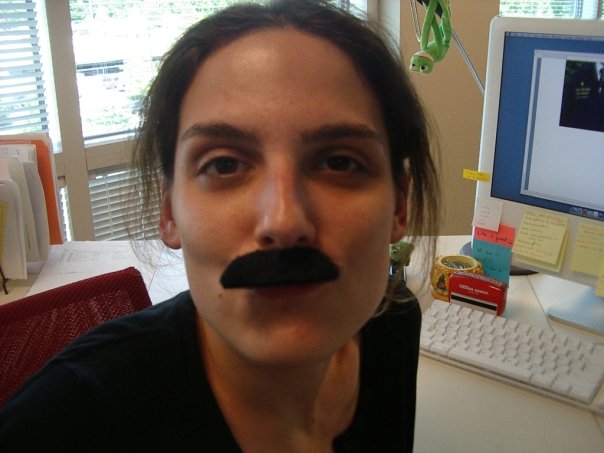
This was for a mustache collage for someone. It turned out well!

Share. I recently received a fun email about cold offices and what cold-natured people go through in order to work in them. It was SO true, so I sent it to my fellow freezers. Sure, there’s Facebook and Twitter, but most of us don’t have time to stay on those sites. Therefore, when there’s a funny article or awesome success story, we share it. Many times this causes No. 3, and we get through the day better off than we were before.

Try not to gossip. Sometimes this is unavoidable, but keep it to a minimum. If you wouldn’t say it to their face, it probably doesn’t need to be said. Also, if a coworker confides in you, keep it to yourself unless given permission to share. And always ask for permission. I am very thankful I have always had coworkers I could confide in, and they have helped me through some tough times, such as family and pet passings and school stress.

I know many of my coworkers will read this because they are big supporters of the site. I want them to know how much I appreciate their support and hard work. And to all those people who try to be coworkers, thank you for making all workplaces better places. If you have some great coworker stories, feel free to share in the comments below!