Remakes and Reboots Redux: Part 2

Off The Top of My Head

I remember always being behind the times as a kid. I never saw the Rambo or Indiana Jones movies when they were new. I didn’t get the newest pop music or know anything beyond what showed up in “Weird” Al Yankovic or Kids Incorporated. BUT…I distinctly remember the first time I saw a RoboCop movie.

It was actually RoboCop 2, which is slightly inferior but in the same spirit as the original. I loved the action, the big robots, and the stop motion. You saw little glimpses of Officer Alex Murphy’s previous life as a person, enough to make his current state as a cyborg meaningful, but it was mostly shoot ‘em up robot fun with some funny parts and just a dash of character development.

I didn’t see the first film until the 2000s and despite its decidedly 80s vision of crime and the future it held up very well; and I can say that honestly as I didn’t have any youthful attachments to it. Bad guys were wonderfully bad. Robo had an established personality but was a great cyborg. His partner, Anne Lewis, was one of the best tough female characters this side of Vasquez from Aliens. And the story had an excellent progression and a fantastic “oooh gotcha!” conclusion.

The Real RoboCop

THEN they did a remake.

The original RoboCop series established certain demands on anything trying to call itself “RoboCop.” He-is-go-ing-to-talk-like-the-computer-in-War-games. He’ll spin that gun like a he’s in a 1950s western. He’ll call someone a “creep. “ Tell them to freeze. Then lots of shooting will occur.

That’s what RoboCop means to those of us who care about the series and, to be totally honest, would be the audience for a remake series.

Here’s what I don’t watch RoboCop movies for: To see his family life. To get to know him as a person for hour. To have a strong female character turned into…a dude… To see RoboCop CRY. And have Alex Murphy talk like Marky Mark Circa 1991.

Nearly half the remake is used building Alex Murphy’s character. He’s an honest cop, a devoted family man, a good partner, a decent person, a tough guy, a badass, a rebel against corruption. For an hour we see this in story, exposition, and flashbacks. Even after he becomes RoboCop we see more character exposition, as he copes with his new status, trains to become RoboCop a la Batman Begins, and fights against corporate prejudice (from one of the many rather good performances in the film, this one by Jackie Earl Haley. Other great performances include those of Sam Jackson, Michael Keaton, and Gary Oldman).

This is some strange RoboCop…thing

Less than half an hour into the original film Alex Murphy is RoboCop. Out RoboCopping it up with Old Detroit’s street trash. Before he gets all Robo’d, he’s introduced as a rookie to the precinct, which means other characters have to get to know him naturally and thus the audience gets to know him in an organic process. He’s cocky and arrogant, but in less than five seconds of dialogue we see how he’s developed and achieved a rapport with Lewis. He spins his gun because his kid likes it (and maybe he does too…) establishing he’s got a family he cares about, and we see that family in staccato flashes after he’s attacked (actively I’ll say by the bad guys, not in a BS car bomb). All of his character is built in about 10-15 minutes. His transition into RoboCop is done via first-person montage. As he’s switched on, sees something new, and is switched back off again. Time passes, he’s advanced to a new state of Robo, time passes again. Never wasting time so we get to the main story as soon as possible.

RoboCop does a lot of this blow stuff up stuff…

Where Apes updated the premise while making the story fit to a new audience and changing times, 2014’s RoboCop is a near-Clash of the Titans-level farce. The Corporation plot is senseless and muddled. There was a needless “military drones should be legal in the US” angle. Robocop was Strong Sad in an exoskeleton. His wife and child just WOULDN’T GO AWAY. And none of it had to be done.

An hour into the movie RoboCop 2014 makes his first bust (35 minutes passes in the original for RoboCop 1987 to accomplish this) and the corporate mouthpiece comments that Robo ID’d the bad guy after only 60 seconds on duty, and says how impressive that is. Why then, may I ask, did it take the movie 60 MINUTES to get us here?

And none of this “what have they done to me?!” stuff…

Now many of you may start shouting, “But wait, wait, wait, Apes updated its story, was dramatic, and deep, and you showered it with praise!” True. I did. BUT. The original Planet of the Apes movie was a sci-fi drama. Designed to have social commentary, make observations on human hubris, and still wrap it up into a terse, excellent sci-fi movie. That’s exactly what the two new Apes films did.

What was the original RoboCop series? An outstanding, fun, sci-fi action movie with more Dawn of the Dead style tongue-in-cheek commentary on consumerism, economic Darwinism, and social progress seen in the periphery and through action, rather than exposition. It was not a DRAMA. It was NOT a personal introspective look at the life n’ times of a homie from the block who became a robo cop. And how it made it him feel. And what does it mean for society.

The new movie was a product of a film industry that seems not to know how to have much fun anymore. It either makes dreadful and derivative Scary Movie style “fun” or it makes action movies that have to show consequences and emotions rather than just the cartoon style blasty-blasting we saw in the 80s and 90s movies. Even action movies, have to try to hit you in the feels rather than just show a half-dead robo-man blowing away street scum.

More importantly either filmmakers don’t know what kind of movie they want to make, or want to make a cross-genre thing that, as Jim Sterling would say in a mocking, whiny voice, “appeals to a wider audience.” Before making any film the question needs to be asked, “What is this movie about?” And stick to THAT. A movie like RoboCop can have social commentary, the original certainly did. But it shouldn’t shoehorn it in at the expense of the real plot. We shouldn’t spend more than half the film establishing character. We shouldn’t spend an equal amount of time on drama. We shouldn’t waste even more screen time getting into the mechanics of how RoboCop robo-works.  We shouldn’t go down the plot-rabbit-hole chasing military drone legalization and political debate. A movie that tries to do everything at once accomplishes doing nothing much in the end.

In a scene that packs more emotion in three minutes of activity than the 2014 remake did in an hour of exposition, Alex Murphy lies to his wife in RoboCop 2 saying, “They made this…to honor him.” They certainly didn’t make the new RoboCop to honor you, Alex.  So Hollywood, the fans are taking away your remake privileges. Dead or alive they’re coming with me…

Next week will be a bonus wrap up with a pair of movies about the same character, one from the 90s one from the last couple of years, that both succeeded in making fun movies but in totally different ways.

Remakes and Reboots Redux: Part 1

Off The Top of My HeadRise and Dawn of the Planet of the Apes

In my very first series of posts on RevPub I detailed what I thought made a remake, reboot, or sequel successful. In the modern film environment it’s easy to see why that’s important. Over this past weekend I watched three films that made me want to go back and revisit this concept. The first two were excellent (one a reboot/prequel and its subsequent sequel) and the last one dreadful and all helped prove the point of what makes the “re-” genre work and what makes it fail. This week I’ll start with the successes: Rise and Dawn of the Planet of the Apes.


Few films are as iconic, not a word to be used lightly, as the 1968 Planet of the Apes. I’d say it’s up there with The Godfather and Scarface for quotability and nearly invented the modern shocker twist ending. It’s a product of its cold war time period, but many of the lessons it professes are still valid and it largely still holds up, even if many of the film making and special effects may seem dated.
There were a number of less-than-stellar sequels and even the Tim Burton remake from 2001, so when a new one was announced it felts like territory that had been over-traveled. The first film, Rise of the Planet of the Apes was a pleasant surprise…and an impressive film in its own right.
Part reboot, part prequel, it does everything a film in this kind of category should. It pays proper homage to the original, making small references, quoting, and even foreshadowing the previous film, and never NEVER once makes light of the original film or attempts to outdo or show up a film more than 40 years old.
Apes movies are in the “monster” genre I feel and in many ways the latter half of the first movie and the entire second film feel like a far more original extension of the zombie genre. These kinds of monster movies are only as effective as their human characters. In the first film the human cast, led by James Franco and supported by John Lithgow, Brian Cox, and Freida Pinto are compelling in their positive and negative qualities. Andy Serkis, of Gollum fame, is a show stealer as Caesar, the real star of the movie and the character in whose story we are invested. Like his role in the Lord of the Rings however his performance is lost in CGI, though I would wager echoes of his emotions shine through. This is very similar to the stories I remember hearing about how difficult it was for Roddy McDowell and Kim Hunter to emote behind layers of thick prosthetic make up.
The story itself is character-based, always pushed on my characters (mostly Caesar) responding to events and actively making choices and deciding, rather than having choices thrust upon him. Not only that but one actually feels far more attached to him than to the human characters, even those we like, because of how well he is portrayed, both in the writing and in the performance.
Furthermore it fills in plot holes from the original such as why the apes speak English, use human-style tools, and how they progressed so quickly. It also skillfully updates the setting from a cold war nuclear age to a 21st century biological age without detracting from the original purpose or even re-writing the events of the canon.
All in all it’s a terrific reset to a legendary film, and compelling to watch for fans of the original and just those seeking some great entertainment.


Dawn of the Planet of the Apes succeeds where the sequels to the original film largely failed in that it is actually a good movie. Dawn picks up where Rise left off, telling the story of how the newly self-emancipated apes and the remnants of humanity come into conflict with each other, and how even in an idealized setting, one under perfect leadership and the best altruistic foundations, selfishness and violence can creep in. It’s a perfect extension of both the ideology and story of the first film and progresses us more and more toward the eventuality of the progenitor film. Again the human cast is effective led by Gary Oldman, Jason Clarke, and Keri Russell.
Yes this “reboot/prequel” franchise is a success. It succeeds because it takes what made the original film work, builds upon it, pays proper respect to it, and then tells its own narrative. Most of all these two moves are just well-made, well-designed, well-told stories. They know what they set out to do and do it. A rarity in modern film making…
Next week we go from the sublime to the ridiculous as we look at last year’s remake of another classic film…this one from the 1980s.

Story of the Month: April Fooled

On this April Fool’s day I thought a story of how I was fooled by no one in particular and how it was the most fooled I’ve been in ages..

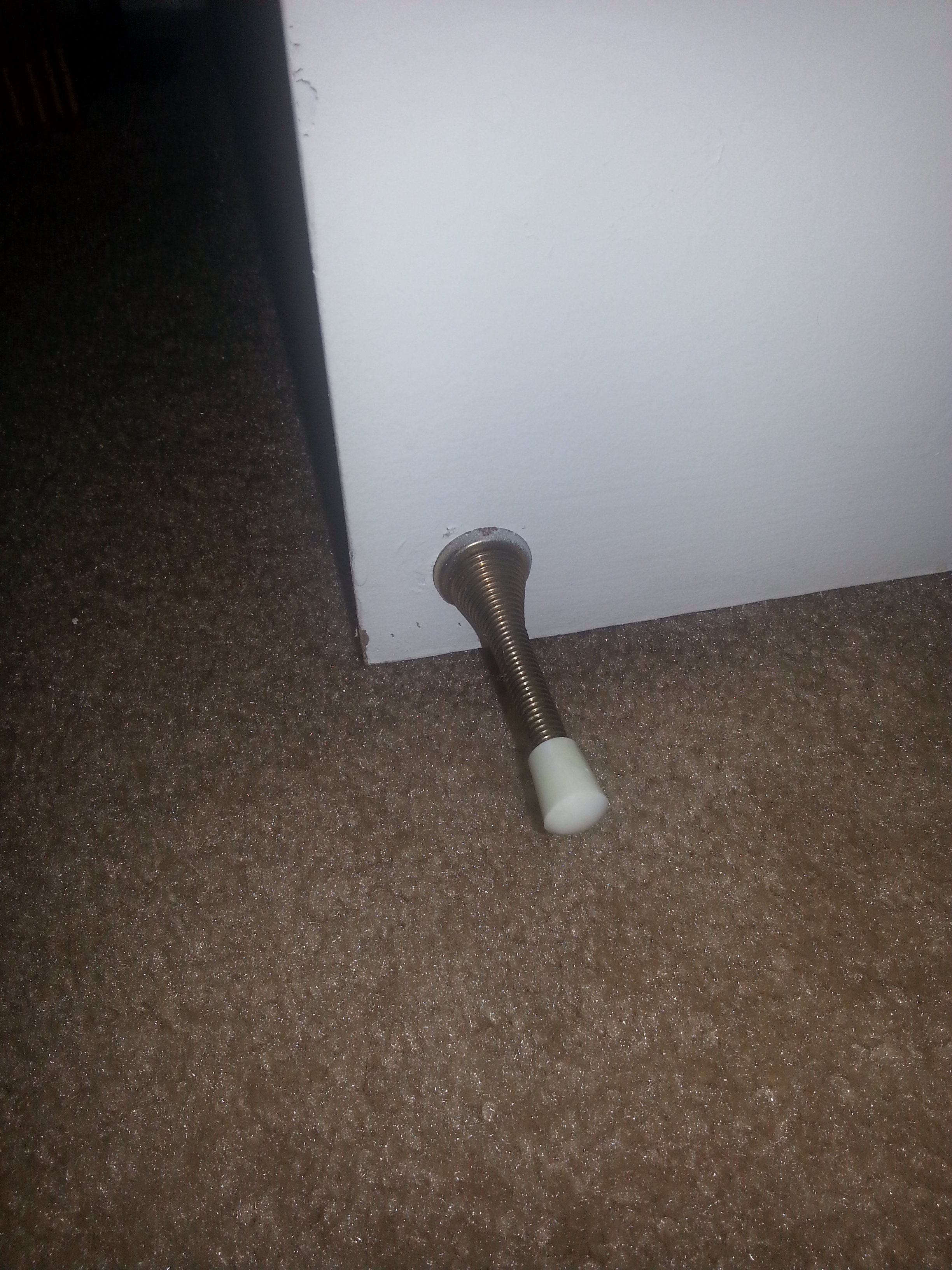
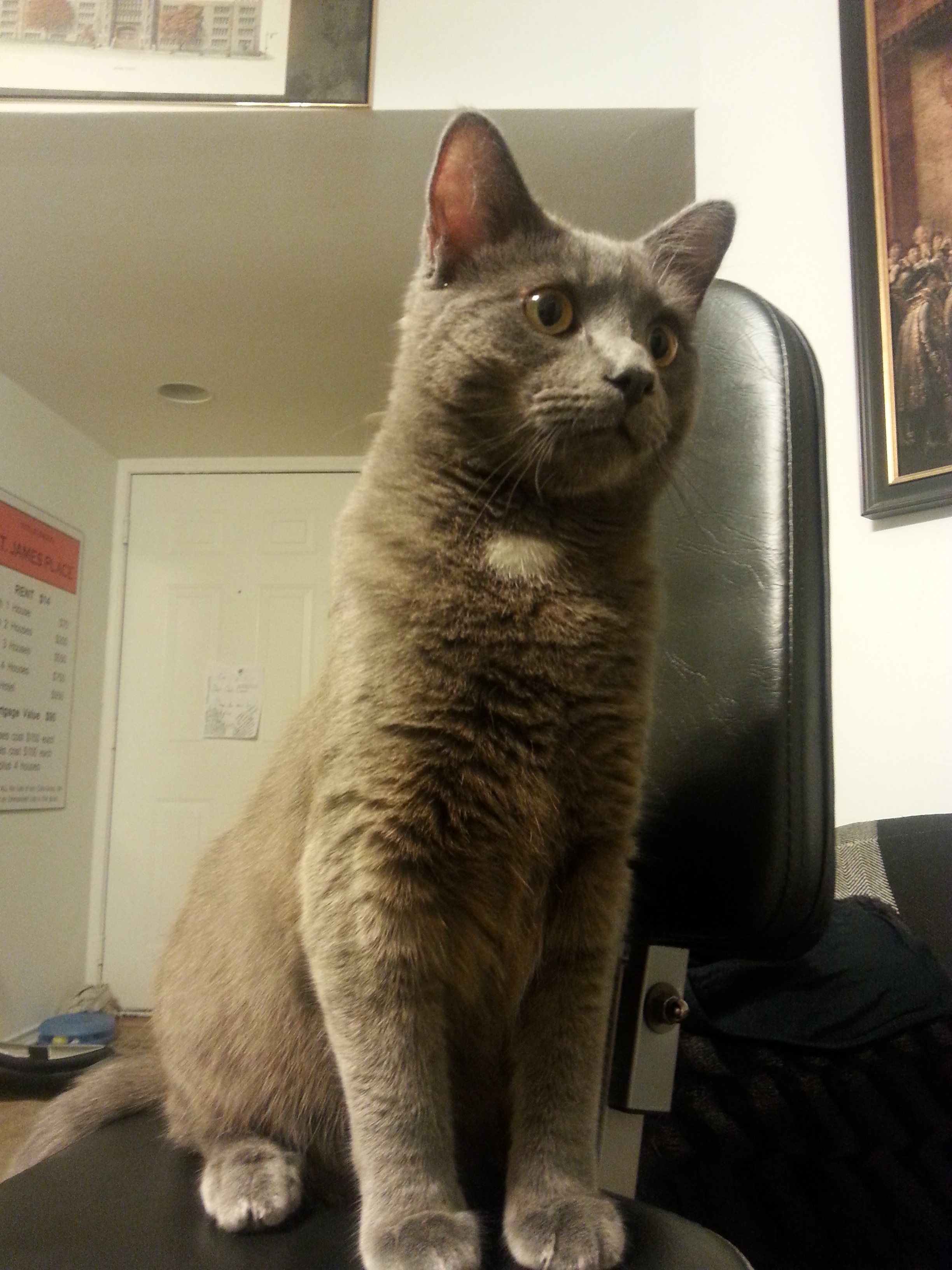
I have a lil Russian Blue cat named Rasputin (Raz or Raz-cat for short).  Raz is a weird little animal and he plays with everything, but one of his favorite toys is the springy doorstops that stop doorknobs from crashing through dry wall.  He’s crazy but he’s soft and sweet and likes to sleep on the pillow next to my head.

image

One night a few weeks ago I was asleep around midnight when I heard the sproy-yo-yo-yoing of one of the doorstops.  I sat up and thought “what is that little maniac doing…” when I noticed Raz sitting bolt upright next to me.  Then my sleep-addled brain caught up with the situation; if Raz was here…what hit the doorstop?

image

I turned on the light and looked at my bedroom door, which was propped open.  I have a few wooden swords leaned up behind it but both were still standing.  Then I slowly looked up and realized it must have been the door in the game room across the hall.  The door was closed.  I live on the second floor and that room is the only window accessible from the outside.  The rest of my windows are all two stories up and unless you’re Spiderman you’d have trouble breaking in through them.

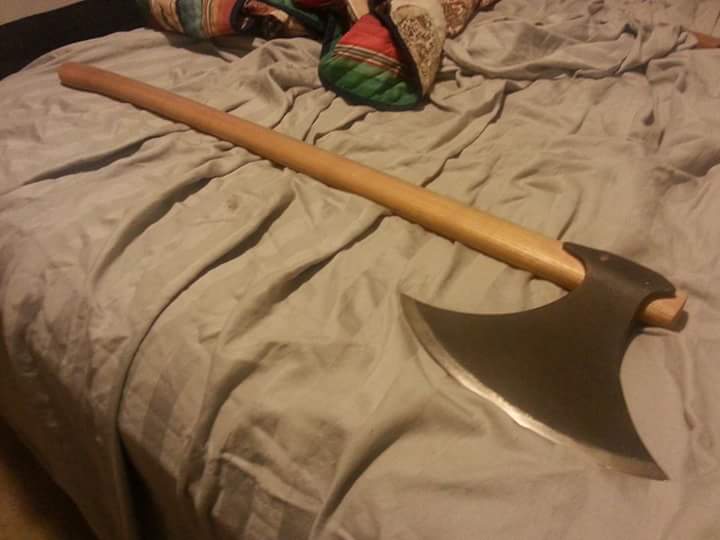
I immediately started thinking of what I could use as a weapon, and it occurred to me that all of the most useful stuff was in the living room…not wanting to cross in front of the door in question I looked around my room and the only weapon I could find was a replica Danish War axe leaning against my book shelf.  It’s not a convenient indoor weapon, about 42 inches long with a 7-pound axe head at the business end.  A quote from Lock, Stock, and Two Smoking Barrels went through my head, “I don’t want to blow the arsehole out of the world, but I don’t want nobody blowing a raspberry at me either…”  It’s kind of a ridiculous weapon in a CQC situation, but it was all I had.

image

Still I picked it up and headed toward the door.  Raz was sitting in the bed looking at me and the game room door with an expression that read, “Was it in there?  You’re not going in there are you?”

image

I leaned against the wall next to the door and listened.  I didn’t hear anything in there.  I decided not to be an idiot and yell out “hello?” and resolved when I opened the door I’d slam it open to go with the shock and awe tactic. I silently braced my shoulder against the door, took a deep breath (looked back at Raz who looked like he was saying “don’t do it…don’t open the door!”) and barged into the door.

To my shock something was pushing back.  The door wouldn’t open as if someone was leaning on the other side or had their foot on the bottom of the door to keep me from opening it.

I pushed harder and went in, axe handle first (I decided I didn’t want to swing that thing and get it caught on the door jamb…).  The door finally opened and I flipped the light on.  I didn’t find any medieval intruders…I found my rolled up Frontline game mat, which I keep standing behind the game room door, had fallen across the doorway and hit the door stop.  I actually fell to me knees and laughed.  Raz looked at me like I was nuts.

image

I’m paranoid, so I still searched the rest of my house before calming down and going to bed.

I learned a couple of good lessons from this incident.  First: It never hurts to be cautious but don’t always assume the worst.  Second, and maybe more importantly, Danish War Axes are not ideal for home defence.

The Ugee Drawing Screen

In my last post I discussed how the effective writing and delivery of Jim Sterling inspires others in their creativity.  This week is a case in point.

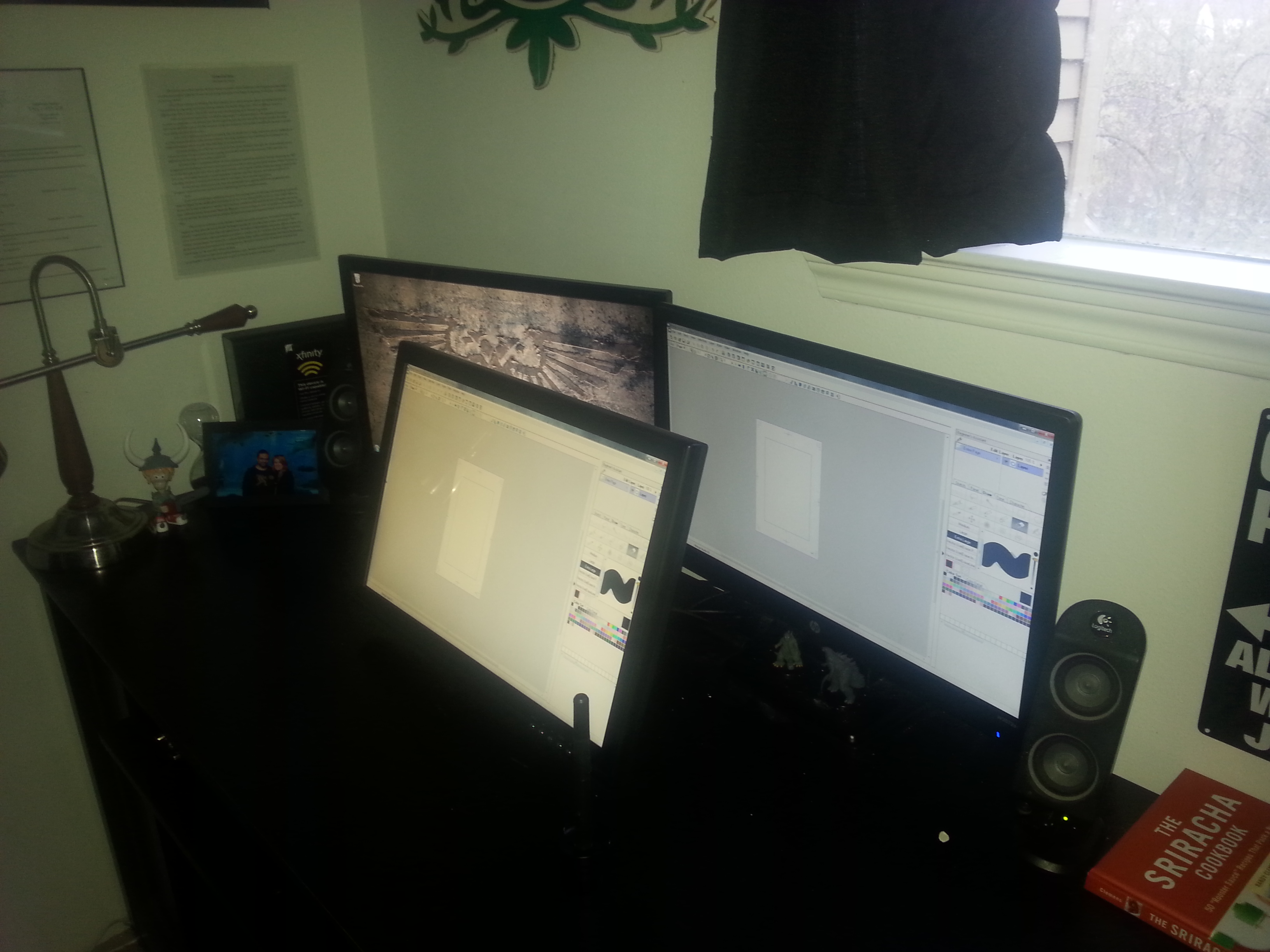
I have had a hard time moving from my beloved paper artwork in this digital age.  I’ve tried drawing, scanning the pencils, then vectoring the pencil art.  It didn’t work well.  I’ve also tried having the artwork inked, then scanning it and vectoring from there.  That tended to work better, but still required about 4-6 steps before I could get it in a format to be edited digitally. I’ve tried two versions of Wacom style tablets where a tablet you hold controls a cursor on the screen.  That had marginal success, but I had a lot of trouble making the connection between the pen touching a black surface to a cursor making precise actions on screen.  It went ok but I’m not good enough at it to produce even close to what I do on paper. The next step was an Android tablet with software that simulates graphic design.  It sounded good because it would allow me to draw right on the screen.  The downside was the only styluses I could find were about the size of an eraser.  Trying to do precise markings was out of the question and even trying to tell where they stylus was touching the screen wasn’t always easy to determine.

During a book signing for Matthew Inman aka The Oatmeal he mentioned he uses a Wacom Cintiq and that sounded perfect.  It essentially allows you to draw right on the screen with a pencil-sized stylus you’re your choice of graphic software.

Unfortunately since I haven’t won any lotteries recently I couldn’t get one of those…so I began browsing off brands.
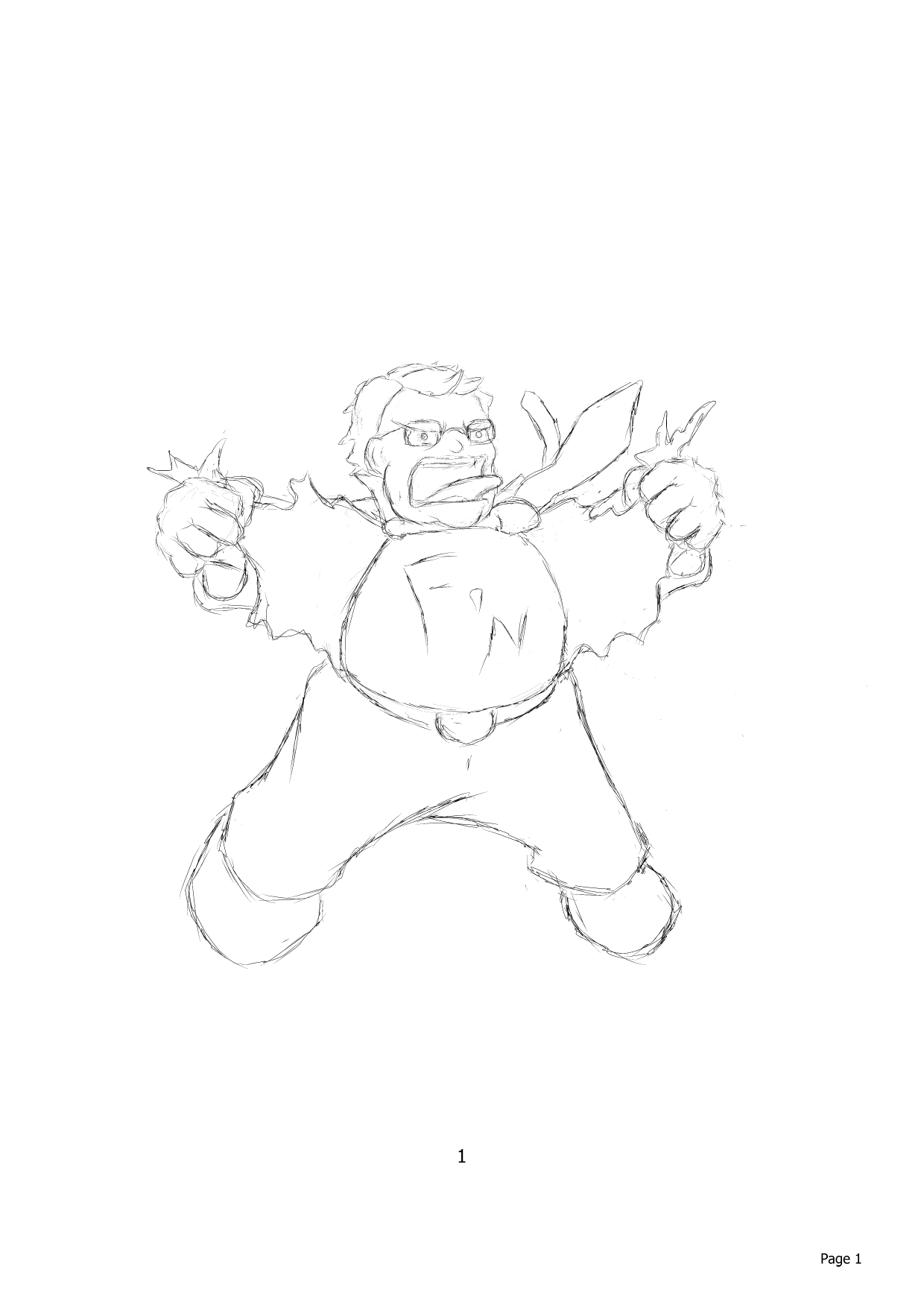
After much consideration I landed on the Ugee drawing screen and it has solved my digitization woes. The first piece of art I produced was my Jim F’N Sterling Son from my last post.
image

I drew into Manga Studio as I preferred the look and feel of its interface as opposed to Illustrator’s.  It just felt more like a real pencil and could be adjusted with sliders to be lighter or darker, as though I was picking a different kind of lead.

After doing the “pencils” in Manga Studio I imported the pencil art into Illustrator, created a layer, and “inked” using Illustrator’s calligraphy tool.  Probably not the best but it worked for my first effort. I was pretty impressed with what could be done relatively quickly, from pencil to colored art took only a couple hours.
image

The Ugee has my approval, its drivers loaded perfectly, it has a large drawing surface, and has an excellent stand.  The only “complaint” is that it can wash out a bit at the wrong angle, but that’s not a big problem when working on a project, just when using it as a regular screen.

As a side note, I’m hoping Jim recovers quickly.  Here’s hoping he’s back on his feet and giving them hell as soon as possible.  We need him in the trenches!

My original Jim Sterling post

Sources of Inspiration: Jim Sterling

image

There are more online pundits and reviewers than we need.  It is rare however to find a reviewer or pundit who actually has something to say.  And even rarer to find one to whom I’d donate money in support.

I started watching videos put up by online magazine The Escapist because of Zero Punctuation aka Ben “Yahtzee” Croshaw.  His show is a pithy, quick, and hilarious take on specific video games and their quirks.  But I admit I stayed to watch Jim Sterling’s Jimquisition shows.

image

Jim’s commentary on video games, video game companies, and their trends is marvelous and, even if you don’t always agree, is always thought provoking.

Jim has had an interesting and transitional career.  From Destructoid to Escapist he has made numerous comments that have “enraged” (I put that in quotes because this is video games we’re talking about here…) game fans.  From being hated for the ultimate sin of “not liking” a Final Fantasy game (I agree though…Final Fantasy is an empty shell compared to the days when it’s games’ technological advancement could be categorized in terms of “bits”) to having the gall to say that female game critics, writers, and producers shouldn’t be threatened with violence and rape.

I’m actually not really interested in his controversy…  Mostly because I don’t find him to be that controversial.  He says what he believes.  One can agree or disagree (I don’t always agree but I find I agree the vast majority of the time) but he never says anything purely out of hate or shock value.  If a game is shit he says it’s shit and faces the backlash like a champ.  See The Slaughtering Grounds incident for an example of that.  If a practice of the industry or its fans is tasteless or predatory he says he thinks it is just that.  In fact I started watching his videos because he voiced exactly my problems with the way games are conceived and produced now.  And why I rarely play a “so-called AAA game,” to use his phrasing, nowadays.

I truly appreciate is his writing, production, and character construction.  The narratives in his videos are often fast, full of information, and loaded with complex ideas, but his presentations are always not only clear (you know EXACTLY his points from the outset) but often very clever, very witty, and biting in their arguments.   It’s that kind of methodology that is inspiring to other creative people, or at least to me as a creative person.  You can always count on Jim, not only to give you his opinion on all kinds of practices but to do so in a way that is so memorable you’ll go back to them repeatedly (I know I’ve queued his vids up to hear why Ubisoft is idiotic, free-to-play is a misnomer, and pre-order culture is poison).

His series with Yahtzee were also fun.  Last year’s rhymedown spectacular and the Uncivil Wars series which Jim won earlier this year provided another look at both his and Yahtzee’s personas outside of the review realm.

His newer material, since he’s gone rogue and become fan-funded through Patreon is even better.  Freed from even the loose shackles of another company he has been able to write more reviews and even start an absolutely terrific podcast series that is one of the best since The Ricky Gervais Show.

image

The fact that he owns a chainsword gives him extra points…

If you are a video game fan, specifically a fan who feels the industry has gone the way of film production in its heartless and cold monetization of all aspects of gaming and its focus on useless tech over art design and storytelling, put on a Jimquisition playlist and you’ll find yourself nodding in agreement or raising your finger and saying “but…”  Either way he’s provoking a response and maybe cranking your brain out of idle for 6-12 minutes.  It’s worth it.  Because he’s Jim F’n Sterling Son.  And thank god for him.

Jim Sterling Cartoon
The Author’s Rendition of Jim on a rant.


Jimquisition website

Un-Mastering Luck: My First Warhammer Fantasy Battles Games

Napoleon once said that genius was the mastering of luck.  Anyone who plays miniature wargames knows just how difficult mastering luck is…

I played my first Warhammer Fantasy Battles games over the past weekend and saw just how difficult luck really is to master. As I said in the last post I prepared a small ogre army for an escalation league at my local Games Workshop store.  I’d never before played Fantasy except for a few little games using the store sets of Island of Blood that weren’t designed to be competitive. My Games Workshop store is surprisingly fresh.  A lot of new players are there so it was nice to go in to this without some of the more negative kinds of players (or the know-it-all, “hurr hurr, look at the noob” types) and it was a really positive experience.  I invited friends to come watch me lose and I thought I’d share the experience.

I showed up on a Friday night and only a couple people were there.  The other player present was also new, and he brought his Skaven army.  The store manager got his rule book out and we played our tiny 250 point game.  I used 8 ogres in two 4-group units, all with additional hand weapons.  This put me at 248 points and lots of attacks.  My opponent took a big block of clanrats with shields and spears, and two bases of rat swarms.  He went first (whew….brought them closer into my charge range!) and I did as expected and charged right into those clanrats.   Ogres on a charge are brutal, impact hits, sixteen attacks, and four stomps.  It was a close round of combat but the ogres won through the weight of their charge.  Because of his “strength in numbers” special rule he had a mighty leadership TEN.  Now I should say I have a history and tendency to roll like crap (you’ll see that in my battle the next day) but I think my lack of luck was catching.  He rolled two sixes!  Failing his leadership test.  He then proceeded to run away 5 inches.  I chose to pursue, rolling a six, catching and eliminating the only viable unit on the field.  I definitely did NOT out play him in my first game.  With only 250 points very few tactical choices are there.  But through pure luck the first game was a win.  And a nice intro to the game mechanics.

I then played the manager’s dark elves, him playing as an NPC.  Though I smashed his witches (even though I’d received their crazy charge) but ran into a wall on his executioners.  I did enough damage on them that even he said he got a bit nervous, but all their elf rules did me in.

The next day I returned for his zombie tarpit challenge.  80 zombies versus my 250 points of ogres.  I chose to make one big unit and smashed into the zombies.  I ended up taking them out in 5 turns, but only had three ogres left by the end.  I realized I would have been smarter to leave them in two units, hitting the zombies on their flank with the second group.  I would have had one extra attack per ogre.  Four extra impact hits (at least…I COULD have rolled a 10+ on my charge) and four additional stomps.  It may have been over in 3 turns…

Later that day I played a kid who had dwarves.  A unit of warriors and a unit of longbeards.  I needed an 8 to make my first charge against the warriors…and rolled two TWOS.  So I received the charge instead.  I made my charge against his longbeards, and surprisingly crushed them into flight.  Here’s where I made tactical errors.  There was only one longbeard left, his standard bearer.  I chose to run them down, which I shouldn’t have done.  I ran them down and moved 9 inches away from my beleaguered other unit.  My other unit of ogres, having lost the combat with the dwarf warriors and fleeing, fled an epic 11 inches.  Then failed their next leadership by rolling a TEN.  My epic bad rolling coming to light again.  His dwarf warriors turned to my unbroken unit and I chose to march them up a hill rather than reform.  I really should’ve reformed, as his next turn would’ve brought them easily into charge range and probably a quick combat after all the impacts, attacks, and stomps.  Since I moved them away, they had their backs to his dwarves and received a flank charge.  Despite this I still killed four dwarves and received zero wounds.  

Unfortunately for me, due to combat resolution math, we tied and his musician broke the tie.  Once again I failed my leadership test (because I’m awesome like that) and fled only to be caught and destroyed!  Him won a clean victory.  All my dice throwing proving just how little of luck I had mastered… my inexperience and the good thinking of my opponents proving to be a deciding factor.

It was a blast to play, win or lose, and I learned some good lessons.

1) Ogres…don’t forget your fear check.  I never had anyone roll for fear ever.  It’s a long shot against elves or dwarves but better to try than not to try.

2) Don’t forget impact his and stomps.  Even with only four ogres in the rank that’s at least four impact hits (D3 per ogre due to the ogre charge rule if you roll a natural 10+) and stomps are four additional attacks.  

3) Ogres are attacking beasts and can soak up lots of damage. Even at speed six it’s best to try to get the ogres back into combat as soon as possible.  Maneuvering with Skaven or Beastmen might be a good choice, but with just three ogres it is always best to try and get them back into doing damage.  It’s what they do best!

I’ve heard that GW is planning to drastically change the landscape of Warhammer Fantasy Battles due to its flagging sales.  Just getting into it now, this makes me quite sad.  I love the complex simplicity of it.  The small rules that turn into big results, and the great fun of throwing gobs of dice and taking off scores of models.  As much as I love 40k, it’s a very different kind of wargame and I’m hoping, no matter the changes they make, the game play will always be welcome on gaming tables.