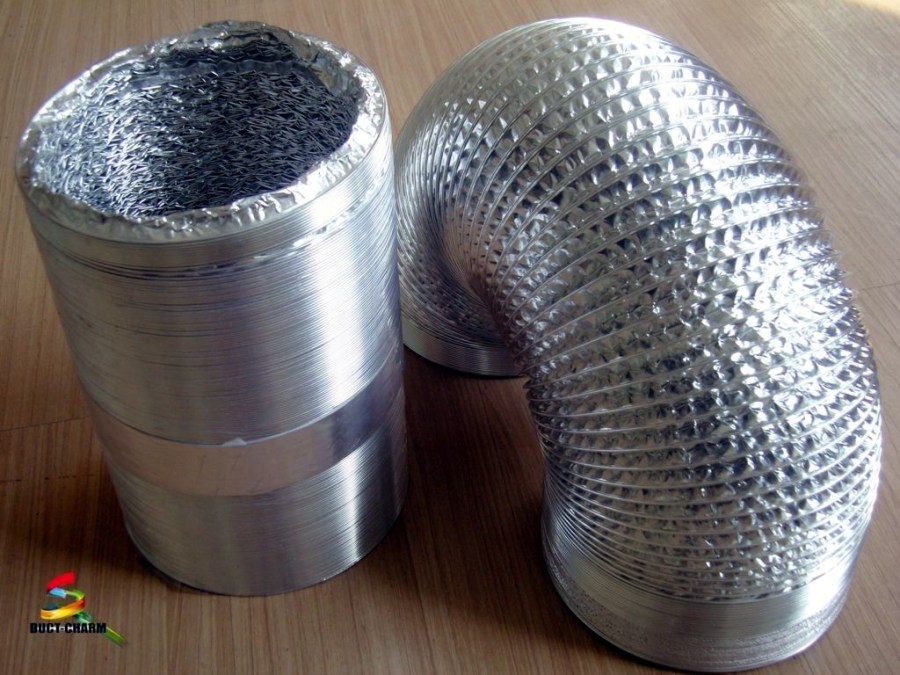
silver airconditioning duct

Story of the Month: Car Slinky

StoryoftheMonth

Do you remember the end of Toy Story? Woody and Buzz hop on R.C. and ride to the moving truck. They make it to the truck, and Slinky Dog hops down and grabs Woody. Slinky Dog stretches as far as he can, moving from one side of the street to the other, until he can’t hold on any longer.

Believe it or not, I’ve had a similar incident involving a car and a slinky-type contraption.
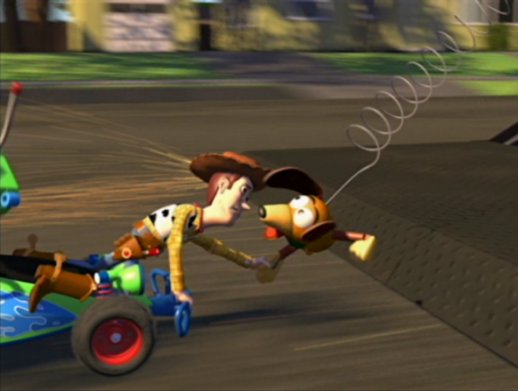
Slinky Dog helping Woody and Buzz
Photo from: platypuscomix.net

 Car Slinky

One night after work, my friend and I decided to take his mom’s 350Z for a spin. It was a beautiful car and an awesome night for a late drive. The weather was perfect.

2003 orange Nissan 350Z
An orange Nissan 350Z. Photo from:
kids-n-fun.com

We drove around and chatted, twisting and turning through all back roads of the Franklin Road area — until we came to this in the middle of the road:

silver airconditioning duct
Photo from:
alibaba.com

You may recognize it. It’s an air conditioning duct. We tried to dodge it, and thought we did until I looked in the side mirror.

The duct was attached underneath the car, and we were dragging it down Edmonson Pike and Nolensville Road at 1 in the morning. The silver car slinky was at least 20 feet long, and it dragged from one side of the street to the other. Frantically, we tried to figure out what to do, but we couldn’t stop laughing. I cried from laughing so hard and knew we were going to get pulled over. No cop would ignore a sports car dragging a 20-plus-foot slinky down a main road in the middle of the night.

I felt like the baby sister in Toy Story seeing Slinky Dog in her side mirror. It was epic.

After about 10 minutes, we were finally able pull into a parking lot and unhook the duct. There was no damage done to the car, and it made for a great story. Some of my fondest memories are car stories, and you never know what you’ll see. Who knows there may be a YouTube video somewhere…

For fun, here’s the end of Toy Story, backwards! And if you have any funny car stories, we’d love to read them!
Driving in Nashville: Tips for Out of Towners

Tuesday morning as I drove to work, a car with Kentucky tags merged over in front of me and slowed down. The speed limit was 70, and Kentucky drove a whopping 60. Inspiration hit me. Out-of-state drivers may need a little help before heading to Music City, unless they want an ugly experience. Here are 10 rules to help tourists drive in Nashville.

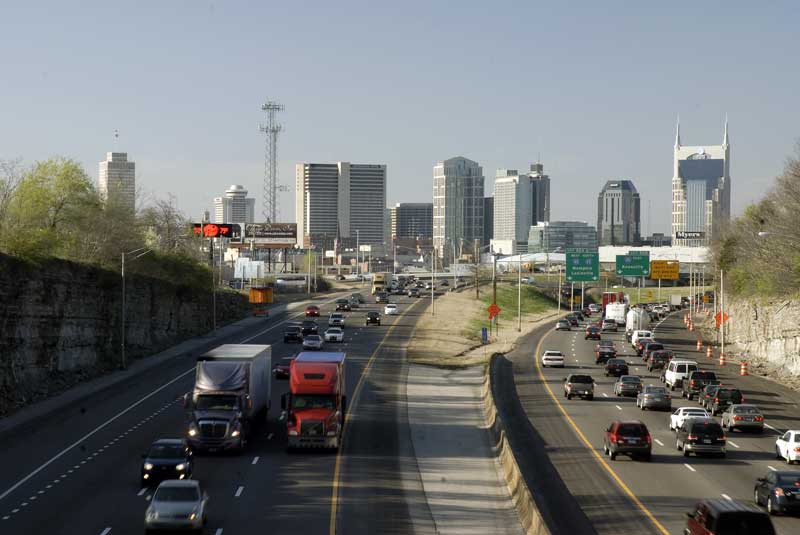
Average interstate traffic in Nashville
Average interstate traffic in Nashville. Photo from news.tn.gov.

1. On a four-lane interstate, the left two lanes are called fast lanes. If the speed limit is 70, you should go 75 in the third and 80 in the fourth. These lanes are also passing lanes, and people use them to pass. Most times, we’re pretty good at this, so just let us do our thing and everyone wins.

2. Unless you are in a school zone, always go 5 miles over the speed limit. Nashvillians like to drive fast, so it’s necessary to keep up with the natural traffic flow. If you refuse, be prepared for hand gestures and horns.

3. Pay attention. Interstates 65, 40, and 24 run throughout the city and change and split along the way. Read signs and make sure you are on the right one.

4. Use your blinkers. If you’re changing lanes or turning, use your blinker and let others know which way you are going.

5. Get over immediately. When you see a lane end sign, try to get over. Do not drive to the end of the lane and expect people to let you over. They won’t. In fact, sometimes we enjoy making you wait. Southern hospitality does not exist when we’re in the car.

6. Be prepared to wait. You will come to long lines of traffic at red lights, off ramps, and on the interstate. Take a deep breath and relax. You’re going to be there awhile, and your plans are not more important than ours.

7. Avoid rush hour. Rush hour is Monday-Friday from 7-9 a.m. and 4-7 p.m., and most everyone commutes to work. Thousands of people live in surrounding counties and work in Nashville and vise versa, so rush hour can be painful. For example, I live in Nashville but work in Franklin (22 miles one way), so my average time to work is 35 minutes, and my average time home is 50 minutes.

8. Do a little research. Old Hickory Blvd. is so confusing it has its own Wikipedia entry. There are several sections of this road, and they do not connect. Know where you are, and pay attention to maps because several roads turn into something else. E.g. Nolensville Rd. turns into 4th Ave.

9. Know where to park and bring cash. Check your apps and ask for recommendations. And listen to them. Residents know the best places to park and the quickest walking routes, and not all lots are safe.

10. Follow the rules. Navigating Nashville isn’t too hard, but there are a few basics to keep in mind:

— Red means stop, green means go.

— Yield means stop when there is oncoming traffic.

— No right on red means exactly that.

Check out our Worst Drivers in Nashville list!

When to Use Was and Were

GrammarTips

You may not think about it, but do you know when to use was and were? Believe it or not, most native English speakers use these intuitively. However, if someone asks us why or when to use them, we stutter and can’t explain it.

Common terms used in this post:

Subject: What is doing the action.

Verb: The action that is performed.

There are only two rules to remember:

1. Subject-verb agreement. If the subject is just one person or thing, use was. If the subject is more than one person or thing, use were.

a. I was going to wash my car, but it rained.

b. The dog was barking, so I couldn’t sleep.

c. He was my favorite speaker.

a. We were going to the zoo, but our car broke down.

b. The kittens were playing all day.

c. James and I were going to play Smallworld, but we played Zombiecide instead.

2. If I and I wish statements. When you say, “I wish…” or “If I…,” use were.

When talking about someone else, were signifies something that will more than likely not happen, and was suggests it is a possibility.

a. I wish I were an Oscar Meyer wiener.

b. If I were president, I would increase minimum wage.

c. I wish he was on the football team. (it’s a possibility, so use was).

My personal tricks to remember these rules: one equals was and the Oscar Meyer wiener song. If you have any fun tips about was and were, feel free to share them below!

References: Grammar Girl, grammar video

Should We Listen to Music at Work?

I was desperate. All week I racked my brain trying to come up with a topic that inspired me. I’m the type of writer who must feel everything I creatively write about. Friday evening as I talked with my lovely co-worker, Emily, the light bulb came on. Music.

How sweet the moonlight sleeps upon this bank!

Here will we sit, and let the sounds of music

Creep in our ears: soft stillness and the night

Become the touches of sweet harmony.

(Shakespeare, The Merchant of Venice, 5.1.63-66)

I once spoke about the importance of music at work in college. In 2004, when I gave that speech, most arguments supported music in the workplace. As I cruised through Google this weekend, I noticed that opinions are now split 50/50. WebMD says music is distracting. The NY Times says music increases productivity. So, what should we do?

Do whatever works for you.

I grew up with music playing all around me. I had a favorite song at 2 or 3 years old, and at 9, I fell in love with U2. Music is important to my soul, and I usually have something playing while I’m doing anything. When writing, I pop in classical, jazz, or metal instrumental. In fact, as I write this I am enjoying a Soul Radics playlist. If I am cleaning up photos, going through data, or working on something mindless, I find something fast and peppy such as Godsmack, Greenday, or Pendulum.

At the store I worked in, there was always music. It made sense because we were usually involved in physical labor and needed the boost. We’d sing, sometimes dance, and worked faster than without music. Our longest nights were when storms knocked out the satellite.

There are a few times when music is distracting. If I’m proofreading, I don’t have music playing because I am internally listening to myself read. I can hear my own voice, and I have a tendency to sing, so it’s not a good mix. Also, if my office is chatty – we’re all guilty of causing that – I’ll take my earbud out because it’s too much noise.

So, be smart about it.

Music almost always evokes an emotion or a memory, so you should also consider how the song or playlist will affect your mood. For example, I can’t listen to techno while proofreading because it makes me fidget. I don’t listen to sad love songs because they depress me. The point of music at work is to keep you energized while you perform workload tasks.

If you listen to music at work, what are your favorite bands or genres? Do you think it increases your productivity or makes work more tolerable?

If You Want to Write: Childhood Memories

“A child experiences things from his true self (creatively) and not from his theoretical self (dutifully), i.e.: the self he thinks he ought to be.” – Brenda Ueland

A child’s imagination is a powerful thing. It’s raw, undisciplined, and fierce. There’s an innocence within a child’s mind that doesn’t hold back or worry about how they should be thinking. My son, who has created countless video games, board and card games, and short stories all before he was 10 years old, simply amazes me. Now that he’s a teenager, he uses software to bring them to life. And because of his drive and creativity, I believe he will become a great game designer.

In this chapter, Ueland urges us to write like a child. She recommends we write about a childhood memory and remember how it felt to be there. Ueland explains that an older person writes from not only their imagination but from their ego and conscious as well. Adults are afraid to write honest details because we’re afraid someone will judge us, or we don’t want to look bad. The exercise is to write about a childhood memory, and although I don’t have full stories with lots of details, one thing tops the list.

Waffles

When my parents separated, my brother and I spent most weekends at our grandparent’s house. On Saturdays, grandma would clean the house and play or make crafts with us. My grandpa usually remodeled something or worked in the yard.

My grandparents. He passed in 2011, but they are still be most amazing couple ever.
My grandparents. He passed in 2011, but they are still the best couple ever.

As great as Saturdays were, Sundays were the best. They had the same routine, but Sundays started in a very special way. My grandparents let me sleep in, sometimes until 10 o’clock, and when I awoke I knew I had a delicious treat awaiting me.

Almost every Sunday my grandparents would make me a waffle for breakfast. There was nothing special about the smell, but it tasted amazing. They would butter the round waffle, which took up the entire plate, and each little square was filled with syrup. They added a sliced peach for each quarter and sprinkled confectioner’s sugar all over it. It was so sweet and so comforting. And I was so hungry.

I still eat my waffles exactly that way. I have never tried any other fruit and get upset if we’re out of confectioner’s sugar. I will not touch a pancake. I realized this year, I had never made my son pancakes. I found myself almost banning pancakes because of my ties to waffles. Strange as it may be, I’ll probably never eat a pancake, but I do cook them now. Our memories can shape us into someone unexpected and cause us to do crazy things.

Another lesson Ueland addresses is that we shape our children. If you want them to be great, you must be great. If you want them to be a musician, you must practice music. If you want them to believe in themselves, we must believe in ourselves. We set the example.

Now, it’s your turn. Think back and try to write about a childhood memory from a child’s perspective, not an adult’s. Try to remember what you were going through or feeling – it may be therapeutic to your soul.

For fun, here’s a recipe for waffles. Maybe you can add your own fruit or make them special for your family!

The Best Things About Mean Girls

You know them, or you have been one. Maybe you still are. It doesn’t matter though because at some point, most women have been a mean girl.

Photo from : meangirls-confessions.tumblr.com

As I’ve admitted, I have a weakness for good teen movies. And I LOVE this movie. I have seen it so many times I can quote it, and even though she’s somewhat crazy now, I still have a soft spot for old-school Lindsay Lohan.

Mean Girls (2004) is dead-on when it shows how girls – and oftentimes women – treat each other. That is the primary reason I hang out with guys. I never have to worry about guys gossiping behind my back or trying to secretly sabotage me while acting like my best friend. I have been a mean girl though, so I don’t blame anyone for not liking me either.

The movie truly tells the story of a group of high school friends who are obsessed with body image, their social and sexual lives, and terrorizing each other to look good and gain popularity. Mean Girls confronts trends, cliques, and all the horrible things teen girls do to each other, and why it shouldn’t be that way.

Aside from the movie’s obvious themes of forgiveness, girl power, support, and unity, I take a lot of other things (some silly) from the movie:

  • I know, right? Thank you, Rachel McAdams (Regina George). I didn’t realize I picked up this phrase from the movie, but I know I did. I’m not sure if that’s a good thing though.
  • Plastics. I’m not sure if the term derived from the movie, but it’s a great word for the high-fashion, fully made-up types. E.g.: The ones who look like Barbie dolls.
  • Amanda Seyfried. According to IMDB, this was her first movie. I want to personally thank the casting director for picking Seyfried to play the stereotypical really dumb blonde. Who knew she’d turn into the young star she is now?
  • School faculty. This movie reminds us that teachers and principals have real lives and problems. The ones in this movie seem to say what you know every faculty member wants to. Two of my favorite quotes, “I cannot tell you how happy I am this year is over,” and “Oh, hell no. I did not leave the South side for this!” Tim Meadows (Mr. Duvall) says.
  • Girl-on-girl crime is self-destructive. Not only does Mean Girls teach you that you can ruin your best friend’s life, it proves you can ruin your own. You will be exposed, and people will hate you.
  • People you torture will have the last laugh. Lizzy Caplan (Janis Ian) delivers a fantastic speech in the end where she simply confesses trying to destroy McAdams’ life. She falls into the crowd as they chant her name. Be careful who you’re mean to; they often find a way to retaliate.

Do you have a mean-girl related story? Feel free to share below!